9U9J | pdb_00009u9j

M4-CTD-docked AP-4 core in apo form


Experimental Data Snapshot

  • Method: ELECTRON MICROSCOPY
  • Resolution: 4.20 Å
  • Aggregation State: PARTICLE 
  • Reconstruction Method: SINGLE PARTICLE 

wwPDB Validation 3D Report Full Report

Validation slider image for 9U9J

This is version 1.1 of the entry. See complete history

Literature

Structural basis for the dynamic conformations of AP-4 and its association with ARF1.

Wang, Y.Li, W.Qiu, Y.Wu, S.Hong, L.Zhao, Y.Feng, W.

(2026) Nat Commun 17

  • DOI: https://doi.org/10.1038/s41467-026-68679-8
  • Primary Citation Related Structures: 
    9U9I, 9U9J, 9U9R, 9U9S

  • PubMed Abstract: 

    Among the distinct adaptor protein (AP) complexes, AP-4 primarily functions as a non-clathrin-coated vesicle machinery essential for intracellular membrane trafficking. ARF1 is a master regulator of AP-4 membrane recruitment, but the underlying mechanism remains elusive. Here, we present the cryo-EM structures of soluble AP-4 and the AP-4/ARF1 complex. Unexpectedly, AP-4 adopts a dynamic equilibrium between closed and open conformations, caused by loose contacts between its medium subunit and central core. ARF1 binding induces only subtle changes in AP-4, which retains its conformational equilibrium. Mutations at the AP-4/ARF1 interface disrupt complex formation and impair ARF1-dependent membrane recruitment. Efficient membrane recruitment of AP-4 likely requires the synergistic engagement of ARF1 and cargoes. Disrupting the conformational flexibility of AP-4 interferes with this synergistic effect and compromises AP-4-mediated membrane trafficking. Our findings may redefine AP-4 as a conformationally dynamic complex modulated by cooperative interactions, providing insights into neurodevelopmental disorders associated with AP-4 dysfunction.


  • Organizational Affiliation
    • State Key Laboratory of Biomacromolecules, Institute of Biophysics, Chinese Academy of Sciences, 15 Datun Road, Beijing, China.

Macromolecule Content 

  • Total Structure Weight: 200.8 kDa 
  • Atom Count: 12,243 
  • Modeled Residue Count: 1,529 
  • Deposited Residue Count: 1,777 
  • Unique protein chains: 4

Macromolecules

Find similar proteins by:|  3D Structure
Entity ID: 1
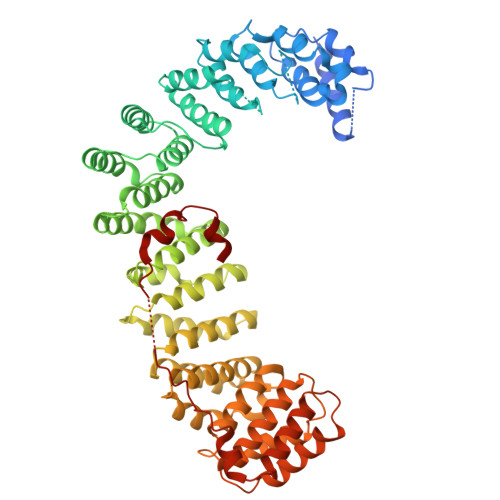
MoleculeChains  Sequence LengthOrganismDetailsImage
AP-4 complex subunit beta-1A [auth B]568Homo sapiensMutation(s): 0 
Gene Names: AP4B1
UniProt & NIH Common Fund Data Resources
Find proteins for Q9Y6B7 (Homo sapiens)
Explore Q9Y6B7 
Go to UniProtKB:  Q9Y6B7
PHAROS:  Q9Y6B7
GTEx:  ENSG00000134262 
Entity Groups
Sequence Clusters30% Identity50% Identity70% Identity90% Identity95% Identity100% Identity
UniProt GroupQ9Y6B7
Sequence Annotations
Expand
Reference Sequence
Find similar proteins by:|  3D Structure
Entity ID: 2
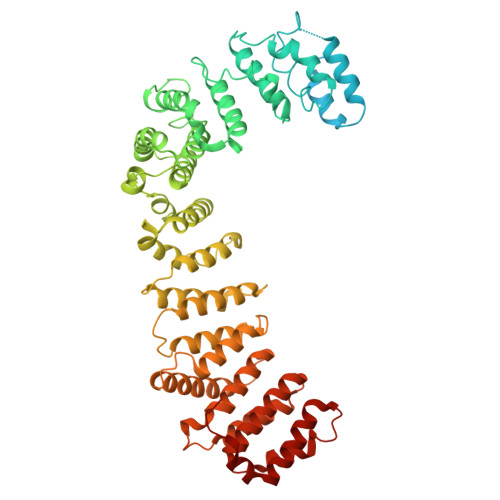
MoleculeChains  Sequence LengthOrganismDetailsImage
AP-4 complex subunit epsilon-1B [auth E]612Homo sapiensMutation(s): 0 
Gene Names: AP4E1
UniProt & NIH Common Fund Data Resources
Find proteins for Q9UPM8 (Homo sapiens)
Explore Q9UPM8 
Go to UniProtKB:  Q9UPM8
PHAROS:  Q9UPM8
GTEx:  ENSG00000081014 
Entity Groups
Sequence Clusters30% Identity50% Identity70% Identity90% Identity95% Identity100% Identity
UniProt GroupQ9UPM8
Sequence Annotations
Expand
Reference Sequence
Find similar proteins by:|  3D Structure
Entity ID: 3
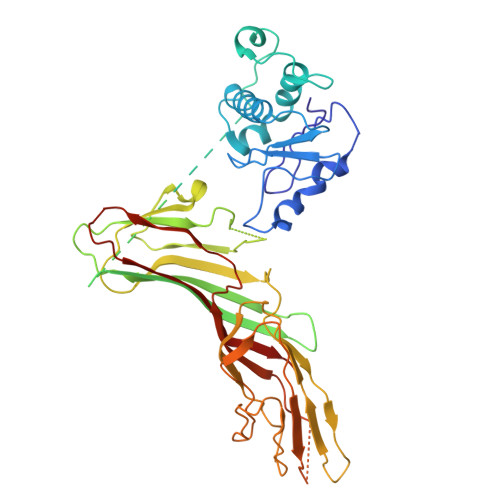
MoleculeChains  Sequence LengthOrganismDetailsImage
AP-4 complex subunit mu-1C [auth M]453Homo sapiensMutation(s): 0 
Gene Names: AP4M1MUARP2
UniProt & NIH Common Fund Data Resources
Find proteins for O00189 (Homo sapiens)
Explore O00189 
Go to UniProtKB:  O00189
PHAROS:  O00189
GTEx:  ENSG00000221838 
Entity Groups
Sequence Clusters30% Identity50% Identity70% Identity90% Identity95% Identity100% Identity
UniProt GroupO00189
Sequence Annotations
Expand
Reference Sequence
Find similar proteins by:|  3D Structure
Entity ID: 4
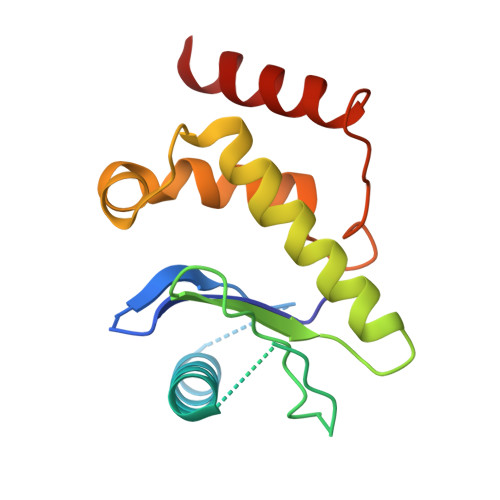
MoleculeChains  Sequence LengthOrganismDetailsImage
AP-4 complex subunit sigma-1D [auth S]144Homo sapiensMutation(s): 0 
Gene Names: AP4S1
UniProt & NIH Common Fund Data Resources
Find proteins for Q9Y587 (Homo sapiens)
Explore Q9Y587 
Go to UniProtKB:  Q9Y587
PHAROS:  Q9Y587
GTEx:  ENSG00000100478 
Entity Groups
Sequence Clusters30% Identity50% Identity70% Identity90% Identity95% Identity100% Identity
UniProt GroupQ9Y587
Sequence Annotations
Expand
Reference Sequence

Experimental Data & Validation

Experimental Data

  • Method: ELECTRON MICROSCOPY
  • Resolution: 4.20 Å
  • Aggregation State: PARTICLE 
  • Reconstruction Method: SINGLE PARTICLE 
EM Software:
TaskSoftware PackageVersion
MODEL REFINEMENTPHENIX

Structure Validation

View Full Validation Report


Entry History 

& Funding Information

Deposition Data


Funding OrganizationLocationGrant Number
Not fundedChina--

Revision History  (Full details and data files)

  • Version 1.0: 2026-03-04
    Type: Initial release
  • Version 1.1: 2026-03-18
    Changes: Data collection, Database references