Download Mendeley
Structural and functional analysis of transglycosylation mechanism of glycogen branching enzyme from Vibrio vulnificus.
An, Y., Tran, P.L., Lee, S.J., Ahn, W.C., Park, K.H., Woo, E.J., Park, J.T.(2026) Int J Biol Macromol 343: 150415-150415
- PubMed: 41577281 Search on PubMed
- DOI: https://doi.org/10.1016/j.ijbiomac.2026.150415
- Primary Citation Related Structures:
9U77 - PubMed Abstract:
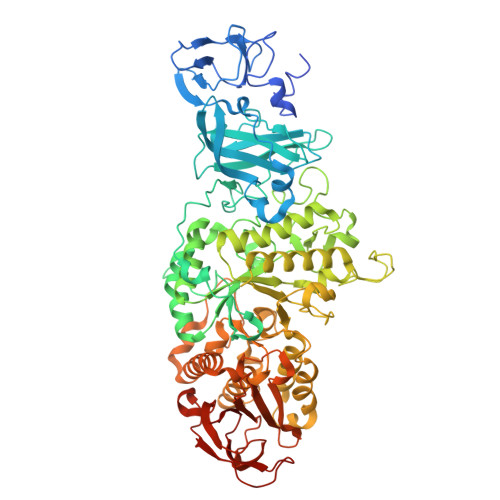
Glycogen branching enzymes (GBEs) catalyze the formation of α-1,6-glucosidic branches during glycogen biosynthesis. In this study, we characterized the GBE from Vibrio vulnificus (VvGBE), highlighting its distinct transglycosylation activity and capacity to generate short-chain branches from defined maltooligosaccharides. The VvGBE crystal structure revealed a typical (β/α) 8 -barrel fold comprising four domains (N1, N2, A, and C), characteristic of type I GBEs. Key residues, including Y229, F312, N389, D423, and E476, formed a negatively charged substrate-binding pocket, with N389 influencing branch length by favoring shorter chains. Biochemical assays showed that VvGBE preferentially transfers glucan chains with a peak degree of polymerization (DP) of 5. Structural superposition with the cceBE1 ligand model indicated that its binding pocket accommodates six glucose residues, with Y229 playing a role in determining the branching pattern. Substrate analysis revealed that a minimum DP of 11 is required for branch activity. Shorter substrates (< 11 glucose units) bound at the A1 site (M490, F489) for α-1,4-chain elongation, whereas longer substrates (≥11 units) adopt a U-shaped conformation at the A2 site (W644, V530) to form α-1,6-branches, with Y433 essential for proper acceptor positioning. These results refine our understanding of GBE substrate specificity and provide a structural framework for enzyme engineering.
- Jilin Medical University, Jilin, 132013, People's Republic of China.
Organizational Affiliation: