9RWP | pdb_00009rwp

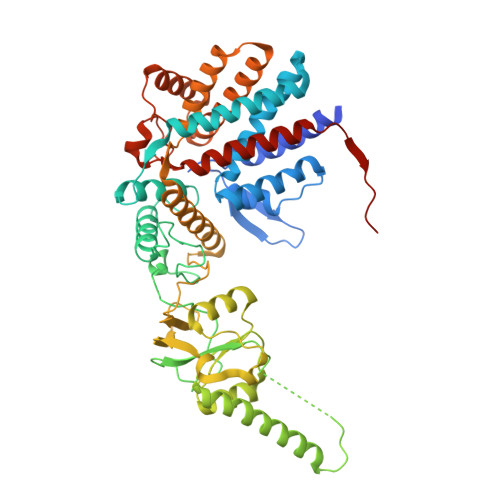
Ancestral Group II Chaperonin (ACII) Double-Ring in Closed Conformation


Experimental Data Snapshot

  • Method: ELECTRON MICROSCOPY
  • Resolution: 3.69 Å
  • Aggregation State: PARTICLE 
  • Reconstruction Method: SINGLE PARTICLE 

Starting Model: in silico
View more details

wwPDB Validation   3D Report Full Report


This is version 1.0 of the entry. See complete history


Literature

Ancestral Chaperonins Provide the First Structural Glimpse into Early Multimeric Protein Evolution.

Severino, R.Cuellar, J.Gutierrez-Seijo, J.Maestro-Lopez, M.Sanchez-Pulido, L.Santiago, C.Moreno-Paz, M.Valpuesta, J.M.Parro, V.

(2025) Mol Biol Evol 

  • DOI: https://doi.org/10.1093/molbev/msaf314
  • Primary Citation of Related Structures:  
    9RWP, 9RWQ, 9RWR

  • PubMed Abstract: 

    Chaperonins are essential protein-folding machines, classified into three structural and phylogenetic groups: Group I (bacterial GroEL), Group II (archaeal thermosome and eukaryotic CCT), and Group III (bacterial thermosome-like). Using ancestral sequence reconstruction (ASR) and protein resurrection, we inferred and experimentally characterized the last common ancestors of these groups (Ancestral Chaperonins ACI, ACII, and ACIII). The resurrected proteins exhibited ATPase activity (except ACII) and protected client proteins from heat-induced inactivation. Structural analyses by electron microscopy and Cryo-EM revealed that ACI forms single 7-mer rings, whereas ACII adopts a mixed population of single/double 8-mer rings, representing the first experimental observation of intermediate oligomeric states. ACII also features a unique cochaperonin-independent closure mechanism, distinct from modern Group I and II chaperonins. Together, these findings provide the experimental structural reconstruction of the most ancient and complex multimeric proteins so far, uncover novel intermediate states in chaperonin evolution, and offer a direct empirical framework for studying the emergence of multimeric complexity in early cellular life.


  • Organizational Affiliation
    • Centro de Astrobiología (CAB), INTA-CSIC, Torrejón de Ardoz, Madrid, Spain.

Macromolecules
Find similar proteins by:  (by identity cutoff)  |  3D Structure
Entity ID: 1
MoleculeChains Sequence LengthOrganismDetailsImage
Ancestral Group II Chaperonin (ACII)
A, B, C, D, E
A, B, C, D, E, F, G, H, I, J, K, L, M, N, O, P
530synthetic constructMutation(s): 0 
Entity Groups  
Sequence Clusters30% Identity50% Identity70% Identity90% Identity95% Identity100% Identity
Sequence Annotations
Expand
  • Reference Sequence
Small Molecules
Ligands 2 Unique
IDChains Name / Formula / InChI Key2D Diagram3D Interactions
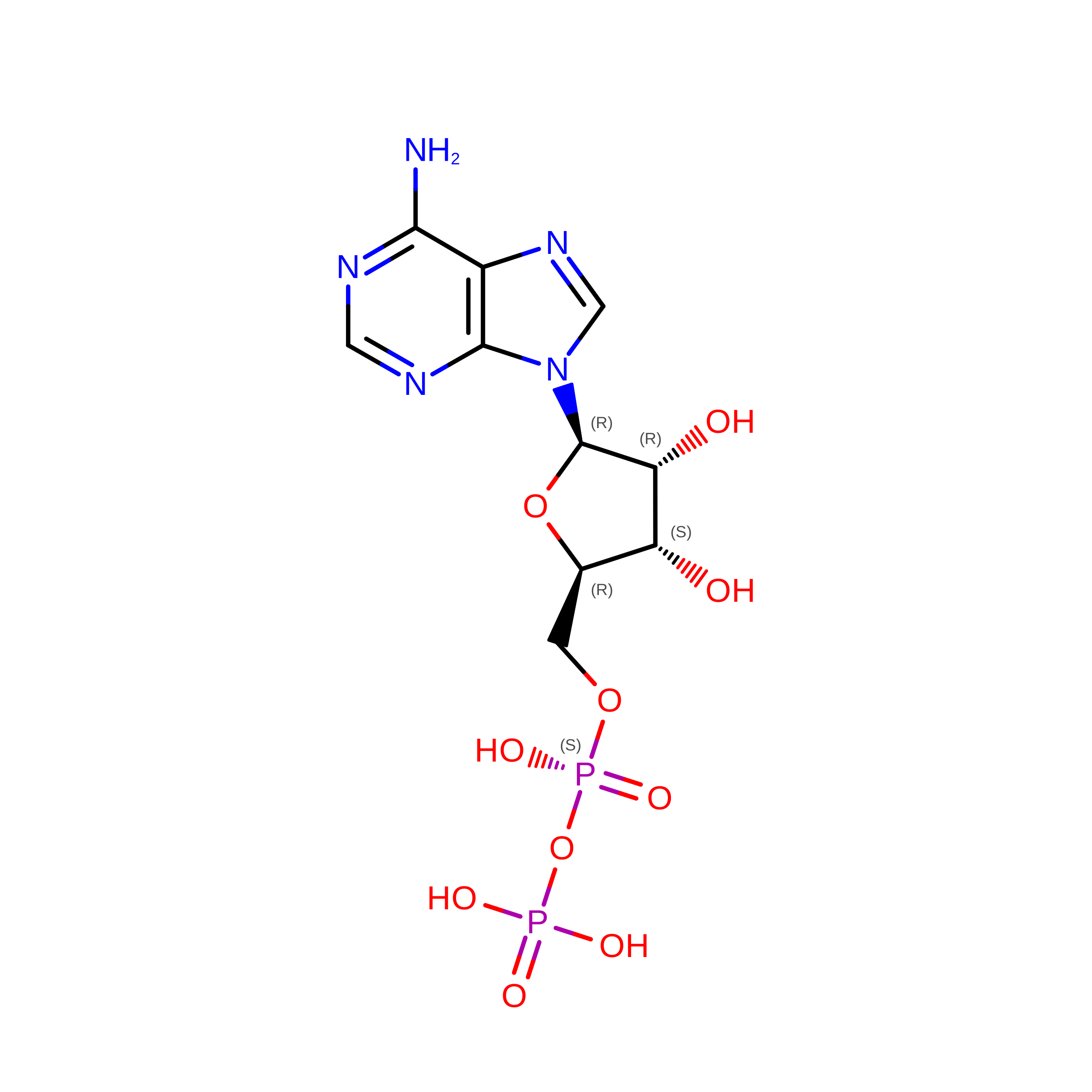
ADP
Query on ADP

Download Ideal Coordinates CCD File 
AA [auth F]
CA [auth G]
EA [auth H]
GA [auth I]
IA [auth J]
AA [auth F],
CA [auth G],
EA [auth H],
GA [auth I],
IA [auth J],
KA [auth K],
MA [auth L],
OA [auth M],
Q [auth A],
QA [auth N],
S [auth B],
SA [auth O],
U [auth C],
UA [auth P],
W [auth D],
Y [auth E]
ADENOSINE-5'-DIPHOSPHATE
C10 H15 N5 O10 P2
XTWYTFMLZFPYCI-KQYNXXCUSA-N
MG
Query on MG

Download Ideal Coordinates CCD File 
BA [auth F]
DA [auth G]
FA [auth H]
HA [auth I]
JA [auth J]
BA [auth F],
DA [auth G],
FA [auth H],
HA [auth I],
JA [auth J],
LA [auth K],
NA [auth L],
PA [auth M],
R [auth A],
RA [auth N],
T [auth B],
TA [auth O],
V [auth C],
VA [auth P],
X [auth D],
Z [auth E]
MAGNESIUM ION
Mg
JLVVSXFLKOJNIY-UHFFFAOYSA-N
Experimental Data & Validation

Experimental Data

  • Method: ELECTRON MICROSCOPY
  • Resolution: 3.69 Å
  • Aggregation State: PARTICLE 
  • Reconstruction Method: SINGLE PARTICLE 
EM Software:
TaskSoftware PackageVersion
MODEL REFINEMENTPHENIX1.20.1_4487:
RECONSTRUCTIONcryoSPARC4.0

Structure Validation

View Full Validation Report


Entry History & Funding Information

Deposition Data


Funding OrganizationLocationGrant Number
Spanish Ministry of Science, Innovation, and UniversitiesSpainPID2021-126746NB-I00
Spanish Ministry of Science, Innovation, and UniversitiesSpainPID2022-137175NB-I00
Other privateRTI2018-094368-B-I00

Revision History  (Full details and data files)

  • Version 1.0: 2025-12-10
    Type: Initial release