Download Mendeley
Ancestral Chaperonins Provide the First Structural Glimpse into Early Multimeric Protein Evolution.
Severino, R., Cuellar, J., Gutierrez-Seijo, J., Maestro-Lopez, M., Sanchez-Pulido, L., Santiago, C., Moreno-Paz, M., Valpuesta, J.M., Parro, V.(2025) Mol Biol Evol 42
- PubMed: 41310978 Search on PubMedSearch on PubMed Central
- DOI: https://doi.org/10.1093/molbev/msaf314
- Primary Citation Related Structures:
9RWP, 9RWQ, 9RWR - PubMed Abstract:
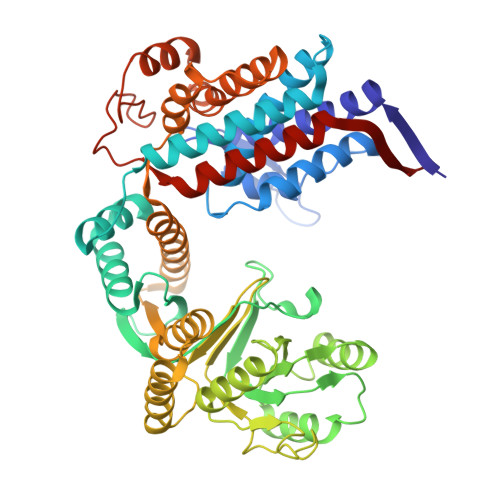
Chaperonins are essential protein-folding machines, classified into three structural and phylogenetic groups: Group I (bacterial GroEL), Group II (archaeal thermosome and eukaryotic CCT), and Group III (bacterial thermosome-like). Using ancestral sequence reconstruction (ASR) and protein resurrection, we inferred and experimentally characterized the last common ancestors of these groups (ancestral chaperonins ACI, ACII, and ACIII). The resurrected proteins exhibited ATPase activity (except ACII) and protected client proteins from heat-induced inactivation. Structural analyses by electron microscopy and Cryo-EM revealed that ACI forms single 7-mer rings, whereas ACII adopts a mixed population of single/double 8-mer rings, representing the first experimental observation of intermediate oligomeric states. ACII also features a unique cochaperonin-independent closure mechanism, distinct from modern Group I and II chaperonins. Together, these findings provide the experimental structural reconstruction of the most ancient and complex multimeric proteins so far, uncover novel intermediate states in chaperonin evolution, and offer a direct empirical framework for studying the emergence of multimeric complexity in early cellular life.
- Centro de Astrobiología (CAB), INTA-CSIC, Madrid, Spain.
Organizational Affiliation: