Download Mendeley
The structure of the Vibrio alginolyticus flagellar filament suggests molecular mechanism for the rotation of sheathed flagella.
Qin, K., Einenkel, R., Zhao, W., Kuhne, C., Atherton, J., Erhardt, M., Bergeron, J.R.C.(2026) Nat Commun 17
- PubMed: 42026045 Search on PubMedSearch on PubMed Central
- DOI: https://doi.org/10.1038/s41467-026-71203-7
- Primary Citation Related Structures:
9RCB, 9RCD - PubMed Abstract:
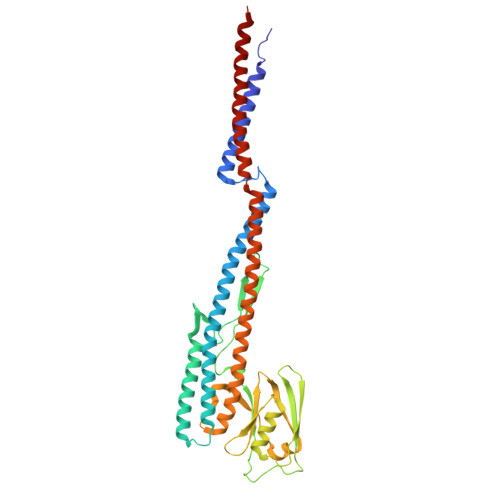
In several pathogenic bacteria, including Vibrio species, the filament of the bacterial flagellum is encased by a membranous sheath, an extension of the bacterial outer membrane. It has been proposed that having sheathed flagella permit bacteria to evade an immune response against flagellar components, suggesting a role in virulence. However, the molecular details of the interaction between sheath and filament, and how it impacts filament rotation, remain largely uncharacterized. Here, we combine single-particle cryo-electron microscopy, cryo-electron tomography, and genetic analyses to resolve the molecular architecture and biogenesis of the sheathed flagellum in Vibrio alginolyticus. We show that the flagellar filament forms a canonical 11-stranded supercoil made of the flagellin FlaD2 and enveloped by a bilayered sheath. We report that the filament surface is highly electronegative, suggesting that electrostatic repulsion between filament and sheath may reduce friction and supports high-speed flagellar rotation. We also show that the filament cap protein FliD possesses a unique domain in sheathed flagella, that may coordinate sheath assembly with filament elongation. Collectively, this structural insight into the structure of the Vibrio alginolyticus flagellum suggests a molecular mechanism for the rotation of sheathed flagella.
- Randall Centre for Cell and Molecular Biophysics, King's College London, London, UK. kailin.qin@kcl.ac.uk.
Organizational Affiliation: