9Q3U | pdb_00009q3u

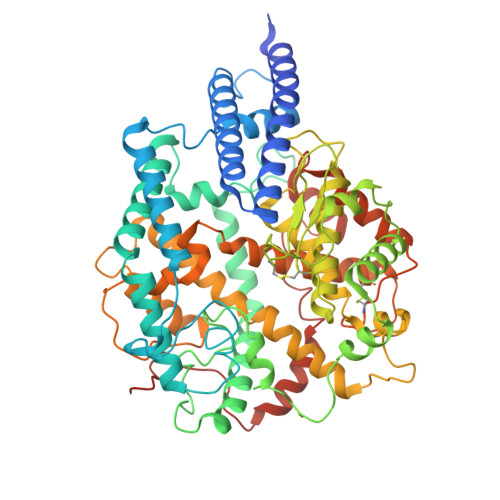
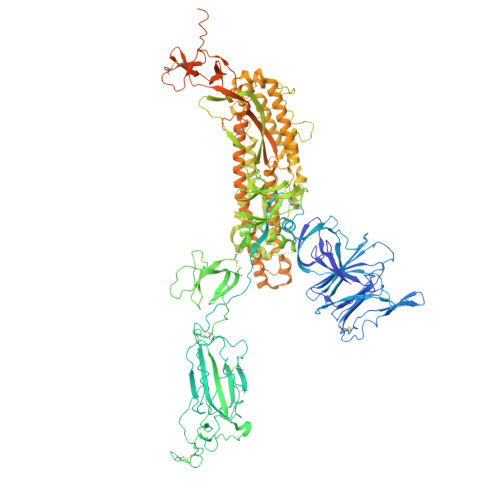
Cryo EM structure of elk ACE2 in complex with SARS-CoV-2 spike trimer


Experimental Data Snapshot

  • Method: ELECTRON MICROSCOPY
  • Resolution: 3.37 Å
  • Aggregation State: PARTICLE 
  • Reconstruction Method: SINGLE PARTICLE 

Starting Model: experimental
View more details

wwPDB Validation 3D Report Full Report

Validation slider image for 9Q3U

This is version 1.1 of the entry. See complete history

Literature

Species- and variant-specific ACE2 compatibility shapes SARS-CoV-2 spillover potential in North American cervids.

Espada, C.Ye, K.Long, Y.Pasai, K.DeLiberto, T.J.Heale, J.Wiese, R.Yang, Q.Zhou, M.Streich, S.Tao, Y.J.Chandler, J.C.Wan, X.F.

(2026) Nat Commun 

  • DOI: https://doi.org/10.1038/s41467-026-71623-5
  • Primary Citation Related Structures: 
    9Q3U, 9Q3V

  • PubMed Abstract: 

    Free-ranging white-tailed deer (WTD) are established SARS-CoV-2 reservoirs, but the susceptibility of other cervid species remains unclear. Here we integrate receptor analysis, structural modeling, and field surveillance to assess SARS-CoV-2 susceptibility across North American cervids. We identify species- and variant-specific differences in ACE2-spike compatibility. Elk ACE2 exhibits weak binding to the ancestral strain (Wuhan-Hu-1) and Delta spike receptor-binding domains (RBDs), likely due to a unique K31N substitution. In contrast, it shows stronger binding to Alpha, Beta, Gamma, and Omicron RBDs containing N501Y. Biophysical assays, gel filtration chromatography, and cryo-EM confirm stable complex formation between elk ACE2 and Alpha RBD, but not RBD from the ancestral strain. Despite weak binding, elk ACE2 supports viral entry and replication in vitro. However, surveillance revealed limited evidence of infection in the United States, contrasting with widespread WTD transmissions. These findings demonstrate that ACE2 compatibility alone is insufficient to predict reservoir potential and provide a framework for assessing species susceptibility to emerging coronaviruses.


  • Organizational Affiliation
    • NextGen Center for Influenza and Emerging Infectious Diseases, University of Missouri, Columbia, MO, USA.

Macromolecule Content 

  • Total Structure Weight: 505.61 kDa 
  • Atom Count: 30,729 
  • Modeled Residue Count: 3,847 
  • Deposited Residue Count: 4,474 
  • Unique protein chains: 2

Macromolecules

Find similar proteins by:|  3D Structure
Entity ID: 1
MoleculeChains  Sequence LengthOrganismDetailsImage
Angiotensin-converting enzyme 2622Cervus canadensisMutation(s): 0 
EC: 3.4
Find similar proteins by:|  3D Structure
Entity ID: 2
MoleculeChains  Sequence LengthOrganismDetailsImage
Spike protein
B, C, D
1,284Severe acute respiratory syndrome coronavirus 2Mutation(s): 0 
Gene Names: S2

Small Molecules

Ligands 1 Unique
IDChains Name / Formula / InChI Key2D Diagram3D Interactions
NAG
(Subject of Investigation/LOI)

Query on NAG


Download:Ideal Coordinates CCD File
AA [auth D]
BA [auth D]
CA [auth D]
DA [auth D]
E [auth A]
AA [auth D],
BA [auth D],
CA [auth D],
DA [auth D],
E [auth A],
F [auth A],
G [auth A],
H [auth B],
I [auth B],
J [auth B],
K [auth B],
L [auth B],
M [auth C],
N [auth C],
O [auth C],
P [auth C],
Q [auth C],
R [auth C],
S [auth C],
T [auth C],
U [auth C],
V [auth D],
W [auth D],
X [auth D],
Y [auth D],
Z [auth D]
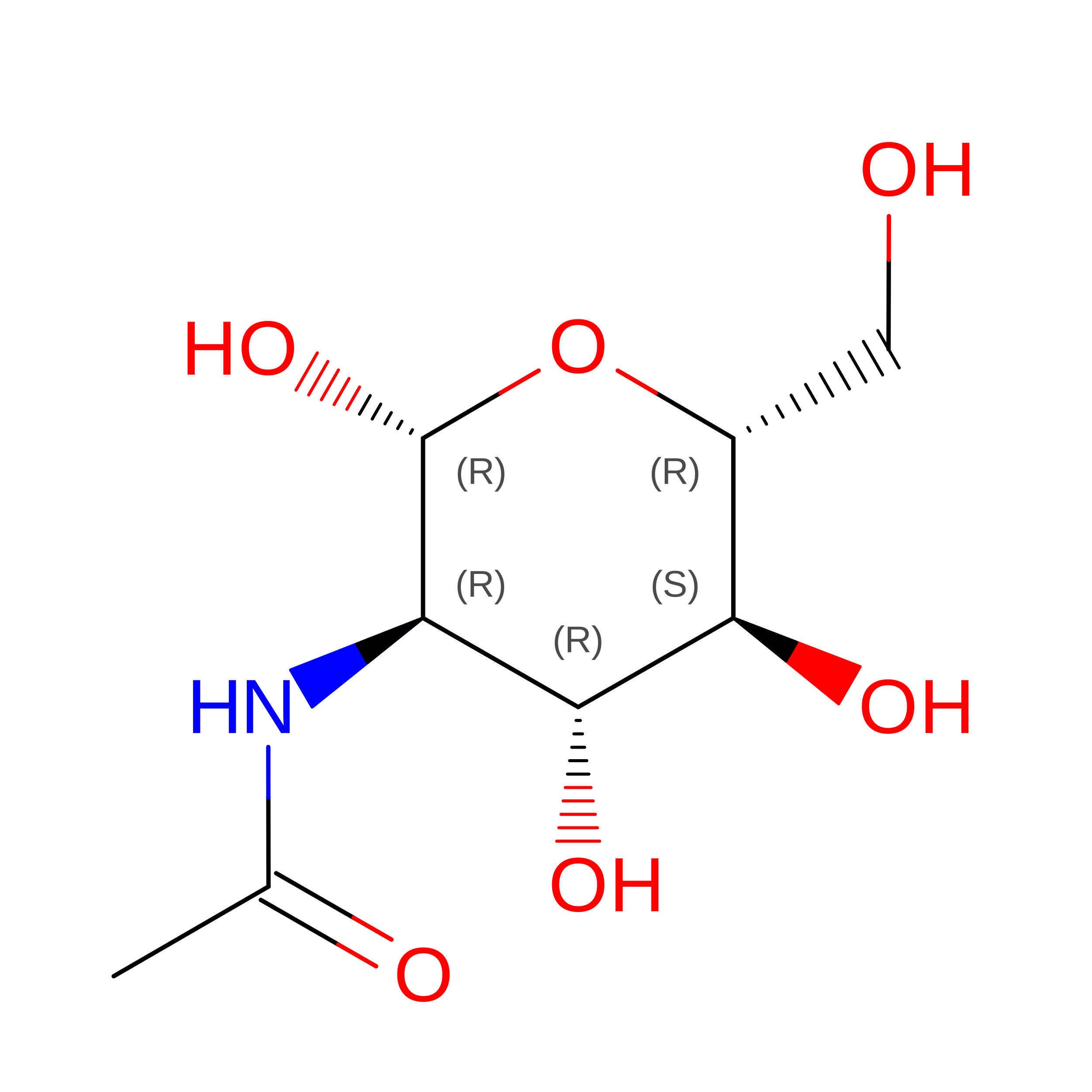
2-acetamido-2-deoxy-beta-D-glucopyranose
C8 H15 N O6
OVRNDRQMDRJTHS-FMDGEEDCSA-N

Experimental Data & Validation

Experimental Data

  • Method: ELECTRON MICROSCOPY
  • Resolution: 3.37 Å
  • Aggregation State: PARTICLE 
  • Reconstruction Method: SINGLE PARTICLE 
EM Software:
TaskSoftware PackageVersion
MODEL REFINEMENTPHENIX1.21.2_5419:
RECONSTRUCTIONcryoSPARC

Structure Validation

View Full Validation Report


Entry History 

& Funding Information

Deposition Data


Funding OrganizationLocationGrant Number
United States Department of Agriculture (USDA)United States--
Robert A. Welch FoundationUnited States--

Revision History  (Full details and data files)

  • Version 1.0: 2026-02-25
    Type: Initial release
  • Version 1.1: 2026-04-22
    Changes: Data collection, Database references