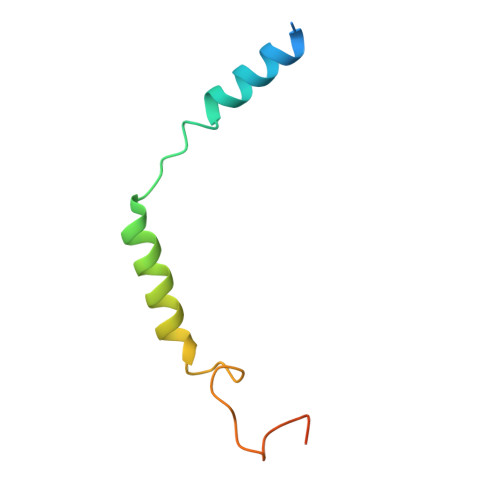
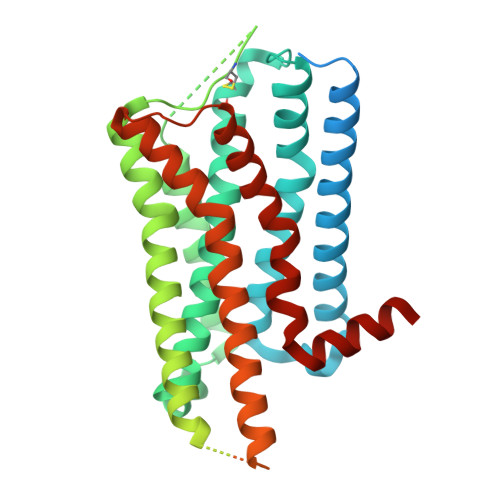
9PLO | pdb_00009plo

Structure of alpha2a adrenergic receptor in complex with Go heterotrimer, scFv16, and N-(5-methylnaphthalen-1-yl)pyridin-4-amine (compound 4905)


Experimental Data Snapshot

  • Method: ELECTRON MICROSCOPY
  • Resolution: 2.74 Å
  • Aggregation State: PARTICLE 
  • Reconstruction Method: SINGLE PARTICLE 

Starting Model: experimental
View more details

wwPDB Validation 3D Report Full Report

Validation slider image for 9PLO

This is version 1.1 of the entry. See complete history

Literature

Toward a Random Background for Ligand Optimization.

Xu, X.Mailhot, O.Correy, G.J.Huang, X.P.Braz, J.Shi, D.Srinivasan, K.Zielinski, K.Holota, Y.Kuziv, Y.Tsoutsouvas, C.Levinzon, N.Doruk, Y.U.Rachman, M.Diolaiti, M.Stevens, M.Liu, F.Holland, K.Hubner, H.Wang, J.Wu, Y.Ashworth, A.Makriyannis, A.Zhang, Y.Moroz, Y.Gmeiner, P.Abel, R.Manglik, A.Basbaum, A.I.Roth, B.L.Fraser, J.S.Shoichet, B.K.

(2026) bioRxiv 

  • DOI: https://doi.org/10.64898/2026.05.10.724162
  • Primary Citation Related Structures: 
    9PLN, 9PLO

  • PubMed Abstract: 

    Ligand optimization is central to drug discovery as hundreds of analogs might be designed and synthesized between an initial hit and a therapeutic candidate. The efficiency of this process is unclear, at least partly because there is no random background for optimization against which to compare. Such a random background might emerge from synthetically accessible but otherwise systematic random small substitutions across starting ligands, measuring likelihood of achieving a substantial improvement in affinity/potency or other property by any single perturbation. Recent literature and ligand-affinity/potency databases suggest that perhaps 10% of analogs with minor modifications improve upon a parent's potency substantially (by ≥10-fold), but this number is clouded by reporting bias, intentional improvement, and inter-group reproducibility. To begin to establish a background expectation for ligand optimization, we comprehensively and systematically modified 18 lead molecules across six targets with single atom changes; 257 compounds were synthesized. Unexpectedly, 11.2% of these random small perturbation analogs improved potency by ≥10-fold over their parents. Conversely, these more potent analogs typically had worse in vitro pharmacokinetics (e.g. reduced metabolic stability, lower plasma free fraction). While it was possible to find analogs where the potency increase compensated for inferior exposure and half-life, resulting in more potent compounds in vivo, overall a frustrated landscape for ligand optimization is revealed. This study begins to establish a background expectation for ligand potency optimization and offers a simple strategy to do so. It also begins to quantify the challenges confronting the field in moving beyond in vitro potency.

Macromolecule Content 

  • Total Structure Weight: 169.04 kDa 
  • Atom Count: 8,657 
  • Modeled Residue Count: 1,110 
  • Deposited Residue Count: 1,533 
  • Unique protein chains: 5

Macromolecules

Find similar proteins by:|  3D Structure
Entity ID: 1
MoleculeChains  Sequence LengthOrganismDetailsImage
Guanine nucleotide-binding protein G(o) subunit alpha354Homo sapiensMutation(s): 0 
Gene Names: GNAO1
EC: 3.6.5
UniProt & NIH Common Fund Data Resources
Find proteins for P09471 (Homo sapiens)
Explore P09471 
Go to UniProtKB:  P09471
PHAROS:  P09471
GTEx:  ENSG00000087258 
Entity Groups
Sequence Clusters30% Identity50% Identity70% Identity90% Identity95% Identity100% Identity
UniProt GroupP09471
Sequence Annotations
Expand
Reference Sequence
Find similar proteins by:|  3D Structure
Entity ID: 2
MoleculeChains  Sequence LengthOrganismDetailsImage
Guanine nucleotide-binding protein G(I)/G(S)/G(T) subunit beta-1358Homo sapiensMutation(s): 0 
Gene Names: GNB1
UniProt & NIH Common Fund Data Resources
Find proteins for P62873 (Homo sapiens)
Explore P62873 
Go to UniProtKB:  P62873
PHAROS:  P62873
GTEx:  ENSG00000078369 
Entity Groups
Sequence Clusters30% Identity50% Identity70% Identity90% Identity95% Identity100% Identity
UniProt GroupP62873
Sequence Annotations
Expand
Reference Sequence
Find similar proteins by:|  3D Structure
Entity ID: 3
MoleculeChains  Sequence LengthOrganismDetailsImage
Guanine nucleotide-binding protein G(I)/G(S)/G(O) subunit gamma-2C [auth G]71Homo sapiensMutation(s): 0 
Gene Names: GNG2
UniProt & NIH Common Fund Data Resources
Find proteins for P59768 (Homo sapiens)
Explore P59768 
Go to UniProtKB:  P59768
PHAROS:  P59768
GTEx:  ENSG00000186469 
Entity Groups
Sequence Clusters30% Identity50% Identity70% Identity90% Identity95% Identity100% Identity
UniProt GroupP59768
Sequence Annotations
Expand
Reference Sequence
Find similar proteins by:|  3D Structure
Entity ID: 4
MoleculeChains  Sequence LengthOrganismDetailsImage
Alpha-2A adrenergic receptorD [auth R]491Homo sapiensMutation(s): 0 
Gene Names: ADRA2AADRA2RADRAR
UniProt & NIH Common Fund Data Resources
Find proteins for P08913 (Homo sapiens)
Explore P08913 
Go to UniProtKB:  P08913
PHAROS:  P08913
GTEx:  ENSG00000150594 
Entity Groups
Sequence Clusters30% Identity50% Identity70% Identity90% Identity95% Identity100% Identity
UniProt GroupP08913
Sequence Annotations
Expand
Reference Sequence
Find similar proteins by:|  3D Structure
Entity ID: 5
MoleculeChains  Sequence LengthOrganismDetailsImage
scFv16E [auth S]259Mus musculusMutation(s): 0 

Small Molecules

Ligands 1 Unique
IDChains Name / Formula / InChI Key2D Diagram3D Interactions
A1CIU
(Subject of Investigation/LOI)

Query on A1CIU


Download:Ideal Coordinates CCD File
F [auth R]N-(5-methylnaphthalen-1-yl)pyridin-4-amine
C16 H14 N2
WUHPUCOIAGCLKE-UHFFFAOYSA-N

Experimental Data & Validation

Experimental Data

  • Method: ELECTRON MICROSCOPY
  • Resolution: 2.74 Å
  • Aggregation State: PARTICLE 
  • Reconstruction Method: SINGLE PARTICLE 
EM Software:
TaskSoftware PackageVersion
RECONSTRUCTIONcryoSPARC
MODEL REFINEMENTPHENIX1.21.2_5419:

Structure Validation

View Full Validation Report


Entry History 

& Funding Information

Deposition Data


Funding OrganizationLocationGrant Number
Defense Advanced Research Projects Agency (DARPA)United States--

Revision History  (Full details and data files)

  • Version 1.0: 2025-07-30
    Type: Initial release
  • Version 1.1: 2026-06-17
    Changes: Data collection, Database references