9L1Y | pdb_00009l1y

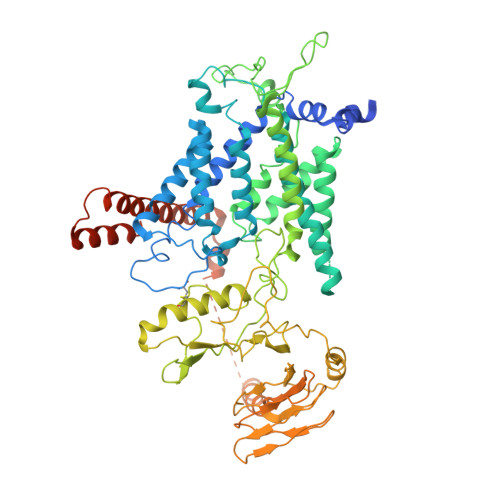
Vitamin K-dependent gamma-carboxylase apo status


Experimental Data Snapshot

  • Method: ELECTRON MICROSCOPY
  • Resolution: 3.46 Å
  • Aggregation State: PARTICLE 
  • Reconstruction Method: SINGLE PARTICLE 

wwPDB Validation 3D Report Full Report

Validation slider image for 9L1Y

This is version 1.1 of the entry. See complete history

Literature

Structural insight into bicarbonate-mediated carboxylation by human vitamin K-dependent carboxylase.

Wu, K.Wang, Z.Yao, D.Li, S.Wang, X.Zhang, Y.Cao, M.Shen, Y.Xing, S.Wu, J.Lei, M.Lan, P.

(2025) Nat Commun 16: 10480-10480

  • DOI: https://doi.org/10.1038/s41467-025-65488-3
  • Primary Citation Related Structures: 
    9L1Y, 9L20, 9L21, 9L23, 9L24, 9L25, 9L54

  • PubMed Abstract: 

    Vitamin K-dependent (VKD) carboxylation, mediated by γ-glutamyl carboxylase (GGCX), is essential for the maturation of VKD proteins involved in critical physiological processes such as blood clotting, vascular calcification and bone metabolism. Here, we present cryo-electron microscopic structures of human GGCX alone and in complex with VKD proteins, vitamin K, and inhibitor anisindione. GGCX specifically recognizes diverse VKD substrates through high-affinity propeptide binding, while substrates like osteocalcin utilize a secondary exosite to enhance interaction. GGCX employs a conserved dipeptide anchoring mechanism that ensures processive carboxylation of glutamate residues. GGCX undergoes allosteric conformational changes that enable coordinated binding of vitamin K and glutamate substrates, facilitating the catalytic process. Additionally, we reveal a bicarbonate-mediated CO₂ capture mechanism that is conserved across bacterial and eukaryotic species, suggesting that this strategy for CO₂ utilization is both ancient and universal. Our findings lay the foundation for developing targeted anticoagulant drugs and innovative enzymatic CO₂ fixation strategies.


  • Organizational Affiliation
    • Institute of Aging and Tissue Regeneration, Renji Hospital, Shanghai Jiao Tong University School of Medicine, Shanghai, China.

Macromolecule Content 

  • Total Structure Weight: 89.4 kDa 
  • Atom Count: 5,267 
  • Modeled Residue Count: 624 
  • Deposited Residue Count: 758 
  • Unique protein chains: 1

Macromolecules

Find similar proteins by:|  3D Structure
Entity ID: 1
MoleculeChains  Sequence LengthOrganismDetailsImage
Vitamin K-dependent gamma-carboxylase758Homo sapiensMutation(s): 0 
Gene Names: GGCXGC
EC: 4.1.1.90
UniProt & NIH Common Fund Data Resources
Find proteins for P38435 (Homo sapiens)
Explore P38435 
Go to UniProtKB:  P38435
PHAROS:  P38435
GTEx:  ENSG00000115486 
Entity Groups
Sequence Clusters30% Identity50% Identity70% Identity90% Identity95% Identity100% Identity
UniProt GroupP38435
Glycosylation
Glycosylation Sites: 3Go to GlyGen: P38435-1
Sequence Annotations
Expand
Reference Sequence

Oligosaccharides

Help  
Entity ID: 2
MoleculeChains Length2D Diagram GlycosylationD Interactions
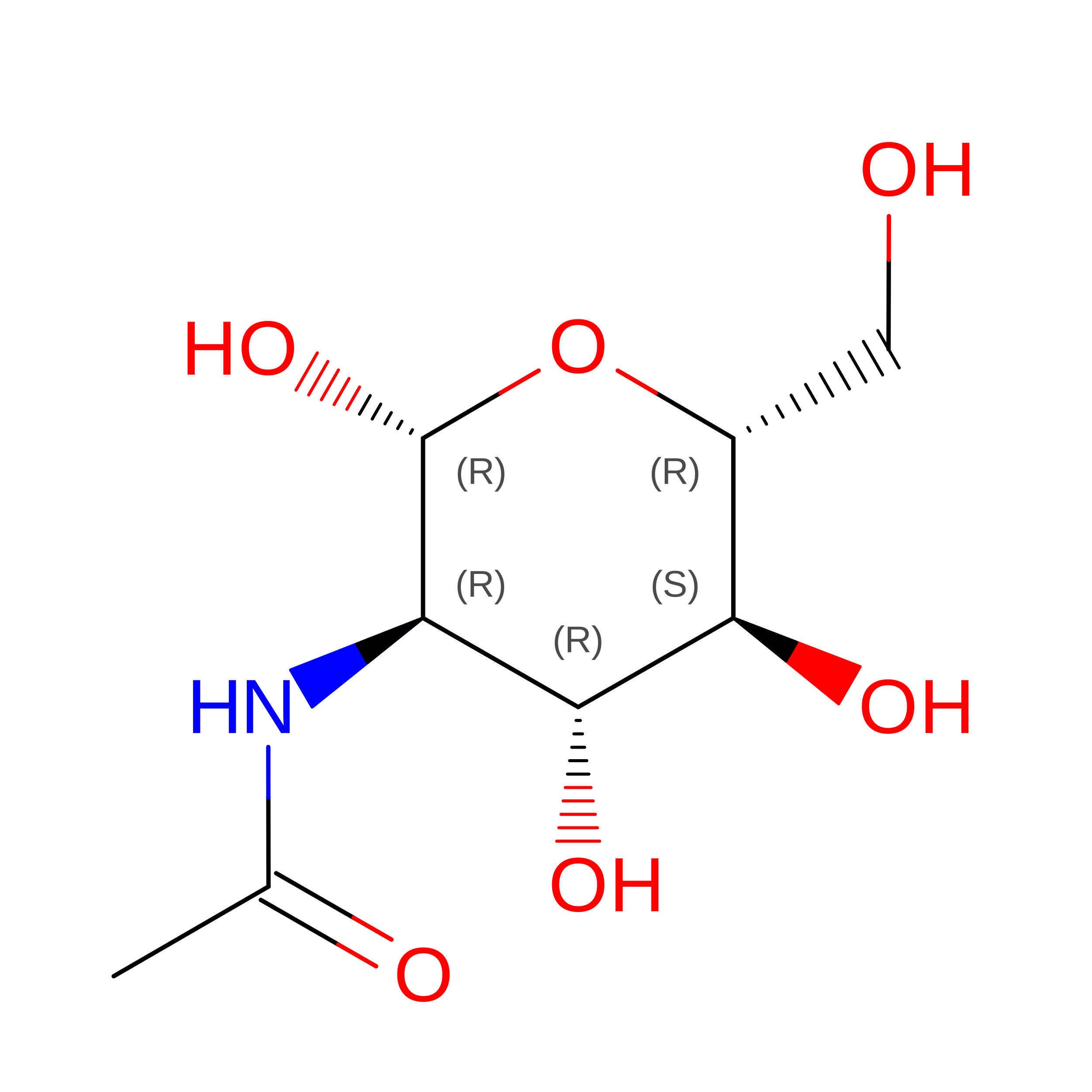
2-acetamido-2-deoxy-beta-D-glucopyranose-(1-4)-2-acetamido-2-deoxy-beta-D-glucopyranose
B
2N-Glycosylation
Glycosylation Resources
GlyTouCan: G42666HT
GlyCosmos: G42666HT
GlyGen: G42666HT

Experimental Data & Validation

Experimental Data

  • Method: ELECTRON MICROSCOPY
  • Resolution: 3.46 Å
  • Aggregation State: PARTICLE 
  • Reconstruction Method: SINGLE PARTICLE 
EM Software:
TaskSoftware PackageVersion
MODEL REFINEMENTPHENIX1.20.1_4487

Structure Validation

View Full Validation Report


Entry History 

& Funding Information

Deposition Data


Funding OrganizationLocationGrant Number
National Natural Science Foundation of China (NSFC)China--

Revision History  (Full details and data files)

  • Version 1.0: 2025-10-22
    Type: Initial release
  • Version 1.1: 2026-05-06
    Changes: Data collection, Database references