Download Mendeley
Structural insight into bicarbonate-mediated carboxylation by human vitamin K-dependent carboxylase.
Wu, K., Wang, Z., Yao, D., Li, S., Wang, X., Zhang, Y., Cao, M., Shen, Y., Xing, S., Wu, J., Lei, M., Lan, P.(2025) Nat Commun 16: 10480-10480
- PubMed: 41290650 Search on PubMedSearch on PubMed Central
- DOI: https://doi.org/10.1038/s41467-025-65488-3
- Primary Citation Related Structures:
9L1Y, 9L20, 9L21, 9L23, 9L24, 9L25, 9L54 - PubMed Abstract:
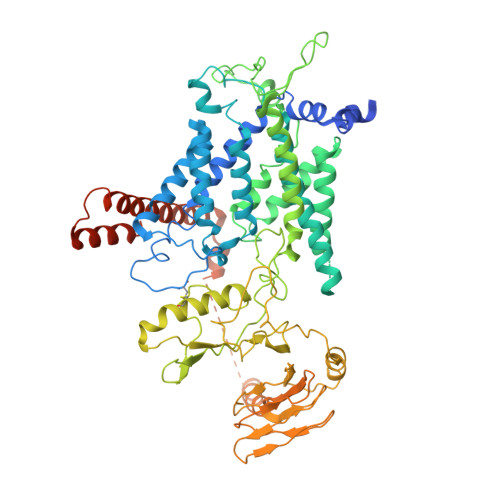
Vitamin K-dependent (VKD) carboxylation, mediated by γ-glutamyl carboxylase (GGCX), is essential for the maturation of VKD proteins involved in critical physiological processes such as blood clotting, vascular calcification and bone metabolism. Here, we present cryo-electron microscopic structures of human GGCX alone and in complex with VKD proteins, vitamin K, and inhibitor anisindione. GGCX specifically recognizes diverse VKD substrates through high-affinity propeptide binding, while substrates like osteocalcin utilize a secondary exosite to enhance interaction. GGCX employs a conserved dipeptide anchoring mechanism that ensures processive carboxylation of glutamate residues. GGCX undergoes allosteric conformational changes that enable coordinated binding of vitamin K and glutamate substrates, facilitating the catalytic process. Additionally, we reveal a bicarbonate-mediated CO₂ capture mechanism that is conserved across bacterial and eukaryotic species, suggesting that this strategy for CO₂ utilization is both ancient and universal. Our findings lay the foundation for developing targeted anticoagulant drugs and innovative enzymatic CO₂ fixation strategies.
- Institute of Aging and Tissue Regeneration, Renji Hospital, Shanghai Jiao Tong University School of Medicine, Shanghai, China.
Organizational Affiliation: