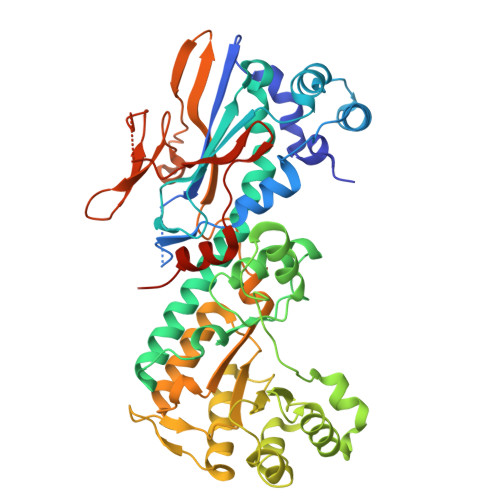
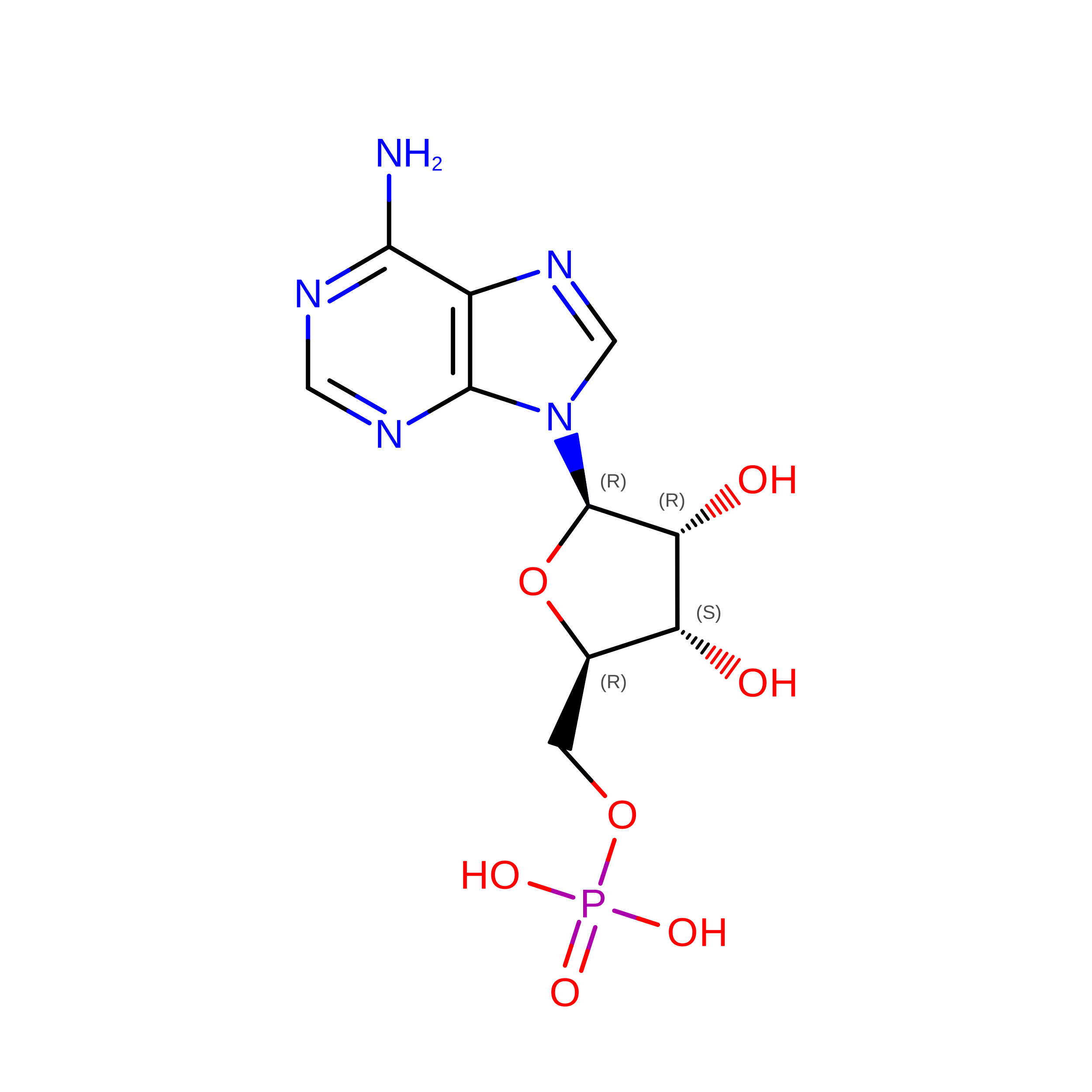
Nicotinamide adenine dinucleotide (NAD + ) is a crucial compound in energy metabolism and cell signaling. Nicotinamide phosphoribosyltransferase (NAMPT) is the rate-limiting enzyme responsible for NAD + biosynthesis from nicotinamide (NAM). Here, we report that NAMPT activity is inhibited by adenosine monophosphate (AMP) in response to energy stress. Our global metabolite-protein interaction mapping reveals that NAMPT differentially interacts with AMP from fasted mouse livers. Crystal structures of NAMPT-AMP show that AMP binds similarly to the NAMPT reaction product, nicotinamide mononucleotide (NMN). The inhibition of NAMPT by AMP can be relieved by NAMPT activators or adenosine triphosphate (ATP), likely in a competitive manner. Based on these findings, we further investigated upstream factors contributing to AMP accumulation and found that activation of purine synthesis unexpectedly promotes the rise of AMP during fasting. Notably, an increased AMP/ATP ratio correlates with NAD + decline in ischemic stroke models, in which NAMPT activators can otherwise confer protection.
Organizational Affiliation:
Institute for Translational Medicine on Cell Fate and Disease, Shanghai Ninth People's Hospital, Key Laboratory of Cell Differentiation and Apoptosis of National Ministry of Education, Department of Pathophysiology, Shanghai Jiao Tong University School of Medicine, Shanghai 200025, China; School of Pharmaceutical Sciences, Beijing Frontier Research Center for Biological Structure, Ministry of Education Key Laboratory of Bioorganic Phosphorus Chemistry and Chemical Biology, Tsinghua University, Beijing 100084, China.
School of Pharmaceutical Sciences, Beijing Frontier Research Center for Biological Structure, Ministry of Education Key Laboratory of Bioorganic Phosphorus Chemistry and Chemical Biology, Tsinghua University, Beijing 100084, China; Joint Graduate Program of Peking-Tsinghua-NIBS, School of Life Sciences, Tsinghua University, Beijing 100084, China.
School of Pharmaceutical Sciences, Beijing Frontier Research Center for Biological Structure, Ministry of Education Key Laboratory of Bioorganic Phosphorus Chemistry and Chemical Biology, Tsinghua University, Beijing 100084, China.
Institute for Translational Medicine on Cell Fate and Disease, Shanghai Ninth People's Hospital, Key Laboratory of Cell Differentiation and Apoptosis of National Ministry of Education, Department of Pathophysiology, Shanghai Jiao Tong University School of Medicine, Shanghai 200025, China; School of Pharmaceutical Sciences, Beijing Frontier Research Center for Biological Structure, Ministry of Education Key Laboratory of Bioorganic Phosphorus Chemistry and Chemical Biology, Tsinghua University, Beijing 100084, China; Peking University, Tsinghua University, National Institute of Biological Sciences Joint Graduate Program, School of Life Sciences, Peking University, Beijing 100871, China.
University of Texas Southwestern Medical Center, Dallas, TX 75390, USA.
National Institute of Biological Sciences, Beijing 102206, China.
School of Kinesiology, Shanghai University of Sport, Shanghai 200438, China.
Ministry of Education Key Laboratory of Protein Science, Tsinghua-Peking Joint Center for Life Sciences, Beijing Advanced Innovation Center for Structural Biology, School of Life Sciences, Tsinghua University, Beijing 100084, China.
School of Life Sciences, Tsinghua University, Beijing 100084, China.
Department of Hematology of Zhongnan Hospital, Research Center for Lifespan Health, Wuhan University, Wuhan 430071, Hubei, China.
Department of Molecular and Cellular Biochemistry, University of Kentucky, Lexington, KY 40536, USA.
Institute for Translational Medicine on Cell Fate and Disease, Shanghai Ninth People's Hospital, Key Laboratory of Cell Differentiation and Apoptosis of National Ministry of Education, Department of Pathophysiology, Shanghai Jiao Tong University School of Medicine, Shanghai 200025, China; School of Pharmaceutical Sciences, Beijing Frontier Research Center for Biological Structure, Ministry of Education Key Laboratory of Bioorganic Phosphorus Chemistry and Chemical Biology, Tsinghua University, Beijing 100084, China; SXMU-Tsinghua Collaborative Innovation Center for Frontier Medicine, Shanxi Medical University, Taiyuan 030605, Shanxi, China. Electronic address: gelinwang@sjtu.edu.cn.








 Download Mendeley