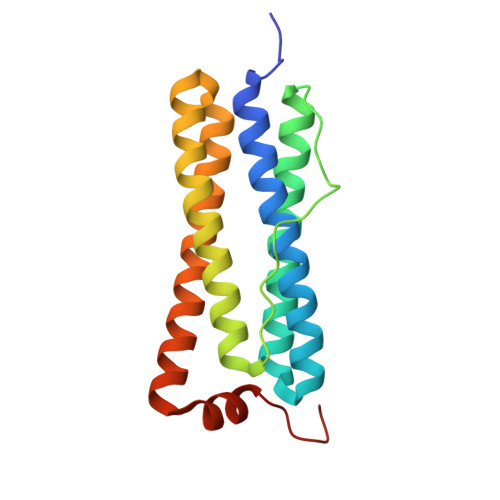
9GZU | pdb_00009gzu

Crystal structure of apo-bacterioferritin (Bfr) from Brucella melitentsis


Experimental Data Snapshot

  • Method: X-RAY DIFFRACTION
  • Resolution: 1.97 Å
  • R-Value Free: 
    0.235 (Depositor), 0.235 (DCC) 
  • R-Value Work: 
    0.198 (Depositor), 0.198 (DCC) 
  • R-Value Observed: 
    0.200 (Depositor) 

Starting Model: experimental
View more details

wwPDB Validation 3D Report Full Report

Validation slider image for 9GZU

This is version 1.1 of the entry. See complete history. 

Literature

Influence of heme and pH on the oligomeric states of Brucella melitensis bacterioferritin.

Scaillet, T., Champagne, C., Wouters, J.

(2026) Acta Crystallogr D Struct Biol 82: 1062-1071

  • DOI: https://doi.org/10.1107/S2059798326006625
  • Primary Citation Related Structures: 
    9GZU

  • PubMed Abstract: 

    Bacterioferritin from Brucella melitensis (BmBfr) is a protein that plays essential roles in oxidative stress management and metal homeostasis in the bacterium. It presents itself as a 24-mer forming a spherical nanocage, allowing further applications such as drug delivery and nanoparticle synthesis. Studying the oligomerization process is thus important for a deeper understanding of the protein. In this work, two forms of the protein were studied: with the heme cofactor (holo BmBfr) and without the cofactor (apo BmBfr). Analyses were performed using size-exclusion chromatography, thermal shift analysis and structure determination of apo BmBfr by X-ray crystallography. This revealed that oligomerization is not possible with the apo form, since the heme is essential for dimer formation, which is the first oligomerization step. Further oligomerization can occur at a pH above 5.0, where interface interactions are favorable, to form a highly stable 24-mer state. Those findings allowed us to suggest an oligomerization mechanism for BmBfr.


  • Organizational Affiliation: 
    • Department of Chemistry, Laboratoire de Chimie Biologique Structurale (CBS), University of Namur (UNamur), Namur Research Institute for Life Sciences (NARILIS), Namur Institute of Structural Matter (NISM), 61 Rue de Bruxelles, 5000 Namur, Belgium.

Macromolecule Content 

  • Total Structure Weight: 19.28 kDa 
  • Atom Count: 1,515 
  • Modeled Residue Count: 162 
  • Deposited Residue Count: 165 
  • Unique protein chains: 1

Macromolecules

Find similar proteins by:|  3D Structure
Entity ID: 1
MoleculeChains  Sequence LengthOrganismDetailsImage
Bacterioferritin165Brucella melitensisMutation(s): 0 
Gene Names: bfr, BruAb2_0659
EC: 1.16.3.1
UniProt
Find proteins for F8WJU0 (Brucella abortus biovar 1 (strain 9-941))
Explore F8WJU0 
Go to UniProtKB:  F8WJU0
Entity Groups
Sequence Clusters30% Identity50% Identity70% Identity90% Identity95% Identity100% Identity
UniProt GroupF8WJU0
Sequence Annotations
Expand
Reference Sequence

Small Molecules

Ligands 3 Unique
IDChains Name / Formula / InChI Key2D Diagram3D Interactions
SO4

Query on SO4


Download:Ideal Coordinates CCD File
D [auth A],
E [auth A],
F [auth A]
SULFATE ION
O4 S
QAOWNCQODCNURD-UHFFFAOYSA-L
CL

Query on CL


Download:Ideal Coordinates CCD File
C [auth A]CHLORIDE ION
Cl
VEXZGXHMUGYJMC-UHFFFAOYSA-M
NA

Query on NA


Download:Ideal Coordinates CCD File
B [auth A],
G [auth A],
H [auth A]
SODIUM ION
Na
FKNQFGJONOIPTF-UHFFFAOYSA-N

Experimental Data & Validation

Experimental Data

  • Method: X-RAY DIFFRACTION
  • Resolution: 1.97 Å
  • R-Value Free:  0.235 (Depositor), 0.235 (DCC) 
  • R-Value Work:  0.198 (Depositor), 0.198 (DCC) 
  • R-Value Observed: 0.200 (Depositor) 
Space Group: F 4 3 2
Unit Cell:
Length ( Å )Angle ( ˚ )
a = 173.78α = 90
b = 173.78β = 90
c = 173.78γ = 90
Software Package:
Software NamePurpose
MxCuBEdata collection
PHENIXrefinement
XDSdata reduction
XSCALEdata scaling
PHASERphasing
Cootmodel building

Structure Validation

View Full Validation Report


Entry History 

& Funding Information

Deposition Data


Funding OrganizationLocationGrant Number
Not funded--

Revision History  (Full details and data files)

  • Version 1.0: 2025-10-15
    Type: Initial release
  • Version 1.1: 2026-10-28
    Changes: Database references