Download Mendeley
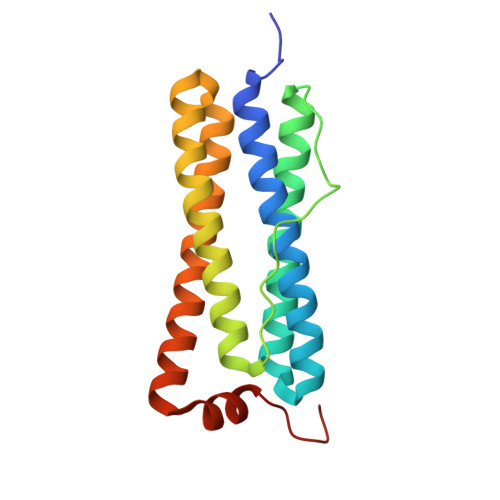
Influence of heme and pH on the oligomeric states of Brucella melitensis bacterioferritin.
Scaillet, T., Champagne, C., Wouters, J.(2026) Acta Crystallogr D Struct Biol 82: 1062-1071
- PubMed: 42572940 Search on PubMedSearch on PubMed Central
- DOI: https://doi.org/10.1107/S2059798326006625
- Primary Citation Related Structures:
9GZU - PubMed Abstract:
Bacterioferritin from Brucella melitensis (BmBfr) is a protein that plays essential roles in oxidative stress management and metal homeostasis in the bacterium. It presents itself as a 24-mer forming a spherical nanocage, allowing further applications such as drug delivery and nanoparticle synthesis. Studying the oligomerization process is thus important for a deeper understanding of the protein. In this work, two forms of the protein were studied: with the heme cofactor (holo BmBfr) and without the cofactor (apo BmBfr). Analyses were performed using size-exclusion chromatography, thermal shift analysis and structure determination of apo BmBfr by X-ray crystallography. This revealed that oligomerization is not possible with the apo form, since the heme is essential for dimer formation, which is the first oligomerization step. Further oligomerization can occur at a pH above 5.0, where interface interactions are favorable, to form a highly stable 24-mer state. Those findings allowed us to suggest an oligomerization mechanism for BmBfr.
- Department of Chemistry, Laboratoire de Chimie Biologique Structurale (CBS), University of Namur (UNamur), Namur Research Institute for Life Sciences (NARILIS), Namur Institute of Structural Matter (NISM), 61 Rue de Bruxelles, 5000 Namur, Belgium.
Organizational Affiliation: