Download Mendeley
Structural and kinetic analysis of distinct active and inactive states of Burkholderia cenocepacia orotate phosphoribosyltransferase.
Sharma, N., Turlington, Z.R., Zupko, S.P., Catoggio, M.N., Lukacs, C.M., Serbzhinskiy, D., Abendroth, J., Edwards, T.E., Lorimer, D.D., Barrera, G., Willis, S., Beyer, O., Toay, S., Da Li, T., Torelli, A.T., Hicks, K.A., French, J.B.(2025) Arch Biochem Biophys 766: 110332-110332
- PubMed: 39938730 Search on PubMed
- DOI: https://doi.org/10.1016/j.abb.2025.110332
- Primary Citation Related Structures:
9E5G - PubMed Abstract:
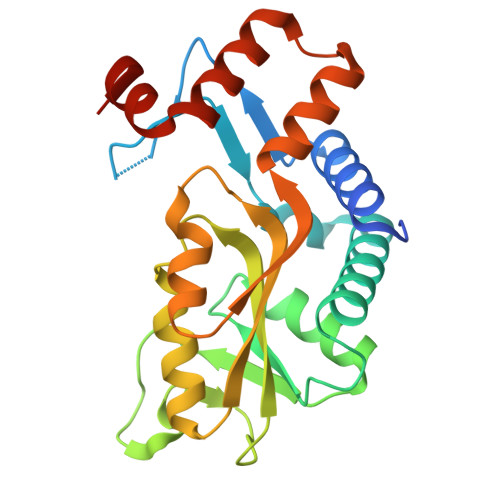
Orotate phosphoribosyltransferase (OPRT) catalyzes the reaction that adds the pyrimidine base to the ribose in the penultimate step of the de novo biosynthesis of pyrimidine nucleotides. The OPRT structure consists of an obligate dimer, conserved throughout the phosphoribosyltransferase family. Here, we describe the structural characterization of Burkholderia cenocepacia OPRT (BcOPRT), both by X-ray crystallography and Cryo electron microscopy (Cryo-EM). While the known dimer is present in the structure of BcOPRT, a putative hexameric form was also observed by multiple methods. Analyses by chromatography, Cryo-EM, and kinetics indicate that both dimeric and hexameric forms of this enzyme are present together in solution. Comparison of the kinetics of the native protein and two variants, which were specifically designed to prevent hexamerization, reveal that only the hexameric form is enzymatically active. Collectively, these data suggest that BcOPRT may use oligomerization to control overall enzymatic activity, thus contributing to the local regulation of pyrimidine biosynthesis in this organism.
- The Hormel Institute, University of Minnesota, Austin, MN 55912.
Organizational Affiliation: