9E5G | pdb_00009e5g

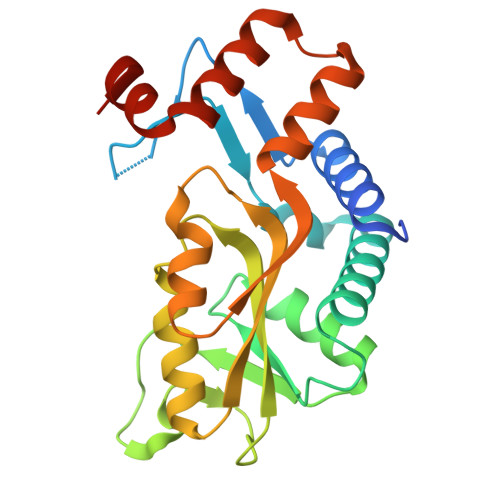
Cryo-EM structure of Burkholderia cenocepacia orotate phosphoribosyltransferase


Experimental Data Snapshot

  • Method: ELECTRON MICROSCOPY
  • Resolution: 3.07 Å
  • Aggregation State: PARTICLE 
  • Reconstruction Method: SINGLE PARTICLE 

wwPDB Validation 3D Report Full Report

Validation slider image for 9E5G

This is version 1.3 of the entry. See complete history

Literature

Structural and kinetic analysis of distinct active and inactive states of Burkholderia cenocepacia orotate phosphoribosyltransferase.

Sharma, N.Turlington, Z.R.Zupko, S.P.Catoggio, M.N.Lukacs, C.M.Serbzhinskiy, D.Abendroth, J.Edwards, T.E.Lorimer, D.D.Barrera, G.Willis, S.Beyer, O.Toay, S.Da Li, T.Torelli, A.T.Hicks, K.A.French, J.B.

(2025) Arch Biochem Biophys 766: 110332-110332

  • DOI: https://doi.org/10.1016/j.abb.2025.110332
  • Primary Citation Related Structures: 
    9E5G

  • PubMed Abstract: 

    Orotate phosphoribosyltransferase (OPRT) catalyzes the reaction that adds the pyrimidine base to the ribose in the penultimate step of the de novo biosynthesis of pyrimidine nucleotides. The OPRT structure consists of an obligate dimer, conserved throughout the phosphoribosyltransferase family. Here, we describe the structural characterization of Burkholderia cenocepacia OPRT (BcOPRT), both by X-ray crystallography and Cryo electron microscopy (Cryo-EM). While the known dimer is present in the structure of BcOPRT, a putative hexameric form was also observed by multiple methods. Analyses by chromatography, Cryo-EM, and kinetics indicate that both dimeric and hexameric forms of this enzyme are present together in solution. Comparison of the kinetics of the native protein and two variants, which were specifically designed to prevent hexamerization, reveal that only the hexameric form is enzymatically active. Collectively, these data suggest that BcOPRT may use oligomerization to control overall enzymatic activity, thus contributing to the local regulation of pyrimidine biosynthesis in this organism.


  • Organizational Affiliation
    • The Hormel Institute, University of Minnesota, Austin, MN, 55912, USA.

Macromolecule Content 

  • Total Structure Weight: 159.72 kDa 
  • Atom Count: 9,927 
  • Modeled Residue Count: 1,318 
  • Deposited Residue Count: 1,416 
  • Unique protein chains: 1

Macromolecules

Find similar proteins by:|  3D Structure
Entity ID: 1
MoleculeChains  Sequence LengthOrganismDetailsImage
Orotate phosphoribosyltransferase
A, B, C, D, E
A, B, C, D, E, F
236Burkholderia cenocepacia J2315Mutation(s): 0 
Gene Names: pyrEA8E72_00610BJL96_16755DT99_13515UE97_16305
EC: 2.4.2.10
UniProt
Find proteins for B4E589 (Burkholderia cenocepacia (strain ATCC BAA-245 / DSM 16553 / LMG 16656 / NCTC 13227 / J2315 / CF5610))
Explore B4E589 
Go to UniProtKB:  B4E589
Entity Groups
Sequence Clusters30% Identity50% Identity70% Identity90% Identity95% Identity100% Identity
UniProt GroupB4E589
Sequence Annotations
Expand
Reference Sequence

Experimental Data & Validation

Experimental Data

  • Method: ELECTRON MICROSCOPY
  • Resolution: 3.07 Å
  • Aggregation State: PARTICLE 
  • Reconstruction Method: SINGLE PARTICLE 
EM Software:
TaskSoftware PackageVersion
MODEL REFINEMENTPHENIX

Structure Validation

View Full Validation Report


Entry History 

& Funding Information

Deposition Data


Funding OrganizationLocationGrant Number
National Institutes of Health/National Institute of General Medical Sciences (NIH/NIGMS)United StatesR35GM124898

Revision History  (Full details and data files)

  • Version 1.0: 2025-02-19
    Type: Initial release
  • Version 1.1: 2025-02-26
    Changes: Data collection, Database references
  • Version 1.2: 2025-03-05
    Changes: Data collection, Database references
  • Version 1.3: 2025-05-21
    Changes: Data collection