Download Mendeley
Molecular insight into microtubule nucleation by the XMAP215/ gamma-TuRC module.
McManus, C.T., Travis, S.M., Jeffrey, P.D., Zhang, R., Petry, S.(2026) Nat Commun
- PubMed: 42103704 Search on PubMedSearch on PubMed Central
- DOI: https://doi.org/10.1038/s41467-026-72370-3
- Primary Citation Related Structures:
9C13 - PubMed Abstract:
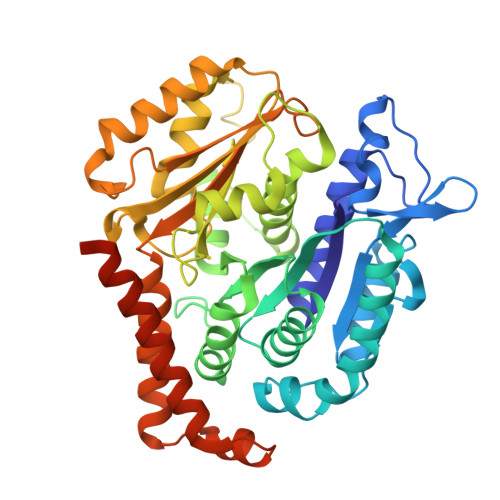
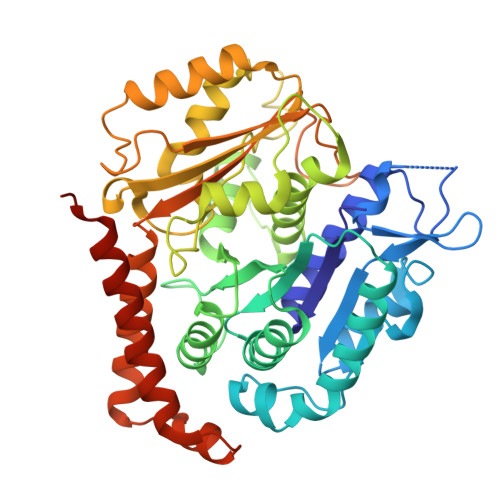
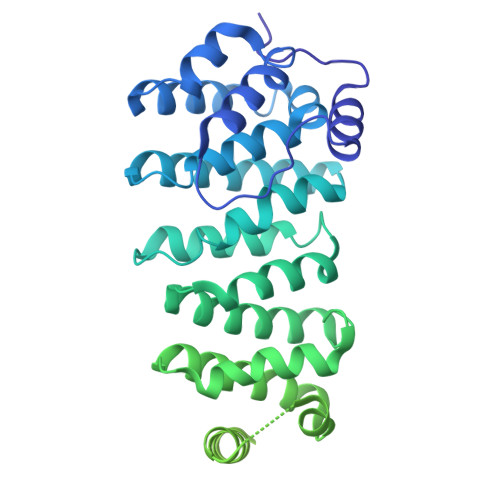
It has become increasingly evident in recent years that nucleation of microtubules from a diverse set of microtubule organizing centers (MTOCs) requires both the γ-tubulin ring complex (γ-TuRC) and the microtubule polymerase XMAP215. Despite their essentiality, little is known about how these nucleation factors interact and work together to generate microtubules. Using biochemical domain analysis of XMAP215 and structural approaches, we find that the XMAP215 C-terminal region interacts broadly with γ-TuRC, involving a sixth TOG domain which binds γ-tubulin. Moreover, TOG6 is required for XMAP215 to promote nucleation from γ-TuRC to its full extent. Interestingly, we find that XMAP215 also depends strongly on TOG5 for microtubule lattice binding and nucleation. We further report a cryo-EM structure of TOG5 bound to the microtubule lattice that reveals promotion of lateral interactions between tubulin dimers. While XMAP215 constructs' effects on nucleation are generally proportional to their effects on polymerization, formation of a direct complex with γ-TuRC allows cooperative nucleation activity. Thus, we propose that XMAP215's C-terminal TOGs 5 and 6 play key roles in nucleation by promoting formation of longitudinal and lateral bonds in nascent γ-TuRC-templated microtubules at cellular MTOCs.
- Department of Molecular Biology, Princeton University, Princeton, NJ, USA.
Organizational Affiliation: