9ZY0 | pdb_00009zy0

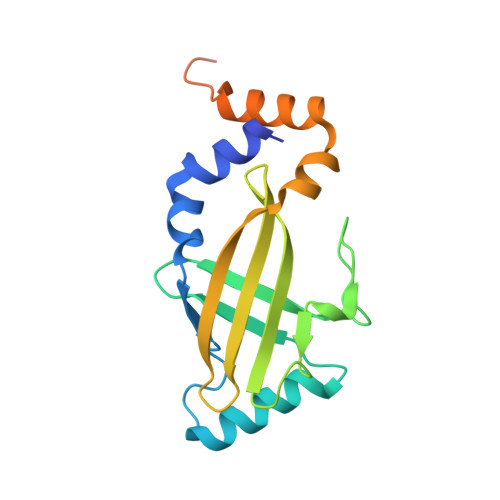
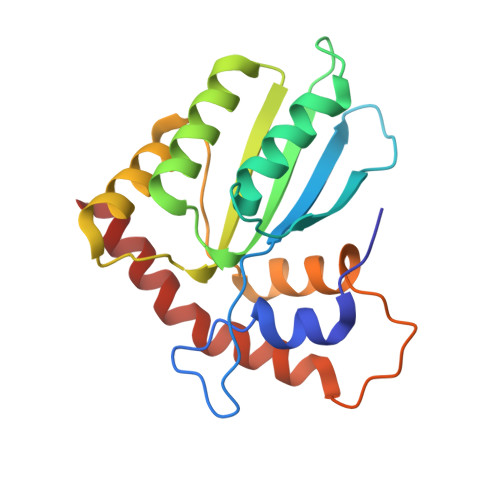
Cryo-EM structure of the monomeric HIV-2 Vif-human APOBEC3H-CBFbeta complex


Experimental Data Snapshot

  • Method: ELECTRON MICROSCOPY
  • Resolution: 3.20 Å
  • Aggregation State: PARTICLE 
  • Reconstruction Method: SINGLE PARTICLE 

wwPDB Validation 3D Report Full Report

Validation slider image for 9ZY0

This is version 1.0 of the entry. See complete history

Literature

The structural mechanism of HIV-2 Vif antagonism of human APOBEC3H.

Niu, Y.Lilly, M.Ronayne, E.K.Emerman, M.Chesarino, N.M.Gross, J.D.

(2026) Nat Commun 

  • DOI: https://doi.org/10.1038/s41467-026-75045-1
  • Primary Citation Related Structures: 
    9ZY0, 9ZY1

  • PubMed Abstract: 

    Human APOBEC3 (A3) proteins restrict retrovirus infection by inducing hypermutations in viral cDNA. To counteract this restriction, lentiviruses, such as HIV-1 and HIV-2 encode the viral infectivity factor (Vif), which hijacks a host Cullin-RING E3 ubiquitin ligase complex to target A3 proteins for proteasomal degradation. Here, we present the cryo-EM structure of HIV-2 Vif in complex with human A3H and CBFβ. The structure reveals that A3H forms a dimer mediated by dsRNA where each A3H monomer directly interacts with an HIV-2 Vif and the host protein CBFβ. Both HIV-2 Vif-A3H and CBFβ-A3H interfaces are critical for A3H degradation. Notably, however, the HIV-2 Vif-A3H interface is entirely distinct from the previously determined cryo-EM structure of the HIV-1 Vif and A3H complex. These findings suggest that HIV-1 and HIV-2 Vif, which are the result of distinct cross-species transmissions from species with different A3H characteristics, have followed separate evolutionary trajectories to counteract human A3H.


  • Organizational Affiliation
    • Department of Pharmaceutical Chemistry, University of California San Francisco, San Francisco, CA, USA.

Macromolecule Content 

  • Total Structure Weight: 73.47 kDa 
  • Atom Count: 4,557 
  • Modeled Residue Count: 525 
  • Deposited Residue Count: 596 
  • Unique protein chains: 3
  • Unique nucleic acid chains: 2

Macromolecules


Find similar proteins by:|  3D Structure
Entity ID: 1
MoleculeChains  Sequence LengthOrganismDetailsImage
Virion infectivity factor215Human immunodeficiency virus 2Mutation(s): 0 
Gene Names: vif
Find similar proteins by:|  3D Structure
Entity ID: 2
MoleculeChains  Sequence LengthOrganismDetailsImage
Core-binding factor subunit beta182Homo sapiensMutation(s): 0 
Gene Names: CBFB
UniProt & NIH Common Fund Data Resources
Find proteins for Q13951 (Homo sapiens)
Explore Q13951 
Go to UniProtKB:  Q13951
PHAROS:  Q13951
GTEx:  ENSG00000067955 
Entity Groups
Sequence Clusters30% Identity50% Identity70% Identity90% Identity95% Identity100% Identity
UniProt GroupQ13951
Sequence Annotations
Expand
Reference Sequence
Find similar proteins by:|  3D Structure
Entity ID: 3
MoleculeChains  Sequence LengthOrganismDetailsImage
Single-stranded DNA cytosine deaminase183Homo sapiensMutation(s): 0 
Gene Names: APOBEC3H
EC: 3.5.4.38
UniProt
Find proteins for B7TQM6 (Homo sapiens)
Explore B7TQM6 
Go to UniProtKB:  B7TQM6
Entity Groups
Sequence Clusters30% Identity50% Identity70% Identity90% Identity95% Identity100% Identity
UniProt GroupB7TQM6
Sequence Annotations
Expand
Reference Sequence
Find similar nucleic acids by:  Sequence
Entity ID: 4
MoleculeChains LengthOrganismImage
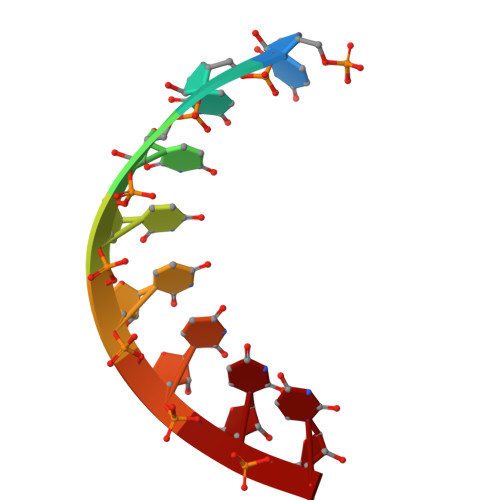
RNA (5'-R(P*UP*UP*UP*UP*UP*UP*UP*U)-3')8synthetic construct
Sequence Annotations
Expand
Reference Sequence
Find similar nucleic acids by:  Sequence
Entity ID: 5
MoleculeChains LengthOrganismImage
RNA (5'-R(P*AP*AP*AP*AP*AP*AP*AP*A)-3')8synthetic construct
Sequence Annotations
Expand
Reference Sequence

Experimental Data & Validation

Experimental Data

  • Method: ELECTRON MICROSCOPY
  • Resolution: 3.20 Å
  • Aggregation State: PARTICLE 
  • Reconstruction Method: SINGLE PARTICLE 
EM Software:
TaskSoftware PackageVersion
RECONSTRUCTIONcryoSPARC

Structure Validation

View Full Validation Report


Entry History 

& Funding Information

Deposition Data


Funding OrganizationLocationGrant Number
National Institutes of Health/National Institute Of Allergy and Infectious Diseases (NIH/NIAID)United StatesU54AI170792

Revision History  (Full details and data files)

  • Version 1.0: 2026-07-15
    Type: Initial release