Download Mendeley
Structural basis for rosuvastatin-induced activation of skeletal muscle ryanodine receptor 1.
Weninger, G., Reiken, S., Yuan, Q., Miotto, M.C., Chang, A., Liu, Y., Wronska, A., Dridi, H., Marks, A.R.(2026) Nat Commun 17
- PubMed: 42830339 Search on PubMedSearch on PubMed Central
- DOI: https://doi.org/10.1038/s41467-026-77372-9
- Primary Citation Related Structures:
9ZO8, 9ZOE - PubMed Abstract:
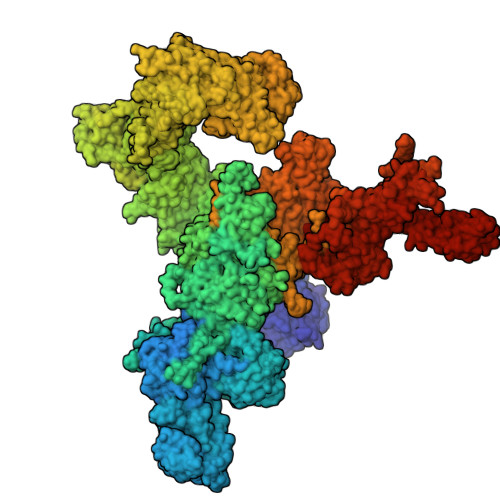
Statin therapies, used to lower high blood cholesterol, have been proposed to cause skeletal muscle side effects including myalgia and rhabdomyolysis. The ryanodine receptor 1 (RyR1)/Ca²⁺ release channel in skeletal muscle has recently been identified as an off-target binder of statins. Here, we report the cryo-electron microscopy structure of RyR1 in complex with rosuvastatin. Rosuvastatin occupies a single binding site in the pore region of RyR1 stabilizing the open conformation. In the closed conformation, the rosuvastatin binding site is occupied by the RyR1 auxiliary transmembrane helices (TMx1-2). Structural comparison indicates steric overlap of rosuvastatin with simvastatin (at Sim-1) but not with atorvastatin on RyR1, while all these statins may interfere with the conformational stability of the TMx1-2 helices. In contrast to simvastatin and atorvastatin, rosuvastatin does not exhibit multiple binding sites on RyR1 while similarly promoting RyR1 activation, indicating its potential as a preferable lead structure for developing statins that minimizes adverse side effects on RyR1.
- Department of Physiology and Cellular Biophysics, Wu Center for Molecular Cardiology, Columbia University Vagelos College of Physicians and Surgeons, New York, NY, USA.
Organizational Affiliation: