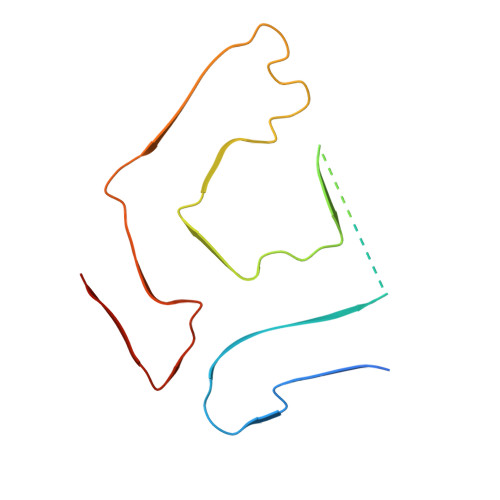
9ZLD | pdb_00009zld

Cryo-EM structure of hepatic amyloid fibril from a variant ATTRV122delta, single filament morphology

  • Classification: PROTEIN FIBRIL
  • Organism(s): Homo sapiens
  • Mutation(s): No 

  • Deposited: 2025-12-08 Released: 2026-04-15 
  • Deposition Author(s): Nguyen, B.A., Ahmed, Y., Saelices, L.
  • Funding Organization(s): National Institutes of Health/National Heart, Lung, and Blood Institute (NIH/NHLBI), American Heart Association, Welch Foundation

Experimental Data Snapshot

  • Method: ELECTRON MICROSCOPY
  • Resolution: 2.90 Å
  • Aggregation State: FILAMENT 
  • Reconstruction Method: HELICAL 

Starting Model: experimental
View more details

wwPDB Validation 3D Report Full Report

Validation slider image for 9ZLD

This is version 1.1 of the entry. See complete history

Literature

Cryo-EM reveals structural variability of apolipoprotein A-I amyloid fibrils across organs, mutations, and clinical presentations.

Nguyen, B.A.Fernandez-Ramirez, M.D.C.Bassett, P.Singh, V.Singh, P.Pekala, M.Villalon, L.Ahmed, Y.Lemoff, A.Evers, B.Lopez, C.Kluve-Beckerman, B.Saelices, L.

(2026) Nat Commun 

  • DOI: https://doi.org/10.1038/s41467-026-72150-z
  • Primary Citation Related Structures: 
    9PVY, 9PVZ, 9PW3, 9ZLD

  • PubMed Abstract: 

    Hereditary apolipoprotein A-I (AApoA‑I) amyloidosis is a rare systemic disease caused by the deposition of amyloid fibrils formed by apolipoprotein A‑I in multiple organs, leading to severe clinical outcomes. With no available therapies or diagnostic tools, defining the structure of AApoA‑I fibrils is crucial to understanding disease mechanisms and guiding intervention. Here we use cryo-electron microscopy to analyze AApoA‑I fibrils from the heart, kidney, liver, and spleen of patients carrying G26R, L90P, and R173P mutations. G26R fibrils, regardless of organ, exhibits untwisted morphologies and cannot be resolved structurally. Conversely, L90P and R173P fibrils display a compact diabolo-shaped conformation in all organs analyzed. Their high-resolution maps enable visualization of cis-Proline 66, which may represent a potential conformational switch during fibril formation. Our findings suggest that mutation-driven polymorphism may influence organ tropism and clinical presentation. This work advances our understanding of AApoA‑I fibril assembly and provides insights toward developing targeted clinical tools.


  • Organizational Affiliation
    • Center for Alzheimer's and Neurodegenerative Diseases, Department of Biophysics, Peter O'Donnell Jr Brain Institute, University of Texas Southwestern Medical Center (UTSW), Dallas, TX, USA. anbinh.nguyen@utsouthwestern.edu.

Macromolecule Content 

  • Total Structure Weight: 68.39 kDa 
  • Atom Count: 3,575 
  • Modeled Residue Count: 455 
  • Deposited Residue Count: 630 
  • Unique protein chains: 1

Macromolecules

Find similar proteins by:|  3D Structure
Entity ID: 1
MoleculeChains  Sequence LengthOrganismDetailsImage
Transthyretin
A, B, C, D, E
126Homo sapiensMutation(s): 0 
UniProt & NIH Common Fund Data Resources
Find proteins for P02766 (Homo sapiens)
Explore P02766 
Go to UniProtKB:  P02766
PHAROS:  P02766
GTEx:  ENSG00000118271 
Entity Groups
Sequence Clusters30% Identity50% Identity70% Identity90% Identity95% Identity100% Identity
UniProt GroupP02766
Sequence Annotations
Expand
Reference Sequence

Experimental Data & Validation

Experimental Data

  • Method: ELECTRON MICROSCOPY
  • Resolution: 2.90 Å
  • Aggregation State: FILAMENT 
  • Reconstruction Method: HELICAL 
EM Software:
TaskSoftware PackageVersion
MODEL REFINEMENTPHENIX1.20.1
RECONSTRUCTIONRELION4.0

Structure Validation

View Full Validation Report


Entry History 

& Funding Information

Deposition Data


Funding OrganizationLocationGrant Number
National Institutes of Health/National Heart, Lung, and Blood Institute (NIH/NHLBI)United StatesDP2-HL163810
American Heart AssociationUnited States847236
Welch FoundationUnited StatesI-2121-20220331

Revision History  (Full details and data files)

  • Version 1.0: 2026-04-15
    Type: Initial release
  • Version 1.1: 2026-04-29
    Changes: Data collection, Database references