Download Mendeley
The crystal structure of the activin B:Fst288 complex and computational insights into the broad antagonistic activity and specificity of follistatin.
Hok, L., Walker, R.G., Howard, J.A., Gouge, M.M., Mast, E.M., Kattamuri, C., Goebel, E.J., Thompson, T.B.(2026) J Biol Chem : 113459-113459
- PubMed: 42607890 Search on PubMed
- DOI: https://doi.org/10.1016/j.jbc.2026.113459
- Primary Citation Related Structures:
9Z3T - PubMed Abstract:
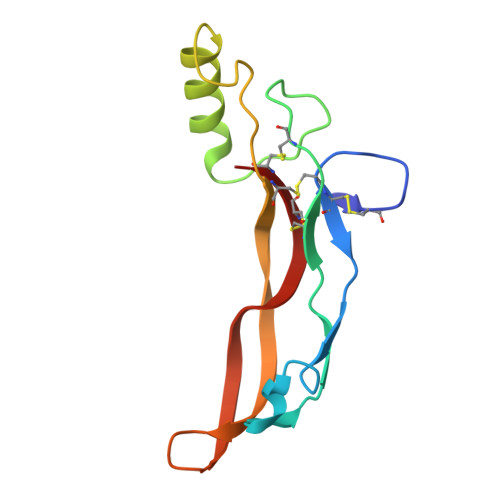
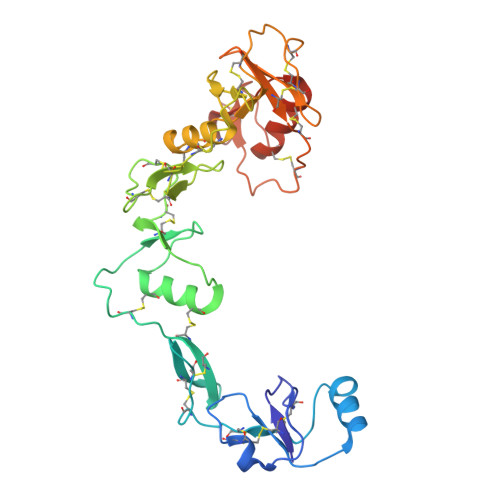
Members of the transforming growth factor-β (TGF-β) family regulate essential biological processes, and their activity is tightly controlled by extracellular antagonists like follistatin 288 (Fst288). While Fst288 potently inhibits several ligands, including activins A and B, GDF8, and GDF11, the structural basis for its interaction with activin B (ActB) has remained largely uncharacterized. This lack of data has limited our understanding of how Fst288 achieves such broad inhibitory activity while maintaining ligand-specific selectivity. In this study, we resolved the crystal structure of the ActB:Fst288 complex at 2.7 Å resolution. Our findings reveal that while Fst288 utilizes a conserved receptor-blocking mechanism, ActB engages the antagonist through a modified structural mode. Most notably, the fingertips of ActB form direct, unique contacts with the third follistatin domain (FSD3). This interaction disrupts the intermolecular head-to-tail cooperativity typically seen in Fst288 dimers, shifting the stabilization of the complex toward individual ligand-domain affinities. Computational analysis supports a model where ActB relies more on direct contacts with Fst288, whereas ActA relies on the intermolecular head-to-tail Fst288 interactions. Further computational analysis indicates ActB is more flexible than ActA and GDF8. These results suggest that Fst288's broad potency arises from a dynamic interplay between ligand flexibility and antagonist conformational plasticity that can accommodate different ligand surfaces. By elucidating unique characteristics of the ActB:Fst288 interface, this study deepens the understanding of ligand selectivity and provides a framework for the rational design of targeted TGF-β antagonists.
- Department of Molecular & Cellular Biosciences, College of Medicine, University of Cincinnati, Cincinnati, OH 45267, USA; Institute of Medical Physics and Biophysics, Universitätsklinikum Münster, Center for Soft Nanoscience, Münster, Germany (Current affiliation).
Organizational Affiliation: