9YI4 | pdb_00009yi4

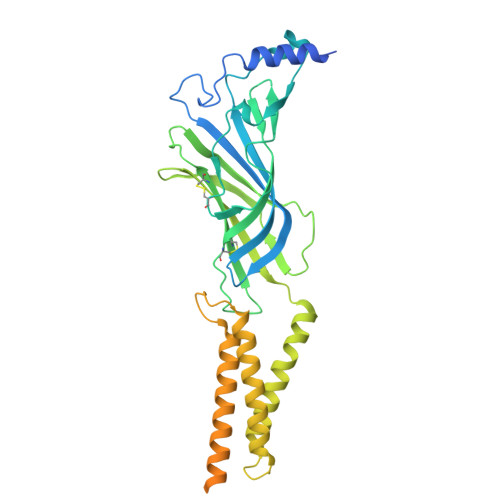
Octopus sensory receptor CRT1 bound to Progesterone


Experimental Data Snapshot

  • Method: ELECTRON MICROSCOPY
  • Resolution: 2.80 Å
  • Aggregation State: PARTICLE 
  • Reconstruction Method: SINGLE PARTICLE 

wwPDB Validation 3D Report Full Report

Validation slider image for 9YI4

This is version 1.2 of the entry. See complete history

Literature

A sensory system for mating in octopus.

Villar, P.S.Jiang, H.Shugaeva, T.Berdan, E.L.Kulkarni, A.Hiroi, M.Masucci, G.Reiter, S.Lindahl, E.Howard, R.J.Hibbs, R.E.Bellono, N.W.

(2026) Science 392: 96-101

  • DOI: https://doi.org/10.1126/science.aec9652
  • Primary Citation Related Structures: 
    9YI4

  • PubMed Abstract: 

    Sensory systems for mate recognition maintain species boundaries and influence diversification. Thus, uncovering how molecules and receptors evolve to mediate this critical function is essential to understanding biodiversity. Male octopuses use a specialized arm called the hectocotylus to identify females and navigate their internal organs to reach the oviduct and deliver sperm. Here, we discovered that the hectocotylus is a dual sensory and mating organ that uses contact-dependent chemosensation of progesterone, a conserved ovarian hormone. We identified chemotactile receptors for progesterone and resolved the structural basis for their evolution from ancestral neurotransmitter receptors and subsequent expansion and tuning across cephalopods. These findings reveal principles by which sensory innovations shape reproductive behavior and suggest mechanisms for how sensory evolution contributes to the diversification of life.


  • Organizational Affiliation
    • Department of Molecular and Cellular Biology, Harvard University, Cambridge, MA, USA.

Macromolecule Content 

  • Total Structure Weight: 243.77 kDa 
  • Atom Count: 12,345 
  • Modeled Residue Count: 1,460 
  • Deposited Residue Count: 2,050 
  • Unique protein chains: 1

Macromolecules

Find similar proteins by:|  3D Structure
Entity ID: 1
MoleculeChains  Sequence LengthOrganismDetailsImage
Chemotactile receptor CRT1
A, B, C, D, E
410Octopus bimaculoidesMutation(s): 0 
Gene Names: OCBIM_22006518mg
UniProt
Find proteins for A0A0L8FVQ9 (Octopus bimaculoides)
Explore A0A0L8FVQ9 
Go to UniProtKB:  A0A0L8FVQ9
Entity Groups
Sequence Clusters30% Identity50% Identity70% Identity90% Identity95% Identity100% Identity
UniProt GroupA0A0L8FVQ9
Glycosylation
Glycosylation Sites: 5
Sequence Annotations
Expand
Reference Sequence

Small Molecules

Ligands 2 Unique
IDChains Name / Formula / InChI Key2D Diagram3D Interactions
STR
(Subject of Investigation/LOI)

Query on STR


Download:Ideal Coordinates CCD File
CA [auth D],
DA [auth E],
K [auth A],
Q [auth B],
W [auth C]
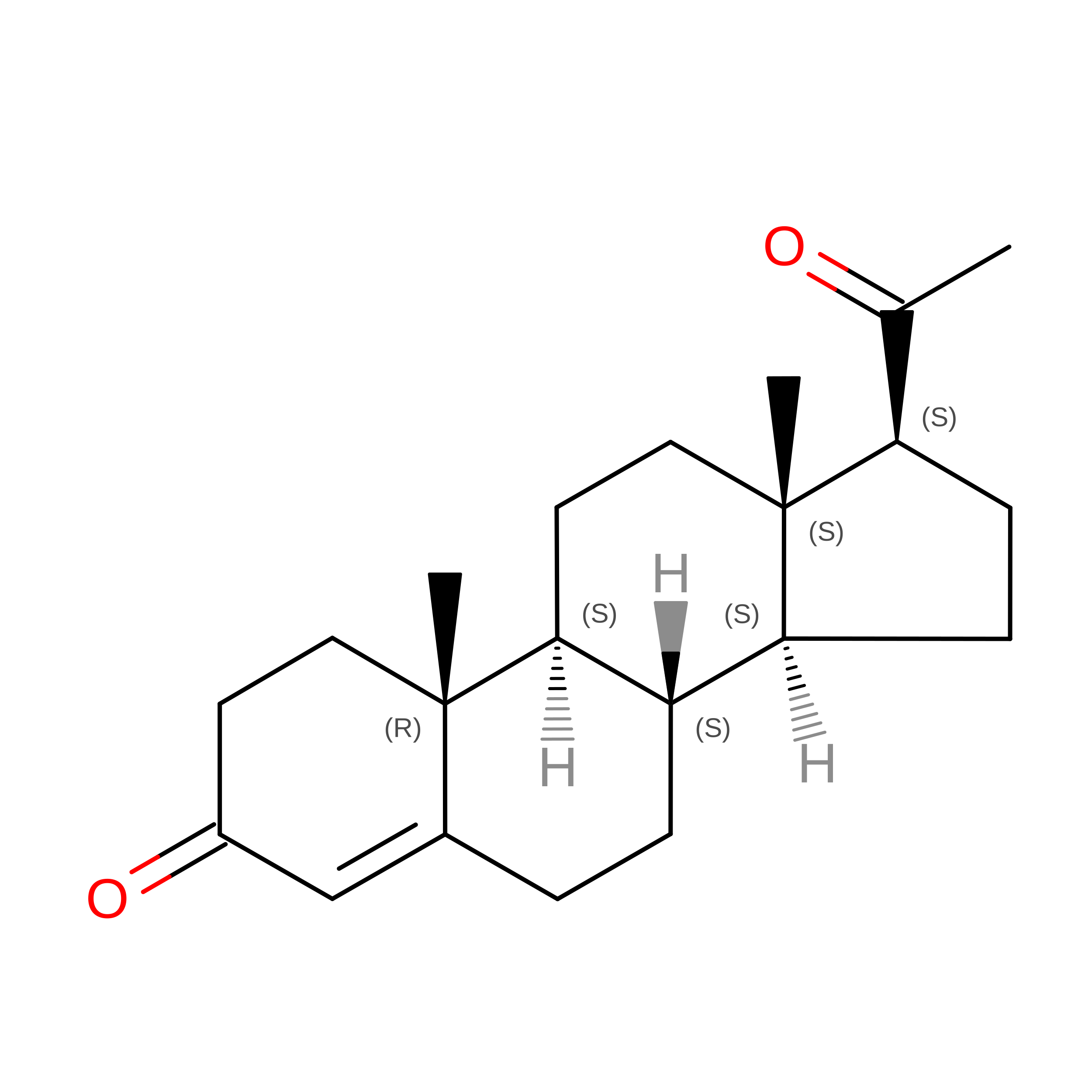
PROGESTERONE
C21 H30 O2
RJKFOVLPORLFTN-LEKSSAKUSA-N
NAG

Query on NAG


Download:Ideal Coordinates CCD File
AA [auth D]
BA [auth D]
EA [auth E]
F [auth A]
FA [auth E]
AA [auth D],
BA [auth D],
EA [auth E],
F [auth A],
FA [auth E],
G [auth A],
GA [auth E],
H [auth A],
HA [auth E],
I [auth A],
IA [auth E],
J [auth A],
L [auth B],
M [auth B],
N [auth B],
O [auth B],
P [auth B],
R [auth C],
S [auth C],
T [auth C],
U [auth C],
V [auth C],
X [auth D],
Y [auth D],
Z [auth D]
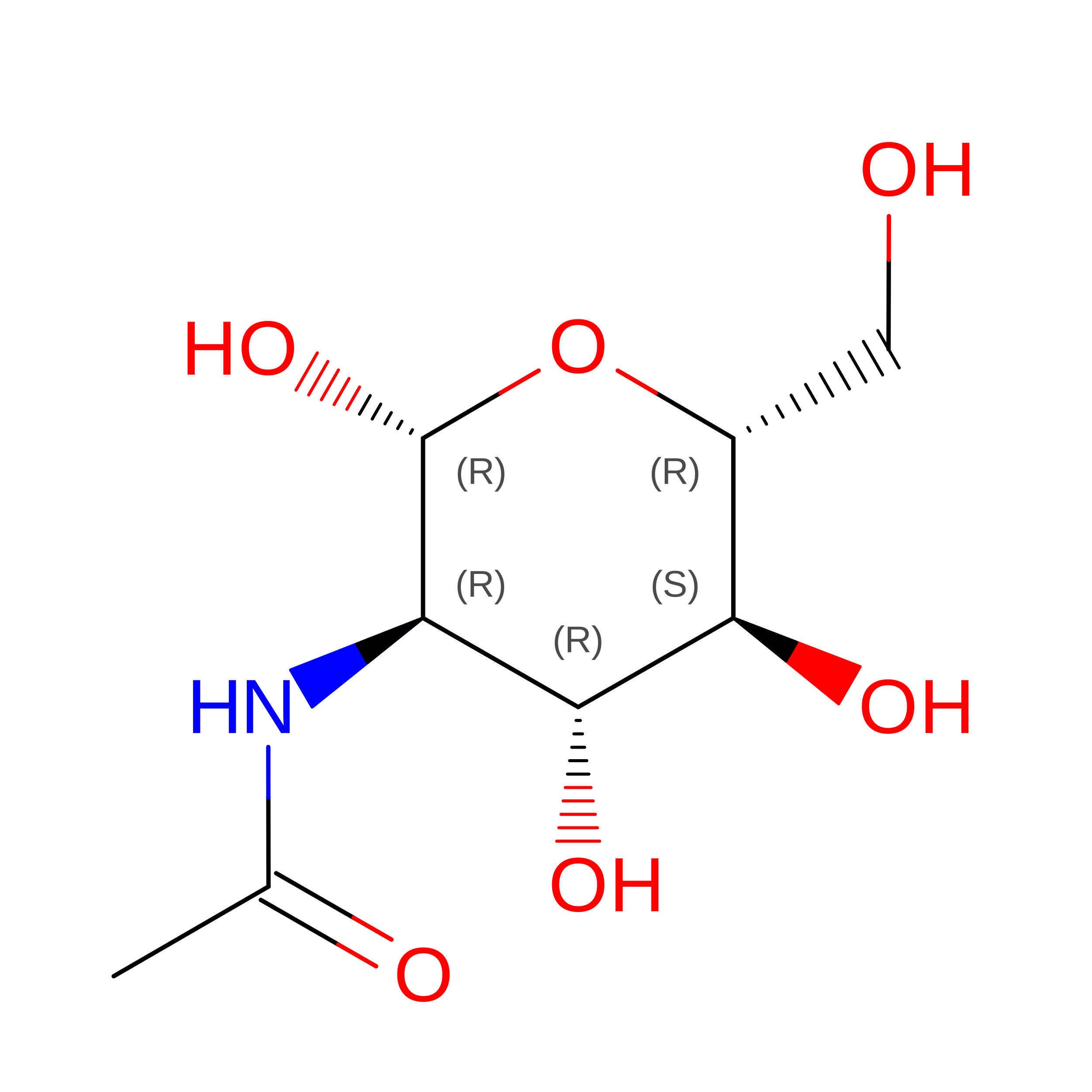
2-acetamido-2-deoxy-beta-D-glucopyranose
C8 H15 N O6
OVRNDRQMDRJTHS-FMDGEEDCSA-N

Experimental Data & Validation

Experimental Data

  • Method: ELECTRON MICROSCOPY
  • Resolution: 2.80 Å
  • Aggregation State: PARTICLE 
  • Reconstruction Method: SINGLE PARTICLE 
EM Software:
TaskSoftware PackageVersion
MODEL REFINEMENTPHENIX1.20.1_4487
RECONSTRUCTIONcryoSPARC

Structure Validation

View Full Validation Report


Entry History 

& Funding Information

Deposition Data


Funding OrganizationLocationGrant Number
National Institutes of Health/National Institute of Neurological Disorders and Stroke (NIH/NINDS)United States--

Revision History  (Full details and data files)

  • Version 1.0: 2026-04-01
    Type: Initial release
  • Version 1.1: 2026-04-08
    Changes: Data collection, Database references
  • Version 1.2: 2026-05-06
    Changes: Data collection, Database references