9YCF | pdb_00009ycf

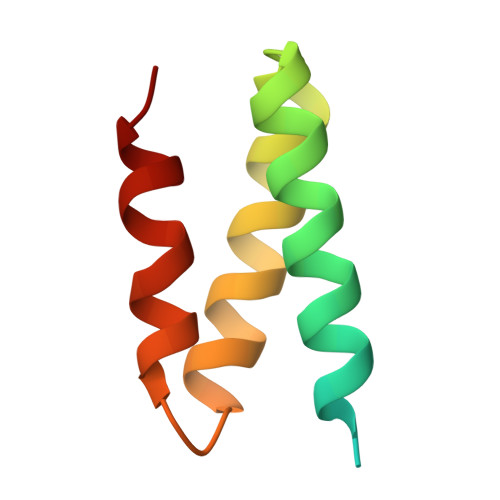
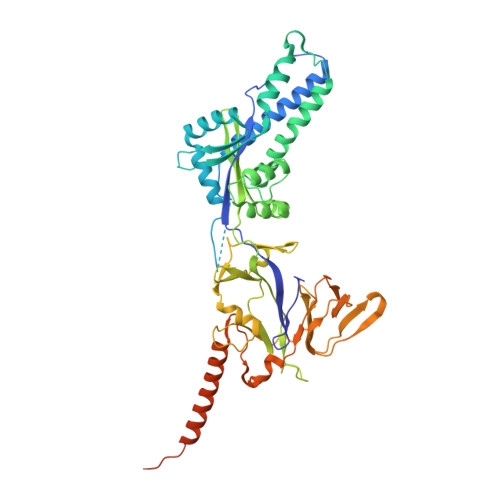
RSV-F SC-DM bound to a designed protein minibinder, cb13


Experimental Data Snapshot

  • Method: ELECTRON MICROSCOPY
  • Resolution: 4.63 Å
  • Aggregation State: PARTICLE 
  • Reconstruction Method: SINGLE PARTICLE 

wwPDB Validation 3D Report Full Report

Validation slider image for 9YCF

This is version 1.1 of the entry. See complete history. 

Literature

Accelerating protein design by scaling experimental characterization.

Qian, J., Milles, L.F., Wicky, B.I.M., Ragotte, R.J., Motmaen, A., Borst, A.J., Skotheim, R., Ols, S., Coventry, B., Li, X., Kibler, R.D., Goreshnik, I., Exposit, M., Lore, K., Stewart, L., Baker, D.

(2026) Nat Commun 17

  • DOI: https://doi.org/10.1038/s41467-026-76740-9
  • Primary Citation Related Structures: 
    9YCF

  • PubMed Abstract: 

    Recent advances in de novo protein design have greatly outpaced standard protein biochemistry workflows, making experimental validation a bottleneck. Here, we describe workflows to address the scale, speed and reproducibility of common in vitro protein testing methods, enabling at least an order of magnitude increase in throughput while reducing wetlab time. Semi-Automated Protein Production (SAPP) is a rapid, modular, scalable and cost-effective protocol, enabling up to milligram-scale protein production and standardized characterization - including yield, dispersity, and oligomeric state - of hundreds of designs per day, at the cost-equivalent of a few DNA oligos per construct. End-to-end protocol execution takes 48 hours, with ~6 hours spent benchside using standard laboratory equipment. We showcase the platform by rapidly screening redesigned fluorescent proteins, as well as identifying de novo binders that potently neutralize respiratory syncytial virus. We also developed a barcoding and demultiplexing protocol (DMX) to further reduce gene synthesis cost 5-fold by leveraging oligo pools as input DNA for the generation of thousands of sequence-verified arrayed clones. These protocols which combine optimized molecular biology, automated analysis, and optional open-source robotics should be widely adoptable, accelerating protein design.


  • Organizational Affiliation: 
    • Department of Biochemistry, University of Washington, Seattle, WA, USA.

Macromolecule Content 

  • Total Structure Weight: 177.4 kDa 
  • Atom Count: 7,045 
  • Modeled Residue Count: 1,423 
  • Deposited Residue Count: 1,600 
  • Unique protein chains: 2

Macromolecules

Find similar proteins by:|  3D Structure
Entity ID: 1
MoleculeChains  Sequence LengthOrganismDetailsImage
cb13A [auth G]73synthetic constructMutation(s): 0 
Entity Groups
Sequence Clusters30% Identity50% Identity70% Identity90% Identity95% Identity100% Identity
Sequence Annotations
Expand
Reference Sequence
Find similar proteins by:|  3D Structure
Entity ID: 2
MoleculeChains  Sequence LengthOrganismDetailsImage
Fusion glycoprotein F0B [auth A],
C [auth B],
D [auth C]
509Homo sapiensMutation(s): 0 
UniProt
Find proteins for P12568 (Human respiratory syncytial virus)
Explore P12568 
Go to UniProtKB:  P12568
Entity Groups
Sequence Clusters30% Identity50% Identity70% Identity90% Identity95% Identity100% Identity
UniProt GroupP12568
Sequence Annotations
Expand
Reference Sequence

Experimental Data & Validation

Experimental Data

  • Method: ELECTRON MICROSCOPY
  • Resolution: 4.63 Å
  • Aggregation State: PARTICLE 
  • Reconstruction Method: SINGLE PARTICLE 
EM Software:
TaskSoftware PackageVersion
MODEL REFINEMENTPHENIX1.21.2_5419
RECONSTRUCTIONcryoSPARC

Structure Validation

View Full Validation Report


Entry History 

& Funding Information

Deposition Data


Funding OrganizationLocationGrant Number
Howard Hughes Medical Institute (HHMI)United States--

Revision History  (Full details and data files)

  • Version 1.0: 2026-07-15
    Type: Initial release
  • Version 1.1: 2026-09-30
    Changes: Data collection, Database references