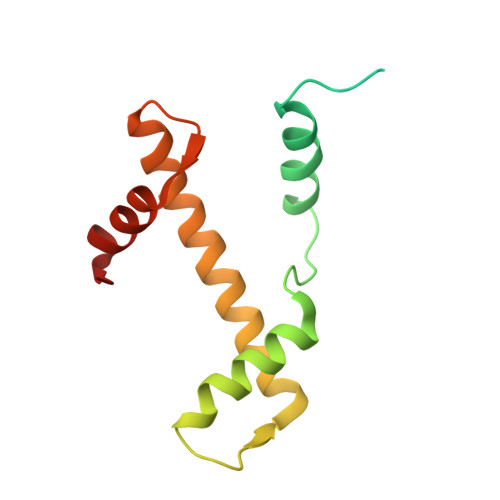
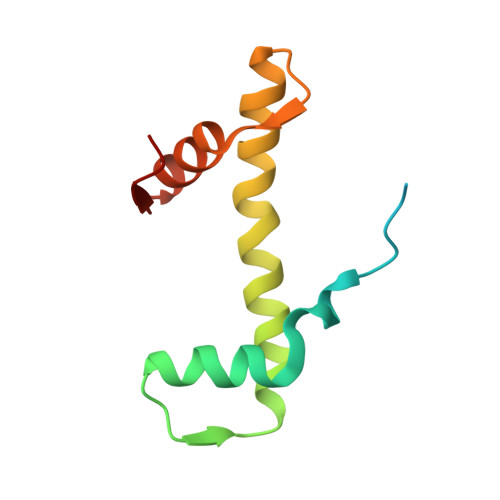
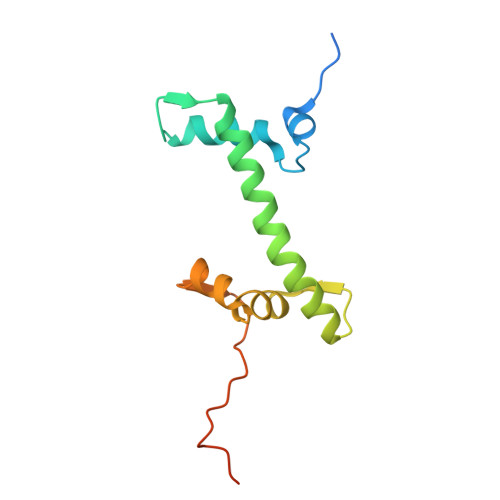
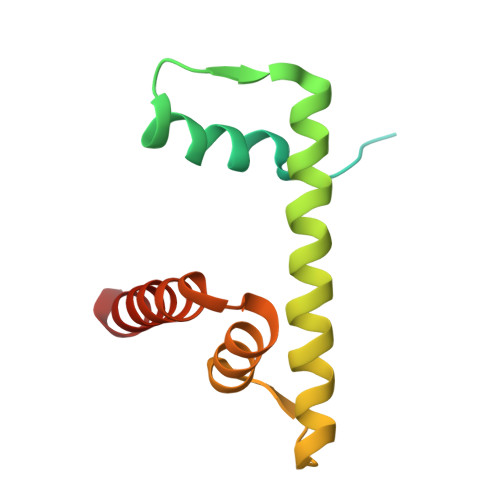
9XYC | pdb_00009xyc

Pol II-DSIF-SPT6-PAF1c-TFIIS-IWS1-ELOF1-LEDGF-nucleosome LEDGF+nucleosome map Q


Experimental Data Snapshot

  • Method: ELECTRON MICROSCOPY
  • Resolution: 3.50 Å
  • Aggregation State: PARTICLE 
  • Reconstruction Method: SINGLE PARTICLE 

Starting Model: experimental
View more details

wwPDB Validation 3D Report Full Report

Validation slider image for 9XYC

This is version 1.1 of the entry. See complete history

Literature

Structure and function of IWS1 in transcription elongation.

Syau, D.Steinruecke, F.Roth, S.Schmid, E.Adelman, K.Walter, J.C.Farnung, L.

(2026) Nucleic Acids Res 54

  • DOI: https://doi.org/10.1093/nar/gkag357
  • Primary Citation Related Structures: 
    9MLC, 9XYC

  • PubMed Abstract: 

    Transcription elongation by RNA polymerase II is a tightly regulated process that requires coordinated interactions between transcription elongation factors. IWS1 (Interacts with SPT6) has been implicated as a core elongation factor, but its molecular role remains unclear. We show that the intrinsically disordered C-terminal region of IWS1 contains short linear motifs (SLiMs) that multivalently engage the elongation machinery. Using cryo-electron microscopy, we map SLiMs in IWS1 that interact with Pol II subunits RPB1, RPB2, and RPB5, as well as elongation factors DSIF, SPT6, and ELOF1. Functional assays demonstrate that distinct IWS1 SLiMs specify IWS1 recruitment and IWS1-dependent transcription stimulation. IWS1 recruitment to the transcription elongation complex depends on association via the RPB1 jaw and binding of downstream DNA. Transcription elongation stimulation requires interactions with the RPB2 lobe and ELOF1. We identify other transcription elongation factors including ELOA and RECQL5 that bind the RPB1 jaw and demonstrate that IWS1 protects the activated transcription elongation complex from RECQL5 inhibition. We also reveal the binding of the histone reader and IWS1 interactor LEDGF to a transcribed downstream nucleosome. Our findings establish IWS1 as a modular scaffold that helps organize the transcription elongation complex, illustrating how disordered regions regulate transcription elongation.


  • Organizational Affiliation
    • Department of Cell Biology, Blavatnik Institute, Harvard Medical School, Boston, MA 02115, United States.

Macromolecule Content 

  • Total Structure Weight: 256.08 kDa 
  • Atom Count: 12,505 
  • Modeled Residue Count: 1,131 
  • Deposited Residue Count: 1,800 
  • Unique protein chains: 5
  • Unique nucleic acid chains: 2

Macromolecules


Find similar proteins by:|  3D Structure
Entity ID: 3
MoleculeChains  Sequence LengthOrganismDetailsImage
Histone H3.2C [auth a],
G [auth e]
136Xenopus laevisMutation(s): 1 
UniProt
Find proteins for P84233 (Xenopus laevis)
Explore P84233 
Go to UniProtKB:  P84233
Entity Groups
Sequence Clusters30% Identity50% Identity70% Identity90% Identity95% Identity100% Identity
UniProt GroupP84233
Sequence Annotations
Expand
Reference Sequence
Find similar proteins by:|  3D Structure
Entity ID: 4
MoleculeChains  Sequence LengthOrganismDetailsImage
Histone H4D [auth b],
H [auth f]
103Xenopus laevisMutation(s): 0 
UniProt
Find proteins for P62799 (Xenopus laevis)
Explore P62799 
Go to UniProtKB:  P62799
Entity Groups
Sequence Clusters30% Identity50% Identity70% Identity90% Identity95% Identity100% Identity
UniProt GroupP62799
Sequence Annotations
Expand
Reference Sequence
Find similar proteins by:|  3D Structure
Entity ID: 5
MoleculeChains  Sequence LengthOrganismDetailsImage
Histone H2A type 1E [auth c],
I [auth g]
130Xenopus laevisMutation(s): 1 
UniProt
Find proteins for P06897 (Xenopus laevis)
Explore P06897 
Go to UniProtKB:  P06897
Entity Groups
Sequence Clusters30% Identity50% Identity70% Identity90% Identity95% Identity100% Identity
UniProt GroupP06897
Sequence Annotations
Expand
Reference Sequence
Find similar proteins by:|  3D Structure
Entity ID: 6
MoleculeChains  Sequence LengthOrganismDetailsImage
Histone H2B 1.1F [auth d],
J [auth h]
126Xenopus laevisMutation(s): 1 
UniProt
Find proteins for P02281 (Xenopus laevis)
Explore P02281 
Go to UniProtKB:  P02281
Entity Groups
Sequence Clusters30% Identity50% Identity70% Identity90% Identity95% Identity100% Identity
UniProt GroupP02281
Sequence Annotations
Expand
Reference Sequence
Find similar proteins by:|  3D Structure
Entity ID: 7
MoleculeChains  Sequence LengthOrganismDetailsImage
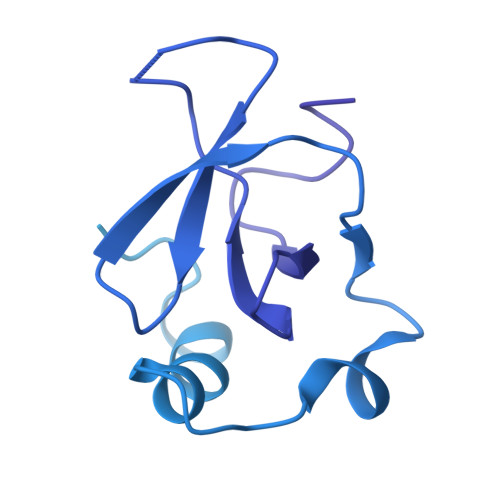
PC4 and SFRS1-interacting proteinK [auth l]532Homo sapiensMutation(s): 0 
Gene Names: PSIP1DFS70LEDGFPSIP2
UniProt & NIH Common Fund Data Resources
Find proteins for O75475 (Homo sapiens)
Explore O75475 
Go to UniProtKB:  O75475
PHAROS:  O75475
GTEx:  ENSG00000164985 
Entity Groups
Sequence Clusters30% Identity50% Identity70% Identity90% Identity95% Identity100% Identity
UniProt GroupO75475
Sequence Annotations
Expand
Reference Sequence
Find similar nucleic acids by:  (by identity cutoff) 
Entity ID: 1
MoleculeChains LengthOrganismImage
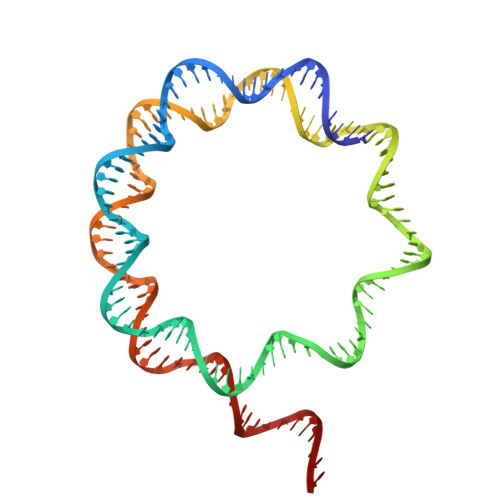
DNA (139-MER)A [auth N]139synthetic construct
Sequence Annotations
Expand
Reference Sequence
Find similar nucleic acids by:  (by identity cutoff) 
Entity ID: 2
MoleculeChains LengthOrganismImage
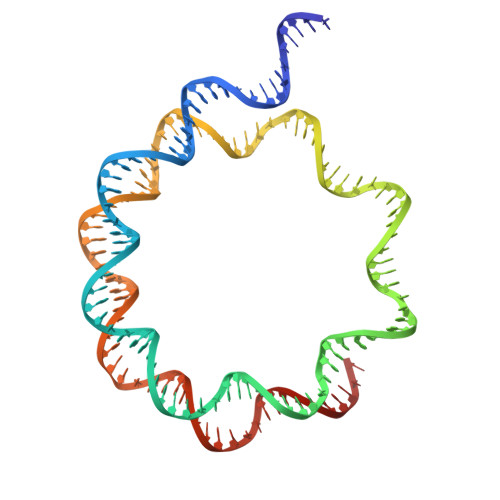
DNA (139-MER)B [auth T]139synthetic construct
Sequence Annotations
Expand
Reference Sequence

Small Molecules

Modified Residues  1 Unique
IDChains TypeFormula2D DiagramParent
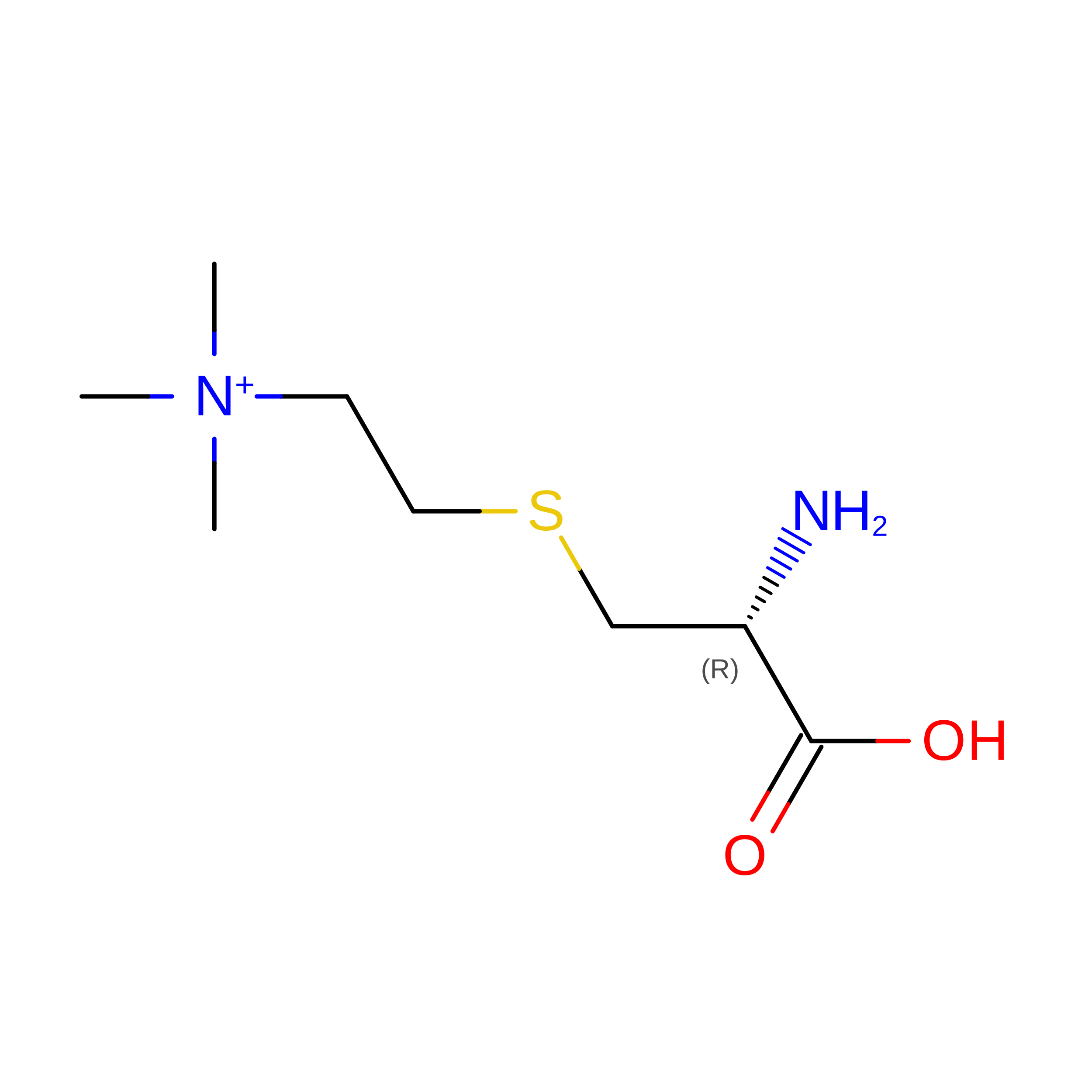
ML3
Query on ML3
C [auth a],
G [auth e]
L-PEPTIDE LINKINGC8 H19 N2 O2 SLYS

Experimental Data & Validation

Experimental Data

  • Method: ELECTRON MICROSCOPY
  • Resolution: 3.50 Å
  • Aggregation State: PARTICLE 
  • Reconstruction Method: SINGLE PARTICLE 
EM Software:
TaskSoftware PackageVersion
RECONSTRUCTIONcryoSPARC4.7.0
MODEL REFINEMENTPHENIX1.20.1-4487

Structure Validation

View Full Validation Report


Entry History 

& Funding Information

Deposition Data


Funding OrganizationLocationGrant Number
Richard and Susan Smith Family FoundationUnited States--
Damon Runyon Cancer Research FoundationUnited States--
National Institutes of Health/National Institute of Environmental Health Sciences (NIH/NIEHS)United StatesDP2-ES036404

Revision History  (Full details and data files)

  • Version 1.0: 2026-03-18
    Type: Initial release
  • Version 1.1: 2026-06-03
    Changes: Data collection, Database references