9XWU | pdb_00009xwu

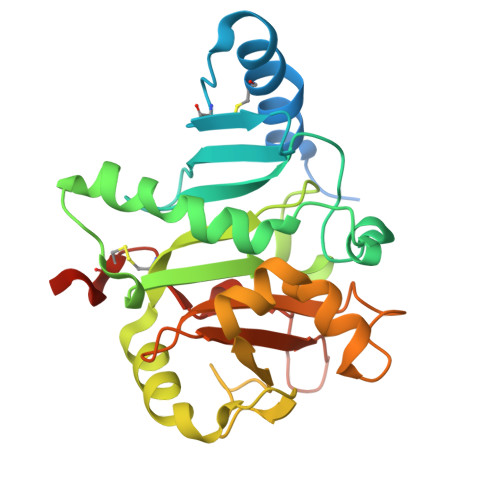
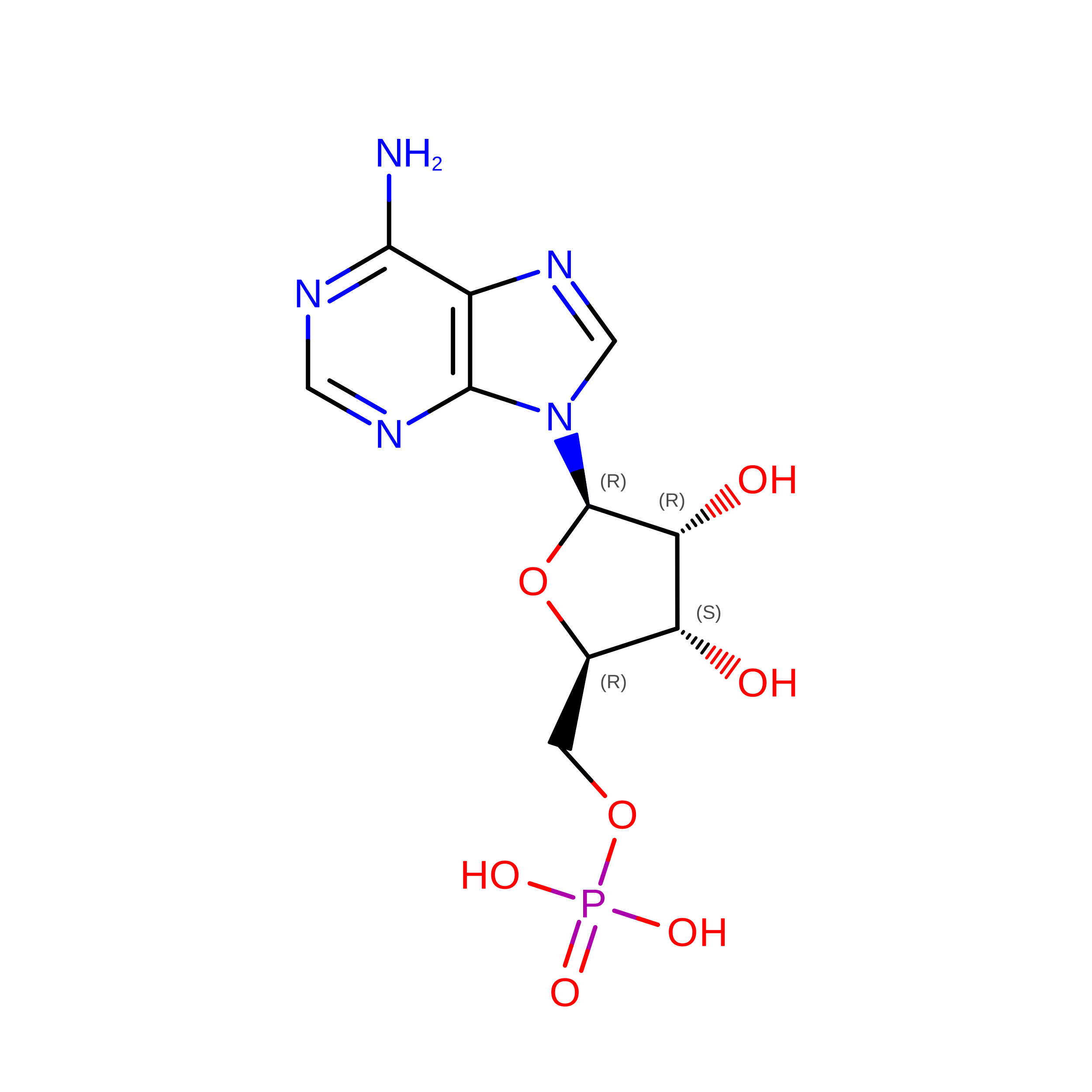
Crystal structure of E.coli CDP-diacylglycerol pyrophosphatase (Cdh) complexed with AMP


Experimental Data Snapshot

  • Method: X-RAY DIFFRACTION
  • Resolution: 2.00 Å
  • R-Value Free: 
    0.253 (Depositor), 0.253 (DCC) 
  • R-Value Work: 
    0.218 (Depositor), 0.218 (DCC) 

Starting Model: in silico
View more details

wwPDB Validation 3D Report Full Report

Validation slider image for 9XWU

Ligand Structure Quality Assessment 


This is version 1.1 of the entry. See complete history

Literature

Structural mechanism of membrane-associated cytidine diphosphate diacylglycerol diphosphatase in Escherichia coli.

Salsabila, S.D.Bae, S.Kim, J.

(2026) Int J Biol Macromol 359: 151839-151839

  • DOI: https://doi.org/10.1016/j.ijbiomac.2026.151839
  • Primary Citation Related Structures: 
    9XWU, 9XWV

  • PubMed Abstract: 

    Cytidine diphosphate diacylglycerol (CDP-DAG) diphosphatase (Cdh) regulates phospholipid biosynthesis by hydrolyzing CDP-DAG into cytidine monophosphate (CMP) and phosphatidic acid (PA), thereby maintaining the steady-state cellular levels of these key metabolic intermediates. Although CDP-DAG serves as a universal branch point in phospholipid metabolism across all three domains of life, Cdh is found predominantly in prokaryotes and, to a lesser extent, in eukaryotes. In Escherichia coli, Cdh is a membrane-associated enzyme belonging to the histidine-triad (HIT)-like hydrolase family and functions independently of metal ions. Here, we report two X-ray crystal structures of E. coli Cdh in complex with a reaction product, CMP, and an inhibitor, AMP, revealing the molecular basis of nucleotide recognition and substrate binding. Integrating structural and biochemical analyses, we identify a pair of conserved histidine residues, His-140 and His-142, as key catalytic determinants. Furthermore, we demonstrate that Cdh adopts a bitopic membrane topology, in which an N-terminal transmembrane helix spans the lipid bilayer and serves as the primary membrane anchor, positioning the catalytic domain at the membrane interface. Together, these findings establish Cdh as a monomeric, membrane-embedded HIT-like hydrolase and provide mechanistic insight into CDP-DAG turnover at the membrane-cytosol interface.


  • Organizational Affiliation
    • Department of Chemistry, Gwangju Institute of Science and Technology, 123 Cheomdan-gwagiro, College B-312, Gwangju, 61005, Republic of Korea.

Macromolecule Content 

  • Total Structure Weight: 59.55 kDa 
  • Atom Count: 3,744 
  • Modeled Residue Count: 446 
  • Deposited Residue Count: 518 
  • Unique protein chains: 1

Macromolecules

Find similar proteins by:|  3D Structure
Entity ID: 1
MoleculeChains  Sequence LengthOrganismDetailsImage
CDP-diacylglycerol pyrophosphatase
A, B
259Escherichia coli K-12Mutation(s): 0 
Gene Names: cdhb3918JW3889
EC: 3.6.1.26
UniProt
Find proteins for P06282 (Escherichia coli (strain K12))
Explore P06282 
Go to UniProtKB:  P06282
Entity Groups
Sequence Clusters30% Identity50% Identity70% Identity90% Identity95% Identity100% Identity
UniProt GroupP06282
Sequence Annotations
Expand
Reference Sequence

Experimental Data & Validation

Experimental Data

  • Method: X-RAY DIFFRACTION
  • Resolution: 2.00 Å
  • R-Value Free:  0.253 (Depositor), 0.253 (DCC) 
  • R-Value Work:  0.218 (Depositor), 0.218 (DCC) 
Space Group: P 1 21 1
Unit Cell:
Length ( Å )Angle ( ˚ )
a = 39.352α = 90
b = 80.047β = 94.608
c = 138.599γ = 90
Software Package:
Software NamePurpose
REFMACrefinement
autoPROCdata processing
MOLREPphasing
Cootmodel building
MxDCdata collection
PDB_EXTRACTdata extraction
STARANISOdata scaling

Structure Validation

View Full Validation Report


Ligand Structure Quality Assessment 


Entry History 

& Funding Information

Deposition Data


Funding OrganizationLocationGrant Number
National Research Foundation (NRF, Korea)Korea, Republic Of--

Revision History  (Full details and data files)

  • Version 1.0: 2026-04-15
    Type: Initial release
  • Version 1.1: 2026-04-22
    Changes: Database references