9WV1 | pdb_00009wv1

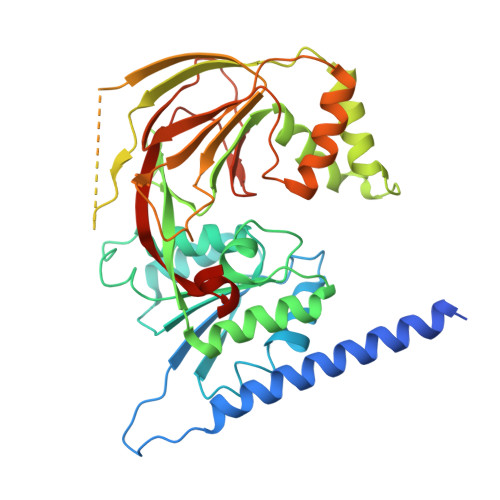
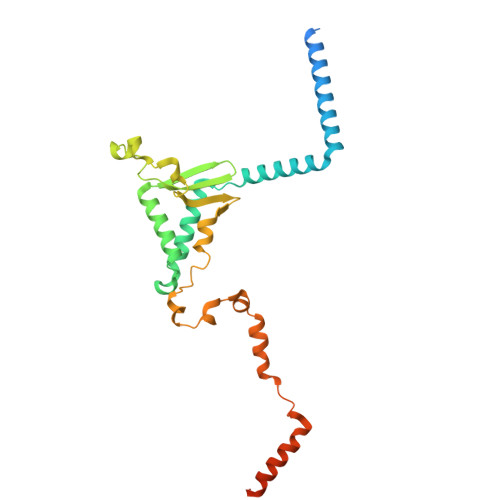
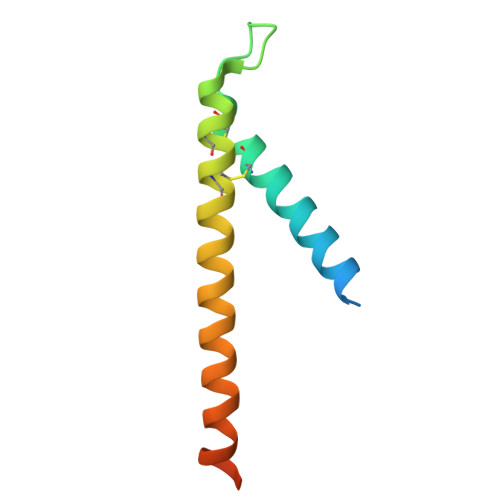
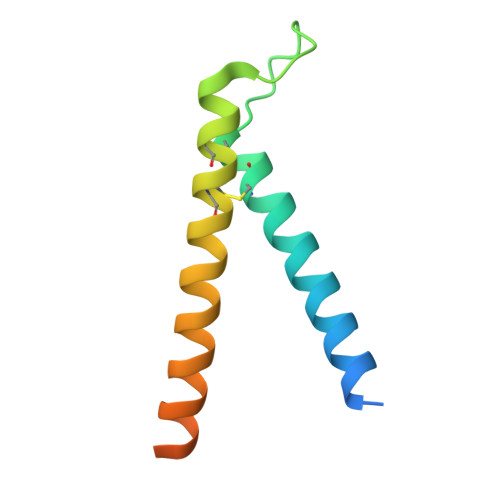
Human TIM22 complex wtih substrate GGC1-sfGFP


Experimental Data Snapshot

  • Method: ELECTRON MICROSCOPY
  • Resolution: 3.10 Å
  • Aggregation State: PARTICLE 
  • Reconstruction Method: SINGLE PARTICLE 

Starting Model: in silico
View more details

wwPDB Validation 3D Report Full Report

Validation slider image for 9WV1

This is version 1.0 of the entry. See complete history

Literature

Direct coupling of human TOM and TIM22 complexes drives mitochondrial carrier import.

Liu, X.Cai, H.Wang, H.Zhou, X.Zhang, Y.Liu, S.Zhu, J.Li, L.

(2026) Nat Struct Mol Biol 

  • DOI: https://doi.org/10.1038/s41594-026-01849-w
  • Primary Citation Related Structures: 
    9WV1, 9WV2, 9WV3

  • PubMed Abstract: 

    Metabolite carriers that control essential metabolite transport are imported into mitochondria through the TOM and TIM22 complexes. How TOM and TIM22 coordinate in human mitochondria has remained largely unknown. Here we show that human TOM and TIM22 assemble into a supercomplex that seamlessly couples carrier translocation across the outer and inner membranes, unlike in yeast where the two complexes appear to function separately. Cryo-electron microscopy structures of the human TOM-TIM22 supercomplex reveal unpaired carrier transmembrane segments traversing the TOM channel along a hydrophobic path and exiting through an unexpected lateral groove outside the channel. The membrane-bound small Tim subunits provide the substrate entry site for TIM22, while a membrane-exposed groove of TIM22 serves as the exit for carrier insertion into the inner membrane. These findings provide insights into the human carrier translocation pathway at molecular resolution and establish the TOM-TIM22 supercomplex as a central organizing unit of mitochondrial carrier import.


  • Organizational Affiliation
    • State Key Laboratory of Membrane Biology, School of Life Sciences, Peking University, Beijing, China.

Macromolecule Content 

  • Total Structure Weight: 227.2 kDa 
  • Atom Count: 12,667 
  • Modeled Residue Count: 1,571 
  • Deposited Residue Count: 1,987 
  • Unique protein chains: 6

Macromolecules

Find similar proteins by:|  3D Structure
Entity ID: 1
MoleculeChains  Sequence LengthOrganismDetailsImage
Mitochondrial import inner membrane translocase subunit Tim22217Homo sapiensMutation(s): 0 
Gene Names: TIMM22TEX4TIM22
UniProt & NIH Common Fund Data Resources
Find proteins for Q9Y584 (Homo sapiens)
Explore Q9Y584 
Go to UniProtKB:  Q9Y584
PHAROS:  Q9Y584
GTEx:  ENSG00000177370 
Entity Groups
Sequence Clusters30% Identity50% Identity70% Identity90% Identity95% Identity100% Identity
UniProt GroupQ9Y584
Sequence Annotations
Expand
Reference Sequence
Find similar proteins by:|  3D Structure
Entity ID: 2
MoleculeChains  Sequence LengthOrganismDetailsImage
Acylglycerol kinase, mitochondrial422Homo sapiensMutation(s): 0 
Gene Names: AGKMULK
EC: 2.7.1.107 (PDB Primary Data), 2.7.1.138 (PDB Primary Data), 2.7.1.94 (PDB Primary Data)
UniProt & NIH Common Fund Data Resources
Find proteins for Q53H12 (Homo sapiens)
Explore Q53H12 
Go to UniProtKB:  Q53H12
PHAROS:  Q53H12
GTEx:  ENSG00000006530 
Entity Groups
Sequence Clusters30% Identity50% Identity70% Identity90% Identity95% Identity100% Identity
UniProt GroupQ53H12
Sequence Annotations
Expand
Reference Sequence
Find similar proteins by:|  3D Structure
Entity ID: 3
MoleculeChains  Sequence LengthOrganismDetailsImage
Mitochondrial import inner membrane translocase subunit Tim29260Homo sapiensMutation(s): 0 
Gene Names: TIMM29c19orf52
UniProt & NIH Common Fund Data Resources
Find proteins for Q9BSF4 (Homo sapiens)
Explore Q9BSF4 
Go to UniProtKB:  Q9BSF4
PHAROS:  Q9BSF4
GTEx:  ENSG00000142444 
Entity Groups
Sequence Clusters30% Identity50% Identity70% Identity90% Identity95% Identity100% Identity
UniProt GroupQ9BSF4
Sequence Annotations
Expand
Reference Sequence
Find similar proteins by:|  3D Structure
Entity ID: 4
MoleculeChains  Sequence LengthOrganismDetailsImage
Mitochondrial import inner membrane translocase subunit Tim9
D, E, F, K, L
89Homo sapiensMutation(s): 0 
Gene Names: TIMM9TIM9TIM9ATIMM9A
UniProt & NIH Common Fund Data Resources
Find proteins for Q9Y5J7 (Homo sapiens)
Explore Q9Y5J7 
Go to UniProtKB:  Q9Y5J7
PHAROS:  Q9Y5J7
GTEx:  ENSG00000100575 
Entity Groups
Sequence Clusters30% Identity50% Identity70% Identity90% Identity95% Identity100% Identity
UniProt GroupQ9Y5J7
Sequence Annotations
Expand
Reference Sequence
Find similar proteins by:|  3D Structure
Entity ID: 5
MoleculeChains  Sequence LengthOrganismDetailsImage
Mitochondrial import inner membrane translocase subunit Tim10
G, H, I, M, N
G, H, I, M, N, O
90Homo sapiensMutation(s): 0 
Gene Names: TIMM10TIM10
UniProt & NIH Common Fund Data Resources
Find proteins for P62072 (Homo sapiens)
Explore P62072 
Go to UniProtKB:  P62072
PHAROS:  P62072
GTEx:  ENSG00000134809 
Entity Groups
Sequence Clusters30% Identity50% Identity70% Identity90% Identity95% Identity100% Identity
UniProt GroupP62072
Sequence Annotations
Expand
Reference Sequence
Find similar proteins by:|  3D Structure
Entity ID: 6
MoleculeChains  Sequence LengthOrganismDetailsImage
Mitochondrial import inner membrane translocase subunit Tim10 B103Homo sapiensMutation(s): 0 
Gene Names: TIMM10BFXC1TIM9BTIMM9B
UniProt & NIH Common Fund Data Resources
Find proteins for Q9Y5J6 (Homo sapiens)
Explore Q9Y5J6 
Go to UniProtKB:  Q9Y5J6
PHAROS:  Q9Y5J6
GTEx:  ENSG00000132286 
Entity Groups
Sequence Clusters30% Identity50% Identity70% Identity90% Identity95% Identity100% Identity
UniProt GroupQ9Y5J6
Sequence Annotations
Expand
Reference Sequence

Experimental Data & Validation

Experimental Data

  • Method: ELECTRON MICROSCOPY
  • Resolution: 3.10 Å
  • Aggregation State: PARTICLE 
  • Reconstruction Method: SINGLE PARTICLE 
EM Software:
TaskSoftware PackageVersion
RECONSTRUCTIONcryoSPARC4.6
MODEL REFINEMENTPHENIX1.20.1-4487

Structure Validation

View Full Validation Report


Entry History 

& Funding Information

Deposition Data


Funding OrganizationLocationGrant Number
National Natural Science Foundation of China (NSFC)China32271269

Revision History  (Full details and data files)

  • Version 1.0: 2026-08-05
    Type: Initial release