Download Mendeley
2'3'-cGAMP-induced membrane shearing promotes broad antiphage immunity.
Gao, Y., Li, Z., Zhou, Y., Li, W., Li, Q., Wang, J., Shi, M., Ye, F., Zhao, C., Liu, S., Jiang, Q., Zhu, Y., Sun, F., Gao, A., Gao, P.(2026) Cell 189: 3636-3650.e19
- PubMed: 41999741 Search on PubMed
- DOI: https://doi.org/10.1016/j.cell.2026.03.043
- Primary Citation Related Structures:
9WQ2, 9WQ3 - PubMed Abstract:
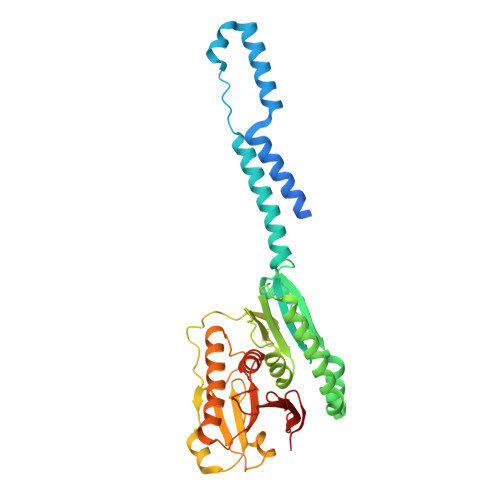
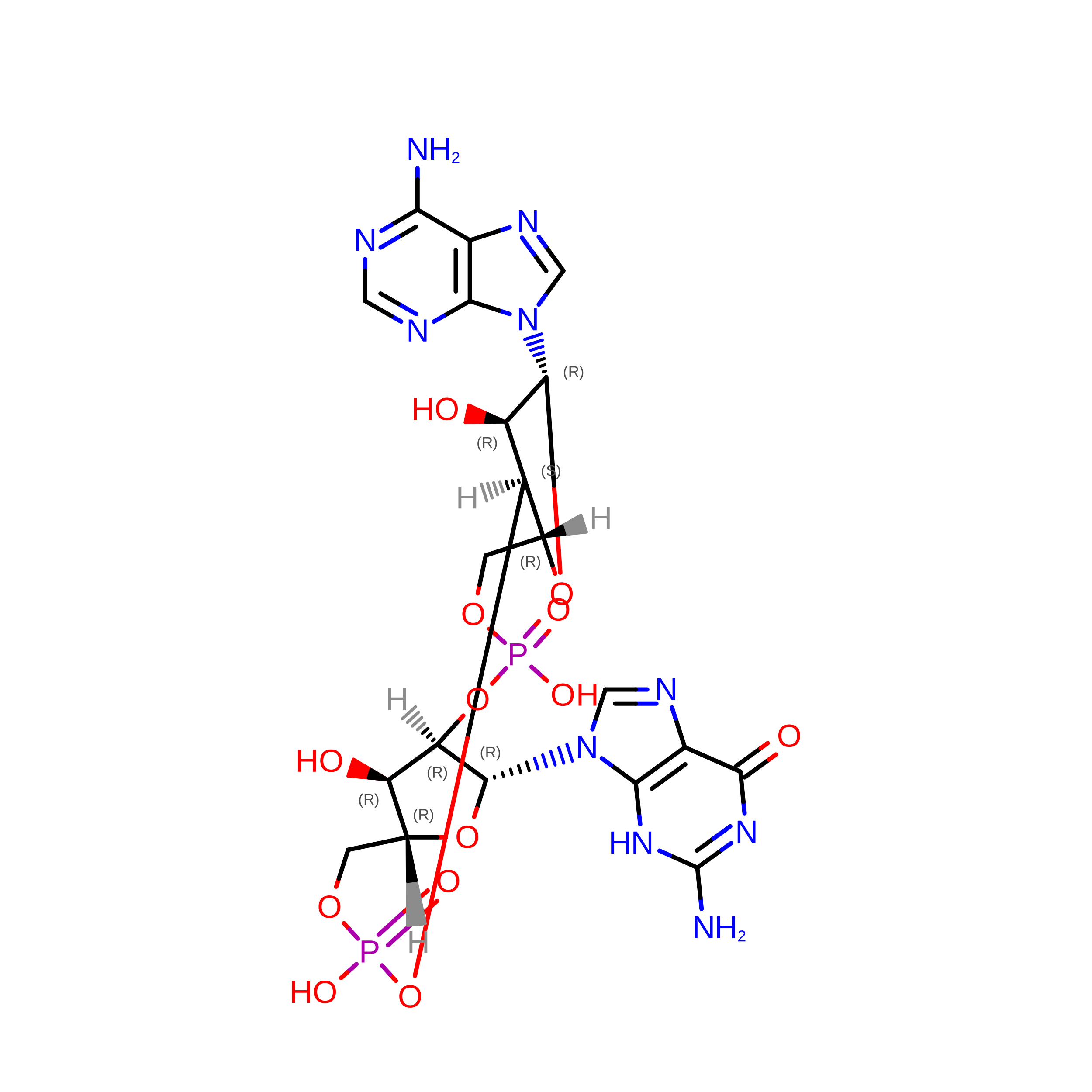
Cyclic-oligonucleotide-based anti-phage signaling system (CBASS), a central prokaryotic antiviral strategy and evolutionary ancestor of the mammalian cyclic GMP-AMP synthase (cGAS)-stimulator of interferon genes (STING) pathway, relies on cyclic-nucleotide-activated effectors to elicit immunity. The most prevalent effectors are transmembrane (TM) proteins, yet their mechanisms remain unknown. Here, we show how a representative three transmembrane (3TM)-SMODS-associated fused to various effector domains (SAVED) effector couples ligand sensing to membrane disruption. Upon binding 2'3'-cyclic GMP-AMP (cGAMP)-synthesized by bacterial cGAS/DncV-like nucleotidyltransferase (CD-NTase) with features resembling mammalian cGAS-3TM-SAVED assembles stepwise from an apo monomer through a transient dimer into extended filaments. Filament assembly employs 2'3'-cGAMP as molecular glue linking SAVED domains and reorients TM helices and amphipathic hairpins into vertically offset arrays. Both arrays bear opposing hydrophobic and hydrophilic faces, thereby driving vertical lipid shearing. This shearing generates a linear pore array that permeabilizes membranes and triggers cell death. These findings uncover the long-missing mechanism of CBASS TM effectors and establish vertical membrane shearing as an unrecognized principle of membrane disruption across domains of life.
- State Key Laboratory of Biomacromolecules, Institute of Biophysics, Chinese Academy of Sciences, Beijing 100101, China.
Organizational Affiliation: