Download Mendeley
Targeting Helicobacter pylori thymidylate kinase: structural insights and validation of novel inhibitors.
Kumari, K., Khan, F.M., Bose, M., Ls, R.J., Yadav, A., Mondal, N., Gourinath, S.(2026) J Struct Biol 218: 108319-108319
- PubMed: 41935652 Search on PubMed
- DOI: https://doi.org/10.1016/j.jsb.2026.108319
- Primary Citation Related Structures:
9WD2 - PubMed Abstract:
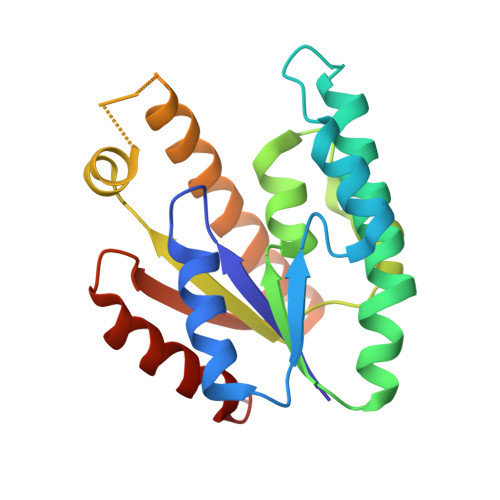
Thymidine (deoxythymidine triphosphate) plays very important role in DNA synthesis, replication and repair. Therefore, thymidine synthesis pathway enzymes are crucial for the survival of the organism and hence are potent therapeutic targets. Thymidylate kinase (TMPK) is at the junction of de novo synthesis pathway and salvage pathway of thymidine synthesis. TMPK is widely recognized as a potential therapeutic target. Inhibiting TMPKs would be an effective technique for discovering medications to treat infectious disorders like bacterial and parasite infections. The slight variation in active sites between human TMPK (hTMPK) and pathogen TMPKs provide support for the development of specific inhibitors. Here, we report the crystal structure of thymidylate kinase from Helicobacter pylori (HpTMPK) at 2.5 Å. The three-dimensional structure of HpTMPK depicts two conserved regions DRX motif and P loop. The highly flexible LID region was absent in HpTMPK crystal structure. Chemdiv library was screened against HpTMPK and the compounds were shortlisted based on the docking scores. Our in-vitro enzyme inhibition study shows that compound F725_0025 exhibits the best inhibition with an IC 50 of 84 µM and a strong affinity of 10.7 µM. It inhibits Helicobacter pylori (H. pylori) with an IC 50 value of 30.14 µM. According to the growth curve of H. Pylori in the presence of inhibitory chemicals, F725_0025 may be a promising lead therapeutic molecule to combat H. pylori infection.
- Structural Biology Laboratory, School of Life Sciences, Jawaharlal Nehru University, New Delhi 110067, India.
Organizational Affiliation: