9UMS | pdb_00009ums

Cryo-EM structure of bacteriophage P1 connector


Experimental Data Snapshot

  • Method: ELECTRON MICROSCOPY
  • Resolution: 3.50 Å
  • Aggregation State: PARTICLE 
  • Reconstruction Method: SINGLE PARTICLE 

wwPDB Validation 3D Report Full Report

Validation slider image for 9UMS

This is version 1.1 of the entry. See complete history

Literature

Structure of defense against restriction proteins DarA and Hdf in phage P1 reveals a new molecular mechanism during phage assembly, infection and DNA ejection.

Zheng, J.Chen, Y.Chen, S.Zhou, J.Xiao, H.Yang, F.Liu, H.

(2026) PLoS Pathog 22: e1013869-e1013869

  • DOI: https://doi.org/10.1371/journal.ppat.1013869
  • Primary Citation Related Structures: 
    9UKM, 9UMS, 9VL4, 9VYI, 9VZ0, 9VZK

  • PubMed Abstract: 

    The continuous "arms race" between bacterial antiviral defense systems and phage anti-defense strategies drives evolutionary innovation. Previous study indicated that the defense against restriction (Dar) proteins DarA and Hdf in myophage P1 are associated with the head morphogenesis. However, the structural information for these proteins was lacking, and the mechanisms by which they mediate head morphogenesis and protect phage DNA against bacterial defense systems remained poorly understood. Using cryo-electron microscopy (cryo-EM), we resolved the entire structures of extended P1 and contracted P1 with partial DNA, with the latter lacking the baseplate, as well as the head structure of contracted P1 without DNA. We identified the structural proteins for the P1, including the head, connector complex, and baseplate, which exhibited conserved properties among the majority of myophages with a simple baseplate. Notably, 55 DarA-Hdf pairs are attached to the inner surface of head at each penton-hexon junction in the extended P1 and contracted P1 with partial DNA. The DarA and Hdf together form a complex that is tightly bound to the capsid and interacts with the DNA. However, these pairs are absent in the contracted P1 without DNA. Based on our three states of P1, we hypothesis that these extensive interactions among DarA, Hdf, DNA, and head play crucial roles in mediating capsid assembly, enhancing capsid stability, and protecting phage DNA. Our results provide a structural basis for further exploration of the mechanism by which Dar proteins function during phage assembly, infection and DNA ejection. This molecular mechanism may be conserved among P1-like phages.


  • Organizational Affiliation
    • Institute of Interdisciplinary Studies, Key Laboratory for Matter Microstructure and Function of Hunan Province, Key Laboratory of Low-dimensional Quantum Structures and Quantum Control, School of Physics and Electronics, Hunan Normal University, Changsha, China.

Macromolecule Content 

  • Total Structure Weight: 194.88 kDa 
  • Atom Count: 11,411 
  • Modeled Residue Count: 1,448 
  • Deposited Residue Count: 1,756 
  • Unique protein chains: 3

Macromolecules

Find similar proteins by:|  3D Structure
Entity ID: 1
MoleculeChains  Sequence LengthOrganismDetailsImage
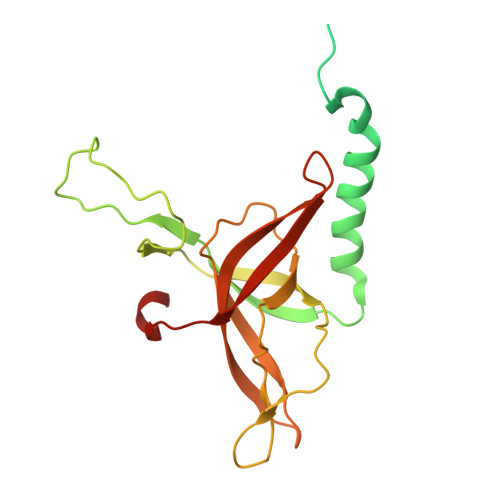
Gp7A [auth B]242Escherichia phage P1Mutation(s): 0 
UniProt
Find proteins for Q71T89 (Escherichia phage P1)
Explore Q71T89 
Go to UniProtKB:  Q71T89
Entity Groups
Sequence Clusters30% Identity50% Identity70% Identity90% Identity95% Identity100% Identity
UniProt GroupQ71T89
Sequence Annotations
Expand
Reference Sequence
Find similar proteins by:|  3D Structure
Entity ID: 2
MoleculeChains  Sequence LengthOrganismDetailsImage
PrtB [auth C],
E [auth D]
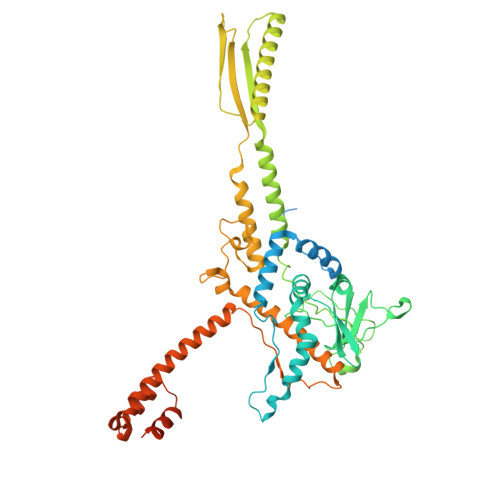
569Escherichia phage P1Mutation(s): 0 
UniProt
Find proteins for Q71TR7 (Escherichia phage P1)
Explore Q71TR7 
Go to UniProtKB:  Q71TR7
Entity Groups
Sequence Clusters30% Identity50% Identity70% Identity90% Identity95% Identity100% Identity
UniProt GroupQ71TR7
Sequence Annotations
Expand
Reference Sequence
Find similar proteins by:|  3D Structure
Entity ID: 3
MoleculeChains  Sequence LengthOrganismDetailsImage
PmgCC [auth A],
D [auth E]
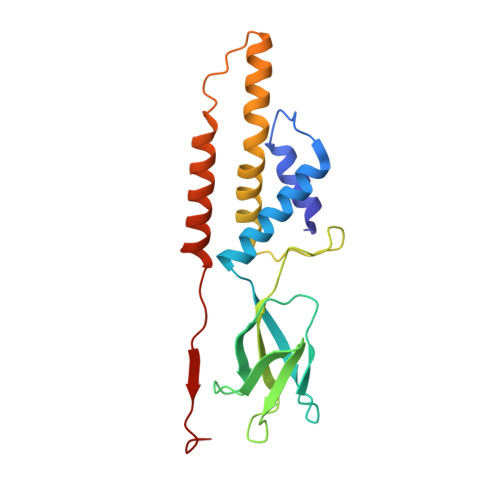
188Escherichia phage P1Mutation(s): 0 
UniProt
Find proteins for Q71TN7 (Escherichia phage P1)
Explore Q71TN7 
Go to UniProtKB:  Q71TN7
Entity Groups
Sequence Clusters30% Identity50% Identity70% Identity90% Identity95% Identity100% Identity
UniProt GroupQ71TN7
Sequence Annotations
Expand
Reference Sequence

Experimental Data & Validation

Experimental Data

  • Method: ELECTRON MICROSCOPY
  • Resolution: 3.50 Å
  • Aggregation State: PARTICLE 
  • Reconstruction Method: SINGLE PARTICLE 
EM Software:
TaskSoftware PackageVersion
MODEL REFINEMENTPHENIX1.20.1_4487

Structure Validation

View Full Validation Report


Entry History 

& Funding Information

Deposition Data


Funding OrganizationLocationGrant Number
National Natural Science Foundation of China (NSFC)China12034006
National Natural Science Foundation of China (NSFC)China32430020
National Natural Science Foundation of China (NSFC)China32071209

Revision History  (Full details and data files)

  • Version 1.0: 2025-10-22
    Type: Initial release
  • Version 1.1: 2026-02-04
    Changes: Data collection, Database references