Download Mendeley
Mechanistic insights into modulation of productive substrate accessibility for efficient PET depolymerization.
Ki, D., Park, J., Hong, H., Seo, H., Kim, B., Hwang, H., Kim, K.J.(2026) Nat Commun 17
- PubMed: 42350423 Search on PubMedSearch on PubMed Central
- DOI: https://doi.org/10.1038/s41467-026-74839-7
- Primary Citation Related Structures:
9UM3, 9UM4, 9UM5, 9UM6, 9UM7, 9UM8 - PubMed Abstract:
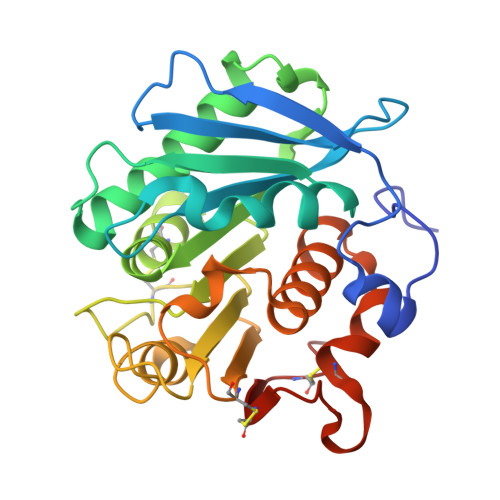
Polyethylene terephthalate (PET) hydrolases have been extensively studied for their potential applications in plastic degradation. However, the structural and mechanistic factors that limit their catalytic efficiency are not yet fully understood. Here, we identify the protruding, surface-exposed C-terminal loop (SEC-loop) in Cryptosporangium aurantiacum PETase (CaPETase) that negatively impacts enzymatic activity by restricting productive access of enzyme to PET. Loop replacement experiments show the non-protruding SEC-loop enhances PET depolymerization rates, despite being ~25 Å from the active site. Kinetic and adsorption studies indicate the non-protruding SEC-loop promotes productive PET access to the enzyme without affecting binding affinity. To further assess the broader applicability of this strategy across diverse PETases, SEC-loop replaced variants of representative PETases are characterized through kinetic and adsorption analyses. We show an engineering strategy focused on modulating enzyme accessibility rather than simply modifying the catalytic site, in rational enzyme design aimed at improving PET degradation efficiency.
- School of Life Sciences, BK21 FOUR KNU Creative BioResearch Group, Kyungpook National University, Daegu, Republic of Korea.
Organizational Affiliation: