9TZD | pdb_00009tzd

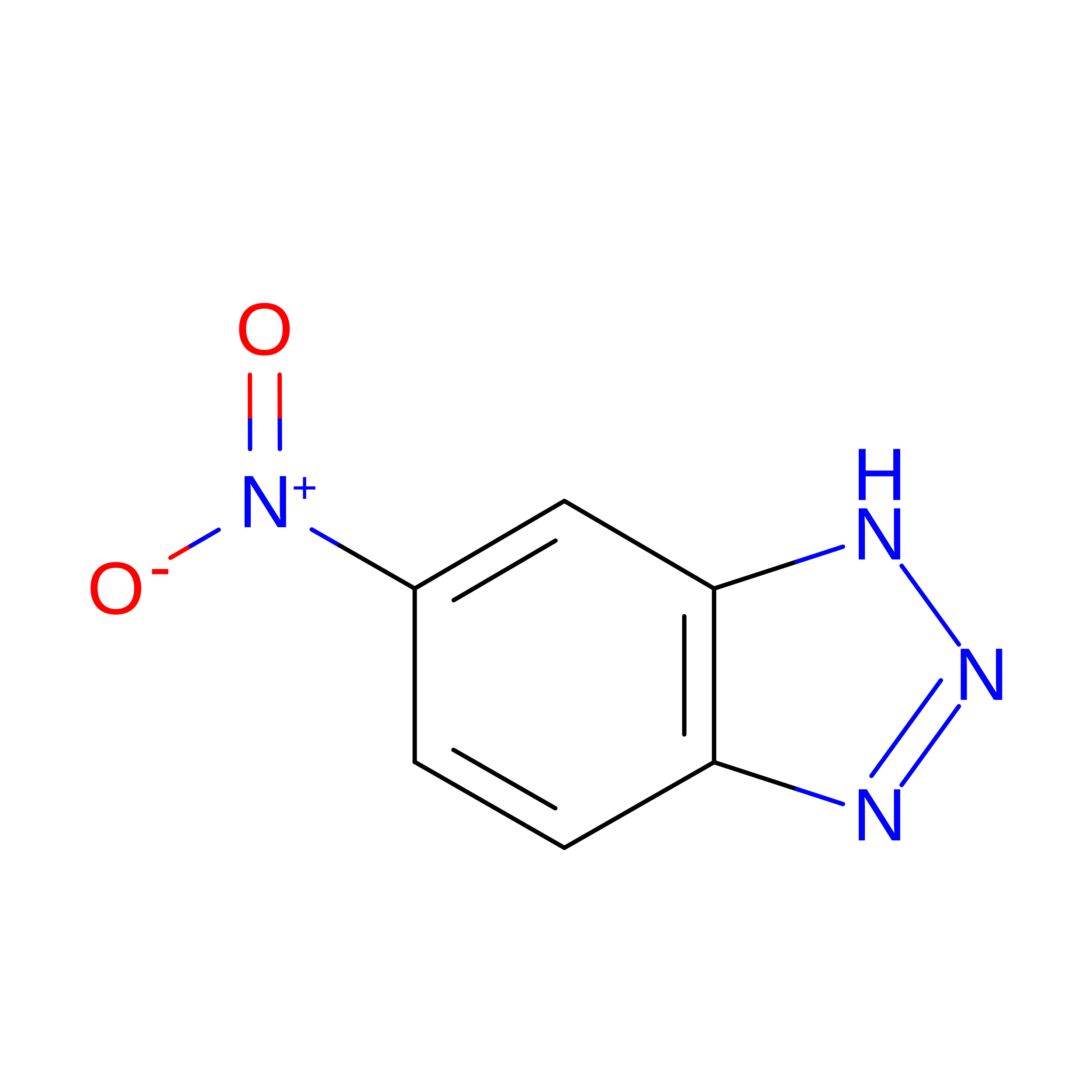
De novo TIM barrel with Kemp eliminase activity - KempTIM1 with bound transition state analogue


Experimental Data Snapshot

  • Method: X-RAY DIFFRACTION
  • Resolution: 1.20 Å
  • R-Value Free: 
    0.176 (Depositor), 0.177 (DCC) 
  • R-Value Work: 
    0.154 (Depositor), 0.156 (DCC) 
  • R-Value Observed: 
    0.155 (Depositor) 

Starting Model: in silico
View more details

wwPDB Validation 3D Report Full Report

Validation slider image for 9TZD

Ligand Structure Quality Assessment 


This is version 1.1 of the entry. See complete history

Literature

Customizing the structure of minimal TIM barrels to craft efficient de novo enzymes.

Beck, J.Smith, B.J.Kriegel, M.Zarifi, N.Freund, E.Harsha, A.G.Hartmann, J.Chica, R.A.Hocker, B.

(2026) Nat Chem Biol 

  • DOI: https://doi.org/10.1038/s41589-026-02250-w
  • Primary Citation Related Structures: 
    9QKX, 9TZD, 9U01

  • PubMed Abstract: 

    The TIM barrel is the most prevalent fold in natural enzymes, supporting efficient catalysis of diverse reactions. While de novo TIM barrels have been designed, their minimalistic architecture lacks structural elements essential for substrate binding and catalysis. Here, we present CANVAS, a computational workflow that introduces a structural lid into a minimal de novo TIM barrel to anchor catalytic residues and form an active site. Starting from two scaffolds, we designed nine variants with tailored lids for the Kemp elimination. Four showed measurable activity, with the most active reaching a catalytic efficiency of 21,000 M -1  s -1 . A cocrystal structure with a transition-state analog confirmed the accuracy of the designed lid and active site. Using the structure of a lower-activity variant, we applied ensemble-based design, increasing catalytic efficiency >1,600-fold to 32,000 M -1  s -1 . These results demonstrate that de novo TIM barrels can be endowed with efficient catalytic function, establishing a platform for building enzymes from minimal protein scaffolds.


  • Organizational Affiliation
    • Department of Biochemistry, University of Bayreuth, Bayreuth, Germany.

Macromolecule Content 

  • Total Structure Weight: 24.19 kDa 
  • Atom Count: 1,979 
  • Modeled Residue Count: 220 
  • Deposited Residue Count: 223 
  • Unique protein chains: 1

Macromolecules

Find similar proteins by:|  3D Structure
Entity ID: 1
MoleculeChains  Sequence LengthOrganismDetailsImage
KempTIM1223synthetic constructMutation(s): 0 

Experimental Data & Validation

Experimental Data

  • Method: X-RAY DIFFRACTION
  • Resolution: 1.20 Å
  • R-Value Free:  0.176 (Depositor), 0.177 (DCC) 
  • R-Value Work:  0.154 (Depositor), 0.156 (DCC) 
  • R-Value Observed: 0.155 (Depositor) 
Space Group: P 21 21 21
Unit Cell:
Length ( Å )Angle ( ˚ )
a = 41.22α = 90
b = 67.27β = 90
c = 70.92γ = 90
Software Package:
Software NamePurpose
PHENIXrefinement
XDSdata reduction
XDSdata scaling
PHASERphasing

Structure Validation

View Full Validation Report


Ligand Structure Quality Assessment 


Entry History 

& Funding Information

Deposition Data


Funding OrganizationLocationGrant Number
European Research Council (ERC)European Union951375

Revision History  (Full details and data files)

  • Version 1.0: 2026-06-24
    Type: Initial release
  • Version 1.1: 2026-07-01
    Changes: Database references