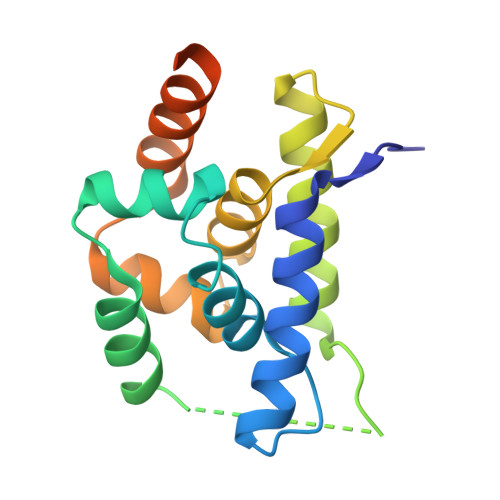
9TXD | pdb_00009txd

N-terminal domain of ClpC from S. aureus


Experimental Data Snapshot

  • Method: X-RAY DIFFRACTION
  • Resolution: 1.90 Å
  • R-Value Free: 
    0.215 (Depositor), 0.214 (DCC) 
  • R-Value Work: 
    0.195 (Depositor), 0.194 (DCC) 
  • R-Value Observed: 
    0.196 (Depositor) 

Starting Model: in silico
View more details

wwPDB Validation 3D Report Full Report

Validation slider image for 9TXD

Ligand Structure Quality Assessment 


This is version 1.1 of the entry. See complete history. 

Literature

Small-molecule activators of the Staphylococcus aureus ClpC/ClpP AAA+ protease.

Jenne, T., Viliuga, V., Uhrig, U., Jehle, B., Schwan, M., Kopp, J., Flemming, D., Seebach, E., Sinning, I., Bukau, B., Mogk, A.

(2026) iScience 29: 117738-117738

  • DOI: https://doi.org/10.1016/j.isci.2026.117738
  • Primary Citation Related Structures: 
    9TXC, 9TXD

  • PubMed Abstract: 

    The central AAA+ ClpC/ClpP protease in Gram-positive bacteria is crucial for virulence and stress resistance and has been recognized as drug target. Natural cyclic peptides deregulate the essential Mycobacterium tuberculosis ClpC1 and cause cell death. Similarly, overactivated mutants of the non-essential Staphylococcus aureus ClpC homolog cause uncontrolled proteolysis and severe toxicity in vivo . However, no chemical modulators of S. aureus ClpC have been described. Here, using a biochemical high-throughput screen, we identify eight distinct bona fide small molecules that stimulate ClpC ATPase and proteolytic activity in vitro . Structural, computational, and mutational analyses define two ligandable regulatory sites within the ClpC N-terminal domain (NTD) as compound targets: a conserved hydrophobic groove and an allosteric pArg1 pocket, both engaged in substrate recognition. These findings establish S. aureus ClpC as chemically targetable and provide mechanistic insight into its regulatory architecture, enabling future development and optimization of chemical probes to deregulate AAA+ protease control.


  • Organizational Affiliation: 
    • Center for Molecular Biology of Heidelberg University (ZMBH), DKFZ-ZMBH Alliance, Im Neuenheimer Feld 345, 69120 Heidelberg, Germany.

Macromolecule Content 

  • Total Structure Weight: 19.45 kDa 
  • Atom Count: 1,171 
  • Modeled Residue Count: 136 
  • Deposited Residue Count: 163 
  • Unique protein chains: 1

Macromolecules

Find similar proteins by:|  3D Structure
Entity ID: 1
MoleculeChains  Sequence LengthOrganismDetailsImage
ATP-dependent Clp protease ATP-binding subunit ClpC163Staphylococcus aureus subsp. aureus NCTC 8325Mutation(s): 0 
Gene Names: clpC, SAOUHSC_00505
UniProt
Find proteins for Q2G0P5 (Staphylococcus aureus (strain NCTC 8325 / PS 47))
Explore Q2G0P5 
Go to UniProtKB:  Q2G0P5
Entity Groups
Sequence Clusters30% Identity50% Identity70% Identity90% Identity95% Identity100% Identity
UniProt GroupQ2G0P5
Sequence Annotations
Expand
Reference Sequence

Experimental Data & Validation

Experimental Data

  • Method: X-RAY DIFFRACTION
  • Resolution: 1.90 Å
  • R-Value Free:  0.215 (Depositor), 0.214 (DCC) 
  • R-Value Work:  0.195 (Depositor), 0.194 (DCC) 
  • R-Value Observed: 0.196 (Depositor) 
Space Group: P 43 21 2
Unit Cell:
Length ( Å )Angle ( ˚ )
a = 60.747α = 90
b = 60.747β = 90
c = 100.626γ = 90
Software Package:
Software NamePurpose
PHENIXrefinement
XDSdata reduction
Aimlessdata scaling
PHASERphasing

Structure Validation

View Full Validation Report


Ligand Structure Quality Assessment 


Entry History 

& Funding Information

Deposition Data


Funding OrganizationLocationGrant Number
Not funded--

Revision History  (Full details and data files)

  • Version 1.0: 2026-09-16
    Type: Initial release
  • Version 1.1: 2026-10-21
    Changes: Database references