Download Mendeley
Mechanistic insights into TAM-mediated OMP assembly in Gram-negative bacteria.
Luo, Q., Dong, X., Zerang, Z., Chen, Y., Zhu, X., Yang, L., Zhang, Z., Zhang, J., Li, X., Chen, H., Ying, B., Chang, S., Zhou, J., Dong, H., Tang, X.(2026) Cell Rep 45: 117733-117733
- PubMed: 42507553 Search on PubMed
- DOI: https://doi.org/10.1016/j.celrep.2026.117733
- Primary Citation Related Structures:
9TGP, 9TGQ, 9TGR, 9TGS - PubMed Abstract:
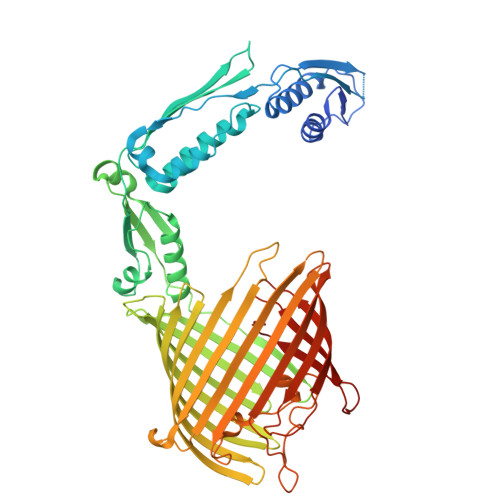
The β-barrel assembly machinery (BAM) is essential for outer membrane protein (OMP) biogenesis in Gram-negative bacteria and represents a validated target for antibiotic development. Its evolutionary relative, the translocation and assembly module (TAM), is thought to assemble OMPs but through a mechanism that remains poorly understood. Here, we present cryo-electron microscopy structures of Escherichia coli TamA and TamAB, capturing multiple conformational states. These structures reveal that the TamB C-terminal tail engages the TamA β-barrel to open its lateral gate, forming a transient hybrid β-interface and activating an extended AsmA-like periplasmic conduit that may facilitate substrate transport. Consistent with this mechanism, NanoLuc Binary Technology (NanoBiT)-based folding assays demonstrate that TamAB promotes OMP assembly more efficiently than TamA alone, with activity dependent on both lateral-gate opening and hybrid-interface formation. Together, our results define a substrate-mimetic priming mechanism that sets TAM apart from BAM and establish a structural framework for understanding OMP biogenesis.
- Department of Laboratory Medicine, State Key Laboratory of Biotherapy, National Clinical Research Center for Geriatrics, West China Hospital, Sichuan University, Chengdu, Sichuan 610041, China; Shenzhen Eye Hospital, Shenzhen Eye Medical Center, Southern Medical University, Shenzhen, Guangdong 518040, China.
Organizational Affiliation: