Download Mendeley
Microsecond Time-Resolved Cryo-EM Based on Jet Vitrification.
Haubner, M., Williams, H.M., Hruby, J., Straub, M.S., Guskov, A., Kovalev, K., Drabbels, M., Lorenz, U.J.(2025) bioRxiv
- PubMed: 41332690 Search on PubMedSearch on PubMed Central
- DOI: https://doi.org/10.1101/2025.11.21.689681
- Primary Citation Related Structures:
9TBD, 9TBE, 9TBF - PubMed Abstract:
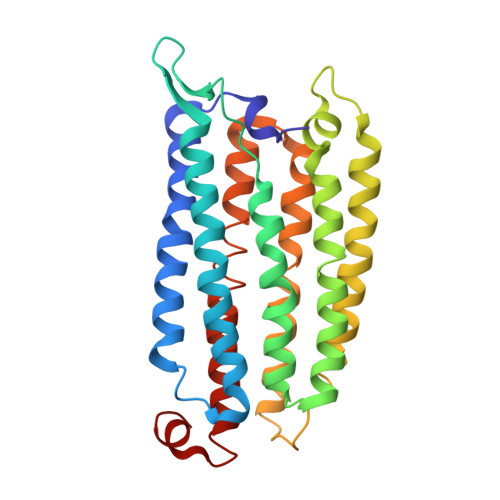
Understanding and ultimately predicting the function of proteins is one of the frontiers in structural biology. This will only be possible if it becomes feasible to routinely observe proteins on the fast timescales on which they perform their tasks. Recently, laser flash melting and revitrification experiments have improved the time resolution of cryo-electron microscopy (cryo-EM) to microseconds, rendering it fast enough to observe the domain motions of proteins that are frequently linked to function. However, observations have been limited to a time window of just a few hundred microseconds. Here, we introduce time-resolved cryo-EM experiments based on jet vitrification that combine microsecond resolution with an observation window of up to seconds. We use a short laser pulse to initiate protein dynamics, and as they unfold, vitrify the sample with a jet of a liquid cryogen to arrest the dynamics at that point in time. We demonstrate that our approach affords near-atomic spatial resolution and a time resolution of 21 µs. This allows us to observe the photoinduced dynamics of the light-driven sodium pump Er NaR on the microsecond to millisecond timescale. Our experiments significantly expand the ability of cryo-EM to observe protein dynamics across multiple timescales.
- Ecole Polytechnique Fédérale de Lausanne (EPFL), Laboratory of Molecular Nanodynamics, CH- 1015 Lausanne, Switzerland.
Organizational Affiliation: