Download Mendeley
Structural insights into cobalamin loading and reactivation of human methionine synthase.
Ferreira, D.S.M., McLennan, K., Diamond, C., Vollmar, M., Kiyani, W., Froese, D.S., Kopec, J., Bailey, H.J., Chalk, R., Basle, A., Elkins, J.M., Coker, J.A., Yue, W.W., McCorvie, T.J.(2026) Nat Commun 17
- PubMed: 42115646 Search on PubMedSearch on PubMed Central
- DOI: https://doi.org/10.1038/s41467-026-72899-3
- Primary Citation Related Structures:
9SSP, 9SSQ, 9SSR, 9SSS, 9SST, 9SSU, 9SSV - PubMed Abstract:
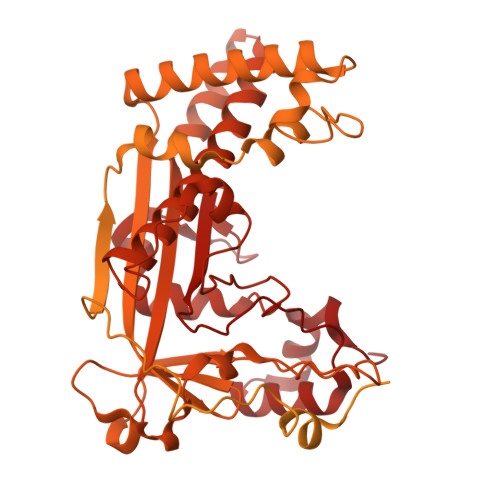
Human methionine synthase (MTR) is an essential enzyme of one carbon metabolism. Consisting of a catalytic N-half and a cobalamin binding C-half, MTR utilises this intricate organometallic cofactor in the methyl transfer from methyltetrahydrofolate to homocysteine producing methionine. Cobalamin loading into MTR, and its subsequent activation, requires methylmalonic aciduria and homocystinuria Type D (MMADHC) protein and methionine synthase reductase (MTRR), respectively. However, the molecular basis of cobalamin binding and activation of human MTR aided by MMADHC and MTRR remains unknown. Here, using cryo-electron microscopy, we determine structures of human MTR in its apo, and cobalamin bound states. Apo MTR adopts a conformation where the two halves of the enzyme act independently with the C-half posed to bind cobalamin. Binding of cobalamin and its activation causes conformational changes in MTR that result in a flexible catalytically active state. AlphaFold predictions, validated by interaction studies, show that MMADHC interacts with the C-half of apo MTR to facilitate cobalamin loading. Unexpectedly we found that MTRR interacts at two distinct sites within the C-half of MTR which may aid in activation. Collectively these findings lay the groundwork to uncover the mechanisms through how MMADHC and MTRR coordinate cobalamin loading and activation of human MTR.
- Nuffield Department of Clinical Medicine, Centre for Medicines Discovery, University of Oxford, Oxford, UK.
Organizational Affiliation: