Download Mendeley
Uncovering the structural impact of KatG Ser315 mutations in Mycobacterium tuberculosis via cryo-EM.
Allport, T., Chaplin, A.K.(2026) Protein Sci 35: e70409-e70409
- PubMed: 41432360 Search on PubMedSearch on PubMed Central
- DOI: https://doi.org/10.1002/pro.70409
- Primary Citation Related Structures:
9SGL, 9SGM, 9SGN, 9SGO, 9SGP, 9SGQ, 9SGR, 9SGS, 9SGT, 9SGY - PubMed Abstract:
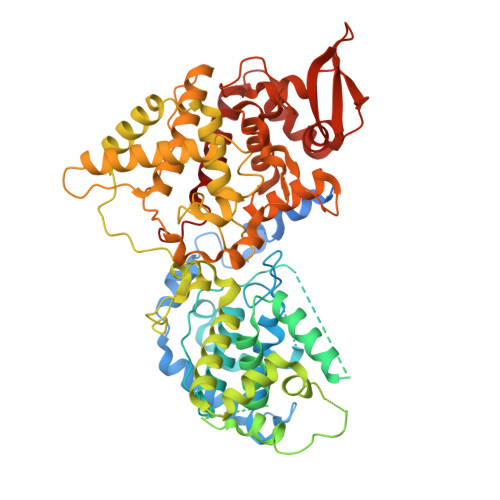
Mycobacterium tuberculosis (Mtb), the causative agent of tuberculosis (TB), is responsible for a global health burden affecting over a quarter of the world's population. The increasing prevalence of drug-resistant TB poses a significant threat to current treatment strategies. Isoniazid (INH) is a first-line prodrug used in TB therapy, which requires activation by the catalase-peroxidase enzyme KatG. Upon activation, INH inhibits InhA, thereby disrupting mycolic acid biosynthesis, a crucial process for maintaining Mtb's distinctive, lipid-rich cell wall. The most common naturally occurring resistance-associated mutation in KatG is S315T, though other variants at this position, such as S315G, S315N, S315I, and S315R, have also been reported. In this study, we employ cryo-electron microscopy (cryo-EM) to investigate the structural basis of INH resistance conferred by these KatG variants. We present high-resolution cryo-EM structures that reveal heterogeneity in heme loading among the mutants. Detailed structural analysis highlights alterations in the hydrogen-bonding network and substrate access channel unique to each variant, offering direct comparisons with the wild-type (WT) KatG protein. Our findings provide a molecular explanation for clinical INH resistance and lay the groundwork for the rational design of next-generation anti-TB therapeutics.
- Department of Molecular and Cell Biology, University of Leicester, Leicester Institute for Structural and Chemical Biology, Leicester, UK.
Organizational Affiliation: