Download Mendeley
Structure and function of a fungal AB toxin-like chimerolectin involved in anti-nematode defense.
Schmieder, S.S., Cordara, G., Kersten, F., Steiner, K., Samim, C.H., Plaza, D.F., Ali-Ahmad, A., Boeggild, A., Karlsen, J.L., Sokolowska, B.O., Boesen, T., Krengel, U., Kunzler, M.(2026) EMBO J 45: 4766-4786
- PubMed: 42192128 Search on PubMedSearch on PubMed Central
- DOI: https://doi.org/10.1038/s44318-026-00812-1
- Primary Citation Related Structures:
9S11 - PubMed Abstract:
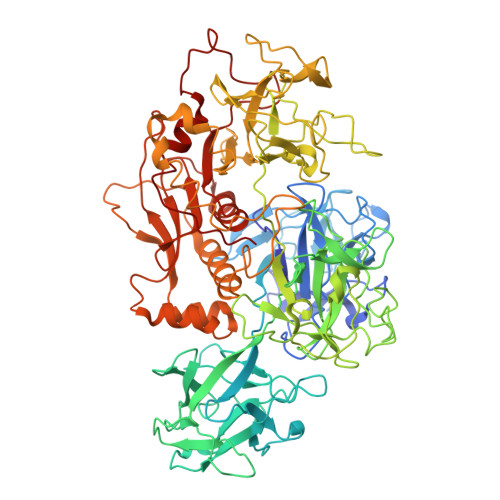
Fungal defense against predators largely relies on protein toxins, many of which are lectins. We previously showed that the production of the nematotoxin CCTX2 is upregulated in the Agaricomycete Coprinopsis cinerea upon predation by nematodes. Here, we classify CCTX2 as the founding member of a previously unknown family of fungal chimerolectins. Cryo-EM analysis to 3.2 Å resolution reveals five domains, with the four N-terminal β-trefoil fold (BTF) domains cradling a C-terminal domain, which exhibits an unusual α + β protein fold with some similarity to killer protein 4. Mutational analysis suggests that both terminal domains are functionally required for nematotoxicity. The first two BTF domains enable CCTX2 binding to glycosphingolipids with LacNAc or LacdiNAc glycoepitopes on nematode intestinal epithelial cells, whereas the biochemical function of the C-terminal domain remains unknown. Experiments in the model nematode Caenorhabditis elegans demonstrate that CCTX2 exploits the endocytic and retrograde trafficking machinery of cells in the intestinal epithelium to exert its toxicity and access the yet-to-be-identified intracellular target of the non-lectin domain. Our findings thus show that the molecular architecture and mode of action of CCTX2 is reminiscent of bacterial and plant AB toxins.
- Institute of Microbiology, Department of Biology, ETH Zürich, Zürich, Switzerland.
Organizational Affiliation: