Download Mendeley
Integrative structural analysis of human endosomal NHE6 reveals a lipid-associated gate and disordered C-terminus.
Feilen, L.P., Sach, L.K., Tranchant, E.E., Lalic, M.R., Havelund, J.F., Jeria Cerda, C.M., Ginsthofer, M., Ostendorf, J., Ma, L., Morrow, E.M., Faergeman, N.J., Pedersen, S.F., Kragelund, B.B., Autzen, H.E.(2026) Nat Commun 17
- PubMed: 42716947 Search on PubMedSearch on PubMed Central
- DOI: https://doi.org/10.1038/s41467-026-76368-9
- Primary Citation Related Structures:
9S0R, 9S0S - PubMed Abstract:
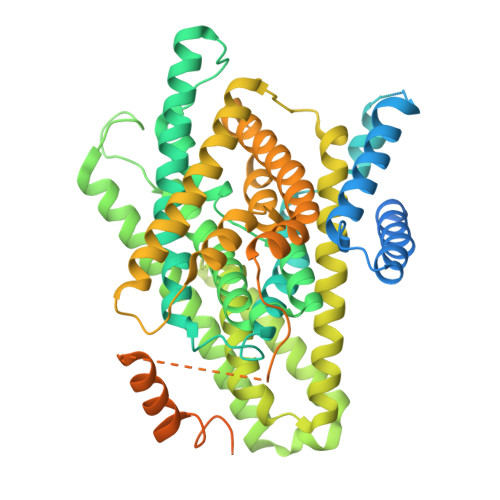
Human NHE6 (HsNHE6) is an endosomal Na⁺/H⁺ exchanger essential for maintaining luminal pH and endo-lysosomal trafficking in neurons. HsNHE6 mutations are implicated in devastating neurological syndromes, but mechanistically the transporter remains poorly understood. Here, we present the single-particle cryo-electron microscopy (cryo-EM) structure of HsNHE6 at 3.4 Å, captured in an inward-facing conformation. The structure reveals a homodimeric architecture with 13 transmembrane helices per protomer, with the conserved ion-binding site located at the interface of the core and dimerization domains. Functional assays demonstrate that HsNHE6 reconstituted in liposomes exchanges Na⁺, K⁺, Li⁺, and Rb + for H + , with kinetic analysis revealing a preference for K⁺. A structured C-terminal helix interacts with the transmembrane core, jointly forming a hydrophobic cavity containing two non-protein cryo-EM densities consistent with bound lipids that may modulate cation access to the ion-binding site. The remaining distal C-terminus of HsNHE6 is intrinsically disordered, as revealed by NMR and small-angle X-ray scattering, and extends up to 170 Å into the cytosol. Our integrative structural model of full-length HsNHE6 provides a framework for understanding HsNHE6-mediated ion exchange and its disruption in Christianson syndrome.
- Department of Biomedical Sciences, University of Copenhagen, Copenhagen N, Denmark.
Organizational Affiliation: