9R6Q | pdb_00009r6q

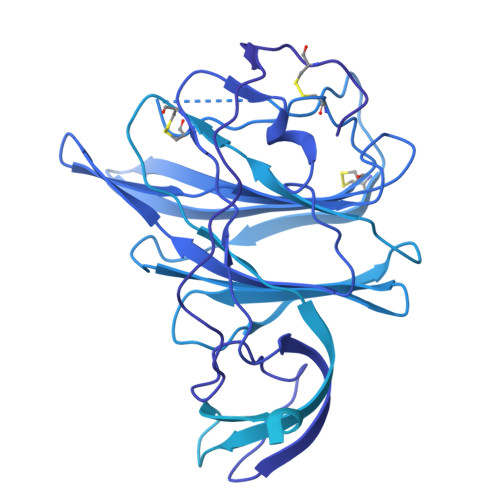
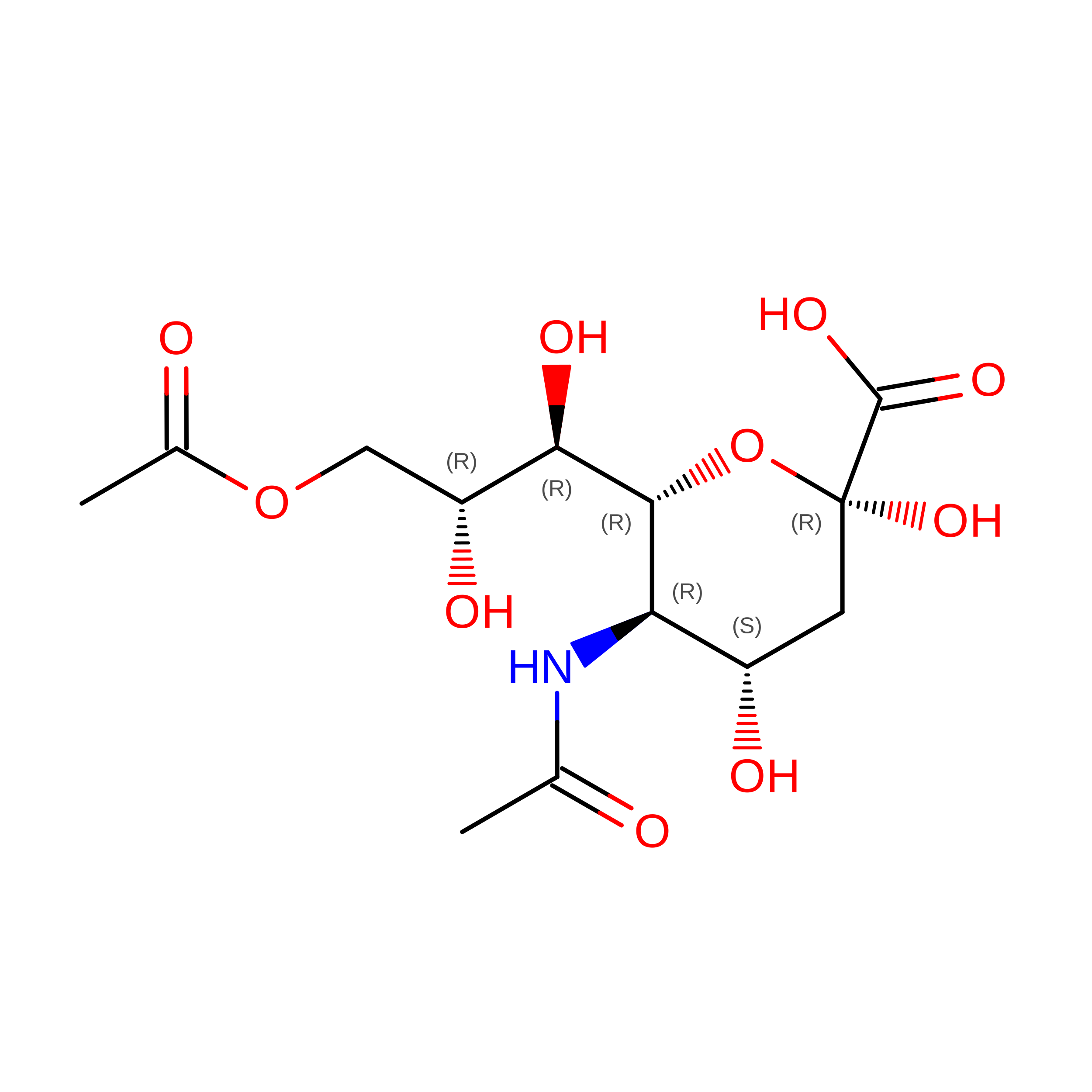
Local refinement of the N-terminal domain (NTD) and receptor binding domain (RBD) from the Porcine hemagglutinating encephalomyelitis virus (PHEV) Spike in the closed conformation bound to 9-O-Ac-Sia


Experimental Data Snapshot

  • Method: ELECTRON MICROSCOPY
  • Resolution: 3.50 Å
  • Aggregation State: PARTICLE 
  • Reconstruction Method: SINGLE PARTICLE 

wwPDB Validation 3D Report Full Report

Validation slider image for 9R6Q

This is version 1.2 of the entry. See complete history

Literature

Dipeptidase 1 is a functional receptor for a porcine coronavirus.

Dufloo, J.Fernandez, I.Arbabian, A.Haouz, A.Temperton, N.Gimenez-Lirola, L.G.Rey, F.A.Sanjuan, R.

(2025) Nat Microbiol 10: 2981-2996

  • DOI: https://doi.org/10.1038/s41564-025-02111-7
  • Primary Citation Related Structures: 
    9H0B, 9H3J, 9R6O, 9R6P, 9R6Q, 9R6R

  • PubMed Abstract: 

    Coronaviruses of the subgenus Embecovirus include several important pathogens, such as the human seasonal coronaviruses HKU1 and OC43, bovine coronavirus and porcine haemagglutinating encephalomyelitis virus (PHEV). While sialic acid is thought to be required for embecovirus entry, protein receptors remain unknown for most of these viruses. Here we show that PHEV does not require sialic acid for entry and instead uses dipeptidase 1 (DPEP1) as a receptor. Cryo-electron microscopy at 3.4-4.4 Å resolution revealed that, unlike other embecoviruses, PHEV displays both open and closed conformations of its spike trimer at steady state. The spike receptor-binding domain (RBD) exhibits extremely high sequence variability across embecoviruses, and we found that DPEP1 usage is specific to PHEV. In contrast, the X-ray structure of the RBD-DPEP1 complex at 2.25 Å showed that the structural elements involved in receptor binding are conserved, highlighting the remarkable versatility of this structural organization in adopting novel receptor specificities.


  • Organizational Affiliation
    • Institute for Integrative Systems Biology, CSIC-Universitat de València, Paterna, València, Spain.

Macromolecule Content 

  • Total Structure Weight: 297.15 kDa 
  • Atom Count: 4,280 
  • Modeled Residue Count: 535 
  • Deposited Residue Count: 2,666 
  • Unique protein chains: 1

Macromolecules

Find similar proteins by:|  3D Structure
Entity ID: 1
MoleculeChains  Sequence LengthOrganismDetailsImage
Spike glycoprotein
A, B
1,333Porcine hemagglutinating encephalomyelitis virusMutation(s): 0 
UniProt
Find proteins for Q2QKN3 (Porcine hemagglutinating encephalomyelitis virus)
Explore Q2QKN3 
Go to UniProtKB:  Q2QKN3
Entity Groups
Sequence Clusters30% Identity50% Identity70% Identity90% Identity95% Identity100% Identity
UniProt GroupQ2QKN3
Glycosylation
Glycosylation Sites: 1
Sequence Annotations
Expand
Reference Sequence

Oligosaccharides

Help  
Entity ID: 2
MoleculeChains Length2D Diagram GlycosylationD Interactions
beta-D-mannopyranose-(1-4)-2-acetamido-2-deoxy-beta-D-glucopyranose-(1-4)-2-acetamido-2-deoxy-beta-D-glucopyranoseC [auth D]3N-Glycosylation
Glycosylation Resources
GlyTouCan: G15407YE
GlyCosmos: G15407YE
GlyGen: G15407YE

Experimental Data & Validation

Experimental Data

  • Method: ELECTRON MICROSCOPY
  • Resolution: 3.50 Å
  • Aggregation State: PARTICLE 
  • Reconstruction Method: SINGLE PARTICLE 
EM Software:
TaskSoftware PackageVersion
MODEL REFINEMENTPHENIX

Structure Validation

View Full Validation Report


Entry History 

& Funding Information

Deposition Data


Funding OrganizationLocationGrant Number
Not funded--

Revision History  (Full details and data files)

  • Version 1.0: 2025-08-06
    Type: Initial release
  • Version 1.1: 2025-10-22
    Changes: Data collection, Database references
  • Version 1.2: 2025-11-12
    Changes: Data collection, Database references