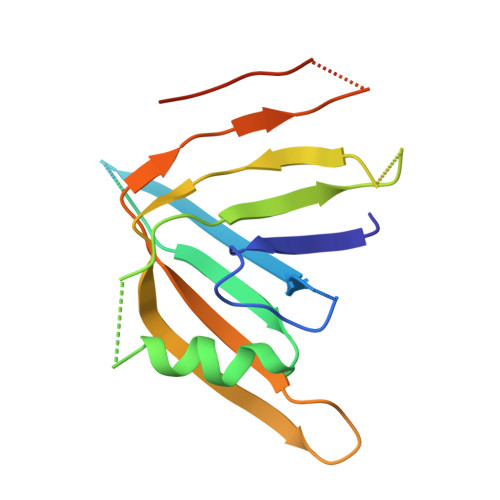
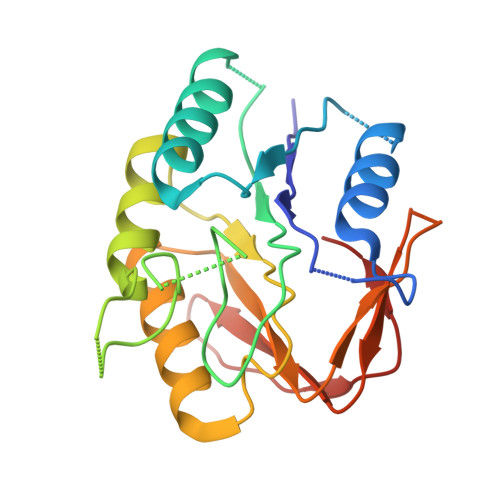
9QPE | pdb_00009qpe

Hcp3-Tce1 complex from the Pseudomonas aeruginosa Type VI Secretion System


Experimental Data Snapshot

  • Method: ELECTRON MICROSCOPY
  • Resolution: 3.80 Å
  • Aggregation State: 3D ARRAY 
  • Reconstruction Method: SINGLE PARTICLE 

wwPDB Validation 3D Report Full Report

Validation slider image for 9QPE

This is version 1.1 of the entry. See complete history. 

Literature

Molecular basis of type VI secretion system effector loading.

Paracuellos, P., Bexter, A., Patkowski, J.B., Kelly, S.D., Omelchenko, O., Mace, K., Ilangovan, A., Subramoni, S., Whitney, J.C., Filloux, A., Costa, T.R.D.

(2026) Nat Microbiol 11: 1982-1994

  • DOI: https://doi.org/10.1038/s41564-026-02363-x
  • Primary Citation Related Structures: 
    9QPE

  • PubMed Abstract: 

    Type VI secretion systems (T6SSs) are widespread bacterial nanomachines that deliver effectors into prokaryotic and eukaryotic cells. How an effector cargo is recruited and loaded into the Hcp ring assemblies that form the tube injected by the T6SS remains poorly understood. Pseudomonas aeruginosa has four T6SSs, each associated with a different Hcp protein. Here we use cryo-electron microscopy to resolve the structure of the Tce1 cargo loaded into a Hcp3 ring from the P. aeruginosa H3-T6SS. We show that a single Tce1 monomer interacts asymmetrically with, and is enclosed by, two hexameric Hcp3 rings, engaging key residues lining the inner surface of the Hcp3 disc. Our data indicate a stepwise loading mechanism, where an initial heterodimeric Hcp-cargo complex forms before ring encapsulation around the effector. Structural modelling suggests similar effector-Hcp3 interactions for a second T6SS effector, Tce2, which has antifungal activity. We propose that this mechanism enables coordinated delivery of a broad payload into target cells.


  • Organizational Affiliation: 
    • Centre for Bacterial Resistance Biology, Imperial College, London, UK.

Macromolecule Content 

  • Total Structure Weight: 127.53 kDa 
  • Atom Count: 6,071 
  • Modeled Residue Count: 799 
  • Deposited Residue Count: 1,191 
  • Unique protein chains: 2

Macromolecules

Find similar proteins by:|  3D Structure
Entity ID: 1
MoleculeChains  Sequence LengthOrganismDetailsImage
Hcp family type VI secretion system effector
A, B, C, D, E
A, B, C, D, E, F
165Pseudomonas aeruginosaMutation(s): 0 
Gene Names: CAZ10_33725, GNQ48_24960, GUL26_29960, IPC1295_17020, L4V69_18200, PAERUG_P19_London_7_VIM_2_05_10_04092
UniProt
Find proteins for A0A069PXC4 (Pseudomonas aeruginosa)
Explore A0A069PXC4 
Go to UniProtKB:  A0A069PXC4
Entity Groups
Sequence Clusters30% Identity50% Identity70% Identity90% Identity95% Identity100% Identity
UniProt GroupA0A069PXC4
Sequence Annotations
Expand
Reference Sequence
Find similar proteins by:|  3D Structure
Entity ID: 2
MoleculeChains  Sequence LengthOrganismDetailsImage
DUF4347 domain-containing protein201Pseudomonas aeruginosaMutation(s): 0 
Gene Names: PA0256
UniProt
Find proteins for Q9I6N3 (Pseudomonas aeruginosa (strain ATCC 15692 / DSM 22644 / CIP 104116 / JCM 14847 / LMG 12228 / 1C / PRS 101 / PAO1))
Explore Q9I6N3 
Go to UniProtKB:  Q9I6N3
Entity Groups
Sequence Clusters30% Identity50% Identity70% Identity90% Identity95% Identity100% Identity
UniProt GroupQ9I6N3
Sequence Annotations
Expand
Reference Sequence

Experimental Data & Validation

Experimental Data

  • Method: ELECTRON MICROSCOPY
  • Resolution: 3.80 Å
  • Aggregation State: 3D ARRAY 
  • Reconstruction Method: SINGLE PARTICLE 

Structure Validation

View Full Validation Report


Entry History 

& Funding Information

Deposition Data


Funding OrganizationLocationGrant Number
Imperial College LondonUnited Kingdom--

Revision History  (Full details and data files)

  • Version 1.0: 2026-04-08
    Type: Initial release
  • Version 1.1: 2026-10-21
    Changes: Data collection, Database references