9Q8K | pdb_00009q8k

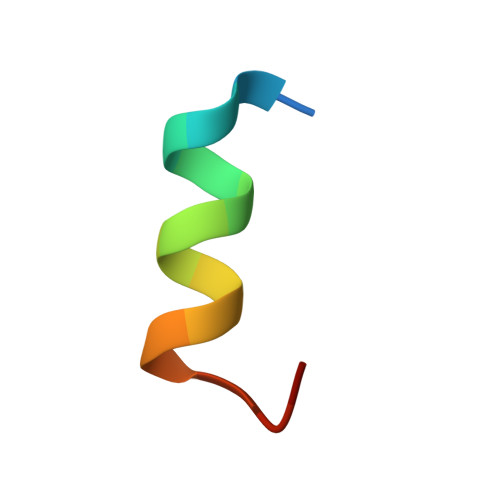
Synthetic bicyclic peptide


Experimental Data Snapshot

  • Method: X-RAY DIFFRACTION
  • Resolution: 1.67 Å
  • R-Value Free: 
    0.262 (Depositor), 0.249 (DCC) 
  • R-Value Work: 
    0.235 (Depositor), 0.243 (DCC) 
  • R-Value Observed: 
    0.236 (Depositor) 

Starting Model: experimental
View more details

wwPDB Validation 3D Report Full Report

Validation slider image for 9Q8K

Ligand Structure Quality Assessment 


This is version 1.1 of the entry. See complete history. 

Literature

Design of Bicyclic Peptide Tandems Mimicking the Homodimeric GDF15 Protein to Inhibit GDF15-GFRaL-RET Complex Cell Signaling.

Noisier, A.F.M., Sandmark, J., Edfeldt, F., Backmark, A., Broddefalk, J., Wandzik, J., Jurva, U., Ek, M., Johansson, C.A., Barlind, L., Gunnarsson, J., Bigalke, J.M., Xue, Y., Frolov, A.I., Kankkonen, C., Roth, R.G., Fritsch, M., Watcham, S., van Rietschoten, K., Mudd, G.E., Harrison, H., Chen, L., Skynner, M.J., Craik, D.J., Chankeshwara, S.V., Lemurell, M.

(2025) J Med Chem 68: 21441-21457

  • DOI: https://doi.org/10.1021/acs.jmedchem.5c01378
  • Primary Citation Related Structures: 
    9HYT, 9Q8K

  • PubMed Abstract: 

    The GDF15-GFRaL-RET signaling complex is involved in a broad range of disease states, with agonistic action of GDF15 affecting metabolism and body weight control, while inhibition is indicated in cancer and wasting disorders like cachexia. Here, we describe the discovery of the peptide inhibitors of the GDF15-GFRaL protein-protein interaction to prevent RET-induced signaling using both a structure-guided design and a phage display approach. Phage display provided bicyclic peptide hits with high affinity for GFRaL, and these were dimerized to mimic the bidentate interaction of homodimeric GDF15. Guided by structural data, the monomeric peptides were converted into tandem Bicycle molecules with picomolar affinities, similar to that of the endogenous GDF15 ligand. These dimerized protein mimetics inhibited cell signaling in a functional assay and showed improved pharmacokinetic properties compared with their monomeric counterparts. This is the first example of a homodimeric Bicycle molecule inhibiting receptor complex formation, thereby antagonizing the intracellular signaling response.


  • Organizational Affiliation: 
    • BicycleTx Limited, Portway Building, Granta Park, Cambridge CB21 6GS, U.K.

Macromolecule Content 

  • Total Structure Weight: 4.57 kDa 
  • Atom Count: 309 
  • Modeled Residue Count: 34 
  • Deposited Residue Count: 34 
  • Unique protein chains: 1

Macromolecules

Find similar proteins by:  Sequence   |   3D Structure  
Entity ID: 1
MoleculeChains  Sequence LengthOrganismDetailsImage
Synthetic bicyclic peptide (CYS-SER-ASP-ALA-LEU-CYS-LYS-PHE-PHE-ARG-GLU-ASN-THR-LYS-CYS)
A, B
17synthetic constructMutation(s): 0 
Entity Groups
Sequence Clusters30% Identity50% Identity70% Identity90% Identity95% Identity100% Identity
Sequence Annotations
Expand
Reference Sequence

Small Molecules

Ligands 1 Unique
IDChains Name / Formula / InChI Key2D Diagram3D Interactions
LFI
(Subject of Investigation/LOI)

Query on LFI


Download:Ideal Coordinates CCD File
C [auth A],
D [auth B]
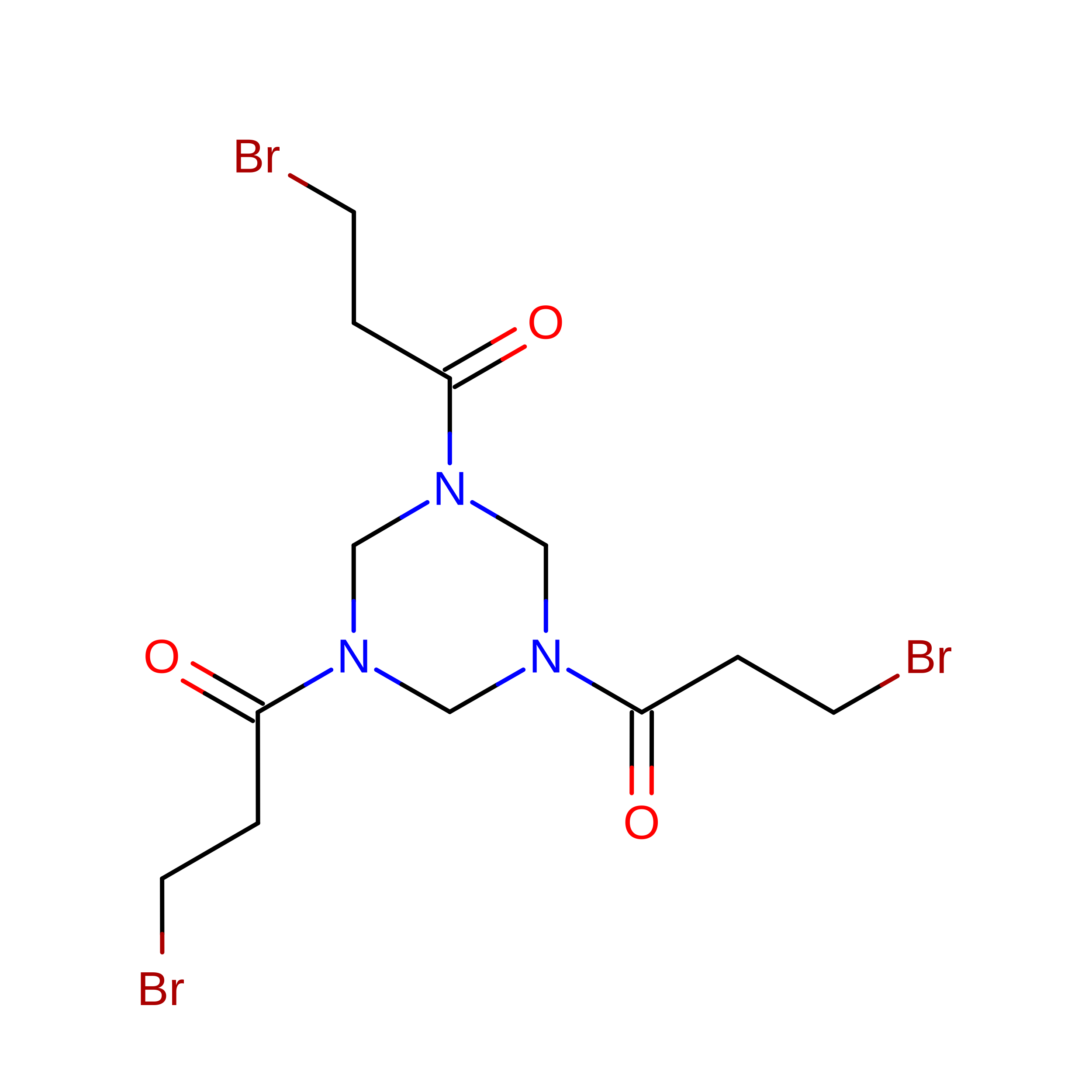
1-[3,5-bis(3-bromanylpropanoyl)-1,3,5-triazinan-1-yl]-3-bromanyl-propan-1-one
C12 H18 Br3 N3 O3
UYNTZRFVDTZUQI-UHFFFAOYSA-N

Experimental Data & Validation

Experimental Data

  • Method: X-RAY DIFFRACTION
  • Resolution: 1.67 Å
  • R-Value Free:  0.262 (Depositor), 0.249 (DCC) 
  • R-Value Work:  0.235 (Depositor), 0.243 (DCC) 
  • R-Value Observed: 0.236 (Depositor) 
Space Group: I 21 3
Unit Cell:
Length ( Å )Angle ( ˚ )
a = 82.72α = 90
b = 82.72β = 90
c = 82.72γ = 90
Software Package:
Software NamePurpose
MOSFLMdata reduction
Aimlessdata scaling
BUSTERrefinement
XDSdata reduction
PHASERphasing

Structure Validation

View Full Validation Report


Ligand Structure Quality Assessment 


Entry History 

& Funding Information

Deposition Data


Funding OrganizationLocationGrant Number
Other privateSweden--

Revision History  (Full details and data files)

  • Version 1.0: 2026-03-11
    Type: Initial release
  • Version 1.1: 2026-09-23
    Changes: Database references