9Q3Y | pdb_00009q3y

GluN1b-GluN2B ATD in complex with radiprodil


Experimental Data Snapshot

  • Method: X-RAY DIFFRACTION
  • Resolution: 2.74 Å
  • R-Value Free: 
    0.223 (Depositor), 0.262 (DCC) 
  • R-Value Work: 
    0.187 (Depositor), 0.234 (DCC) 
  • R-Value Observed: 
    0.188 (Depositor) 

Starting Model: experimental
View more details

wwPDB Validation 3D Report Full Report

Validation slider image for 9Q3Y

Ligand Structure Quality Assessment 


This is version 1.0 of the entry. See complete history

Literature

Inhibition of GluN2B-containing N-methyl-D-aspartate receptors by radiprodil.

Banke, T.G.Regan, M.C.Perszyk, R.E.Zhang, L.Xing, H.Chen, J.Won, S.Simorowski, N.Diaz, E.S.Kim, S.Song, R.Rong, J.Zhou, X.Chaudhary, A.F.Zhang, J.Traynelis, J.F.McDaniels, E.D.Nitsche, K.Roache, S.Raymond, C.S.Low, C.M.Myers, S.J.Roche, K.W.Liang, S.H.Traynelis, S.F.Furukawa, H.Yuan, H.

(2026) Brain 149: 976-992

  • DOI: https://doi.org/10.1093/brain/awaf355
  • Primary Citation Related Structures: 
    9Q3Y

  • PubMed Abstract: 

    N-methyl-D-aspartate (NMDA) receptors mediate a slow, Ca2+-permeable component of excitatory synaptic transmission in the brain and participate in neuronal development and synaptic plasticity. Most NMDA receptors are tetrameric assemblies of two GluN1 and two GluN2 subunits encoded by five genes (GRIN1 and GRIN2A-GRIN2D), which produce GluN1 and GluN2A-GluN2D subunits. NMDA receptors that contain the GluN2B subunit have unique pharmacological properties, being inhibited by multiple structurally distinct series of biaryl compounds with high potency and selectivity. These agents are of considerable therapeutic interest, given the numerous roles that GluN2B-containing NMDA receptors play in normal brain function and pathological situations. Among GluN2B-selective negative allosteric modulators, radiprodil inhibits NMDA receptors that contain GluN2B with high potency and selectivity and appears to be safe in humans. Here, we evaluate the structural determinants of radiprodil binding to the heterodimeric GluN1-GluN2B amino terminal domain by X-ray crystallography and explore the molecular mechanism of inhibition. A large number of de novo variants have been identified in the GRIN gene family in patients with various neurological and neuropsychiatric conditions, including autism, intellectual disability, epilepsy, language disorders and movement disorders. We show that radiprodil is an effective antagonist at >80% of human disease-associated GRIN1 and GRIN2B missense variants tested in vitro (22/27, equally or more effective as wild-type receptors), including variants in the pore-forming region, linker regions and elsewhere that uniformly increase NMDA receptor-mediated charge transfer. We show that radiprodil blocks synaptic GluN2B receptors in brain slices acutely isolated from a knock-in mouse line harbouring the gain-of-function variant GluN2B-Ser810Arg associated with early-onset epileptic encephalopathy and intractable seizures in patients. In addition, radiprodil delays the onset of seizures (458 ± 90 s, versus 207 ± 23 s in the vehicle group) in response to in vivo administration of the chemoconvulsant pentylenetetrazole. These data support the potential utility of GluN2B-selective antagonists, such as radiprodil, for clinical treatments of neurological conditions where clinical aetiologies might involve increased current mediated by GluN2B-containing NMDA receptors.


  • Organizational Affiliation
    • Department of Pharmacology and Chemical Biology, Emory University School of Medicine, Atlanta, GA 30322, USA.

Macromolecule Content 

  • Total Structure Weight: 165.9 kDa 
  • Atom Count: 11,408 
  • Modeled Residue Count: 1,439 
  • Deposited Residue Count: 1,443 
  • Unique protein chains: 3

Macromolecules

Find similar proteins by:|  3D Structure
Entity ID: 1
MoleculeChains  Sequence LengthOrganismDetailsImage
Glutamate receptor ionotropic, NMDA 1359Xenopus laevisMutation(s): 0 
Gene Names: grin1
UniProt
Find proteins for A0A1L8F5J9 (Xenopus laevis)
Explore A0A1L8F5J9 
Go to UniProtKB:  A0A1L8F5J9
Entity Groups
Sequence Clusters30% Identity50% Identity70% Identity90% Identity95% Identity100% Identity
UniProt GroupA0A1L8F5J9
Glycosylation
Glycosylation Sites: 2
Sequence Annotations
Expand
Reference Sequence
Find similar proteins by:|  3D Structure
Entity ID: 2
MoleculeChains  Sequence LengthOrganismDetailsImage
Glutamate receptor ionotropic, NMDA 2B
B, D
363Rattus norvegicusMutation(s): 0 
Gene Names: Grin2b
UniProt
Find proteins for Q00960 (Rattus norvegicus)
Explore Q00960 
Go to UniProtKB:  Q00960
Entity Groups
Sequence Clusters30% Identity50% Identity70% Identity90% Identity95% Identity100% Identity
UniProt GroupQ00960
Glycosylation
Glycosylation Sites: 2Go to GlyGen: Q00960-1
Sequence Annotations
Expand
Reference Sequence
Find similar proteins by:|  3D Structure
Entity ID: 3
MoleculeChains  Sequence LengthOrganismDetailsImage
Glutamate receptor ionotropic, NMDA 1358Xenopus laevisMutation(s): 0 
Gene Names: grin1
UniProt
Find proteins for A0A1L8F5J9 (Xenopus laevis)
Explore A0A1L8F5J9 
Go to UniProtKB:  A0A1L8F5J9
Entity Groups
Sequence Clusters30% Identity50% Identity70% Identity90% Identity95% Identity100% Identity
UniProt GroupA0A1L8F5J9
Glycosylation
Glycosylation Sites: 2
Sequence Annotations
Expand
Reference Sequence

Oligosaccharides

Help  
Entity ID: 4
MoleculeChains Length2D Diagram GlycosylationD Interactions
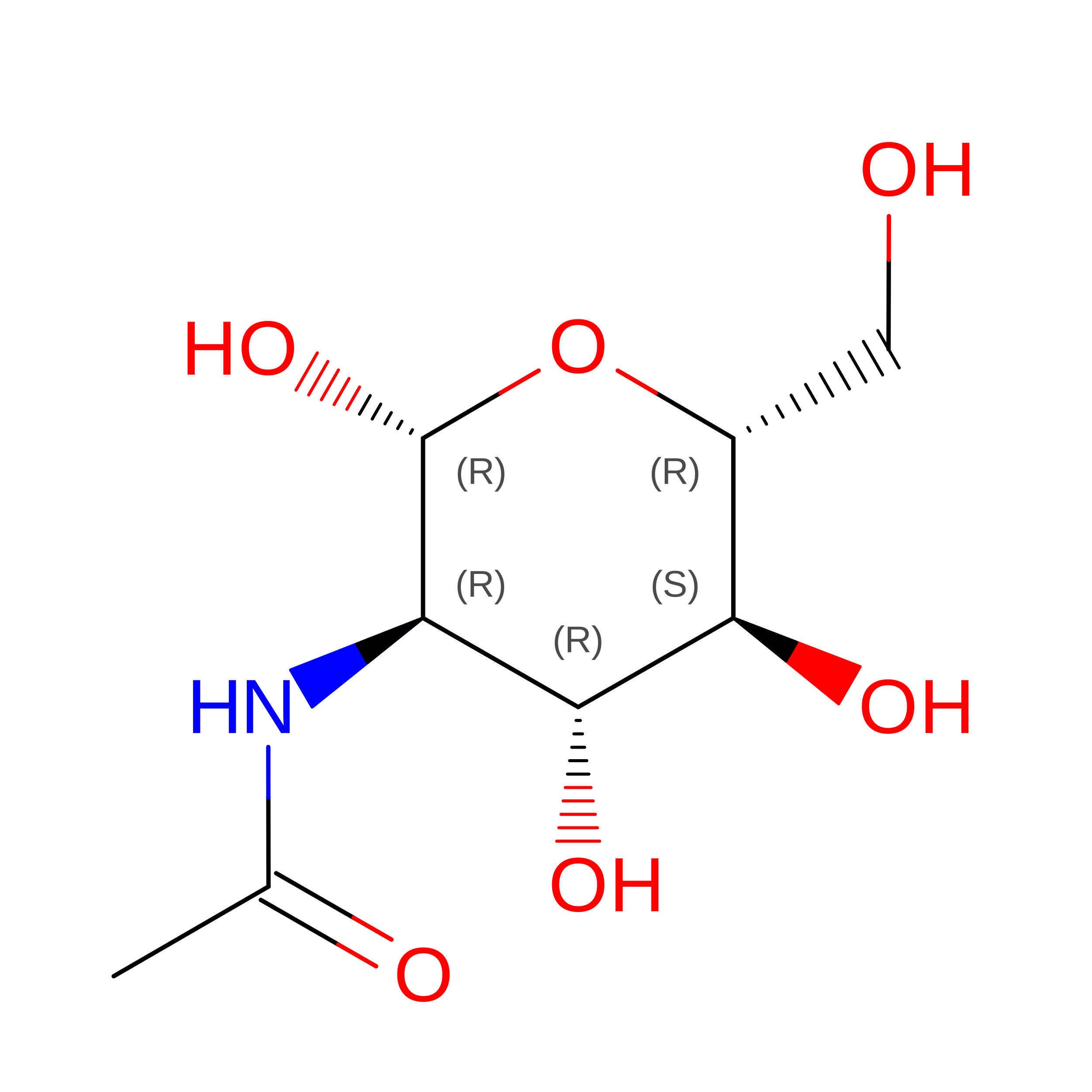
alpha-D-mannopyranose-(1-3)-[alpha-D-mannopyranose-(1-6)]beta-D-mannopyranose-(1-4)-2-acetamido-2-deoxy-beta-D-glucopyranose-(1-4)-2-acetamido-2-deoxy-beta-D-glucopyranose
E
5N-Glycosylation

Small Molecules

Ligands 4 Unique
IDChains Name / Formula / InChI Key2D Diagram3D Interactions
A1CNW(
Subject of Investigation/LOI)

Query on A1CNW


Download:Ideal Coordinates CCD File
G [auth A],
W [auth D]
radiprodil
C21 H20 F N3 O4
GKGRZLGAQZPEHO-UHFFFAOYSA-N
NAG
(Subject of Investigation/LOI)

Query on NAG


Download:Ideal Coordinates CCD File
F [auth A]
K [auth B]
L [auth B]
P [auth C]
Q [auth C]
F [auth A],
K [auth B],
L [auth B],
P [auth C],
Q [auth C],
V [auth D]
2-acetamido-2-deoxy-beta-D-glucopyranose
C8 H15 N O6
OVRNDRQMDRJTHS-FMDGEEDCSA-N
CL
(Subject of Investigation/LOI)

Query on CL


Download:Ideal Coordinates CCD File
I [auth A]
J [auth A]
M [auth B]
N [auth B]
O [auth B]
I [auth A],
J [auth A],
M [auth B],
N [auth B],
O [auth B],
S [auth C],
T [auth C],
U [auth C],
X [auth D]
CHLORIDE ION
Cl
VEXZGXHMUGYJMC-UHFFFAOYSA-M
NA
(Subject of Investigation/LOI)

Query on NA


Download:Ideal Coordinates CCD File
H [auth A],
R [auth C]
SODIUM ION
Na
FKNQFGJONOIPTF-UHFFFAOYSA-N

Experimental Data & Validation

Experimental Data

  • Method: X-RAY DIFFRACTION
  • Resolution: 2.74 Å
  • R-Value Free:  0.223 (Depositor), 0.262 (DCC) 
  • R-Value Work:  0.187 (Depositor), 0.234 (DCC) 
  • R-Value Observed: 0.188 (Depositor) 
Space Group: C 1 2 1
Unit Cell:
Length ( Å )Angle ( ˚ )
a = 267.949α = 90
b = 60.672β = 116.23
c = 144.647γ = 90
Software Package:
Software NamePurpose
REFMACrefinement
XDSdata scaling
XDSdata reduction
PHASERphasing
PDB_EXTRACTdata extraction

Structure Validation

View Full Validation Report


Ligand Structure Quality Assessment 


Entry History 

& Funding Information

Deposition Data


Funding OrganizationLocationGrant Number
National Institutes of Health/National Institute of Mental Health (NIH/NIMH)United StatesMH085926

Revision History  (Full details and data files)

  • Version 1.0: 2026-07-22
    Type: Initial release