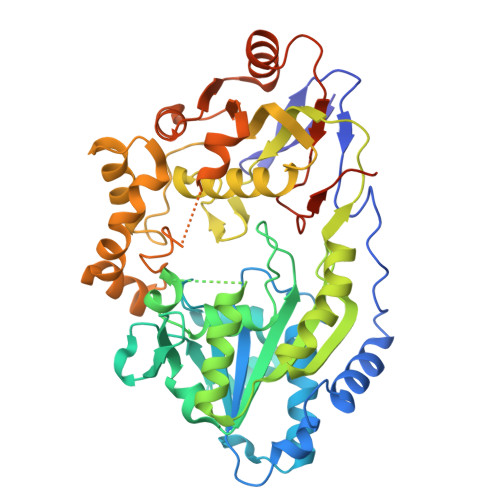
9Q3J | pdb_00009q3j

Structures of LarA-like nickel-pincer nucleotide cofactor-utilizing enzyme with a single catalytic histidine residue from Blautia wexlerae


Experimental Data Snapshot

  • Method: ELECTRON MICROSCOPY
  • Resolution: 3.15 Å
  • Aggregation State: PARTICLE 
  • Reconstruction Method: SINGLE PARTICLE 

wwPDB Validation 3D Report Full Report

Validation slider image for 9Q3J

This is version 1.0 of the entry. See complete history

Literature

Structures of two LarA-like nickel-pincer nucleotide cofactor-utilizing enzymes with a single catalytic histidine residue.

Gatreddi, S.Subramanian, S.Sui, D.Wang, T.Urdiain-Arraiza, J.Desguin, B.Hausinger, R.P.Parent, K.N.Hu, J.

(2025) bioRxiv 

  • DOI: https://doi.org/10.1101/2025.08.19.671153
  • Primary Citation Related Structures: 
    9Q3J, 9Q3K

  • PubMed Abstract: 

    The nickel pincer nucleotide (NPN) cofactor catalyzes the racemization/epimerization of α-hydroxy acids in enzymes of the LarA family. The established proton-coupled hydride transfer mechanism requires two catalytic histidine residues that alternately act as general acids and general bases. Notably, however, a fraction of LarA homologs (LarAHs) lack one of the active site histidine residues, replacing it with an asparaginyl side chain that cannot participate in acid/base catalysis. Here, we investigated two such LarAHs and solved their cryo-electron microscopic structures with and without loaded NPN cofactor, respectively. The structures revealed a consistent octameric assembly that is unprecedented in the LarA family and unveiled a new set of active site residues that likely recognize and process substrates differently from those of the well-studied LarAHs. Genomic context analysis suggested their potential involvement in carbohydrate metabolism. Together, these findings lay the groundwork for expanding the breadth of reactions and the range of mechanisms of LarA enzymes.


  • Organizational Affiliation
    • Department of Microbiology, Genetics, and Immunology, Michigan State University, MI, USA.

Macromolecule Content 

  • Total Structure Weight: 460.08 kDa 
  • Atom Count: 28,832 
  • Modeled Residue Count: 3,611 
  • Deposited Residue Count: 4,040 
  • Unique protein chains: 1

Macromolecules

Find similar proteins by:|  3D Structure
Entity ID: 1
MoleculeChains  Sequence LengthOrganismDetailsImage
DUF2088 domain-containing protein
A, B, C, D, E
A, B, C, D, E, F, G, H
505Blautia wexleraeMutation(s): 0 
Gene Names: ERS852523_02626GT728_05510
UniProt
Find proteins for A0A174QNZ5 (Blautia wexlerae)
Explore A0A174QNZ5 
Go to UniProtKB:  A0A174QNZ5
Entity Groups
Sequence Clusters30% Identity50% Identity70% Identity90% Identity95% Identity100% Identity
UniProt GroupA0A174QNZ5
Sequence Annotations
Expand
Reference Sequence

Experimental Data & Validation

Experimental Data

  • Method: ELECTRON MICROSCOPY
  • Resolution: 3.15 Å
  • Aggregation State: PARTICLE 
  • Reconstruction Method: SINGLE PARTICLE 
EM Software:
TaskSoftware PackageVersion
MODEL REFINEMENTPHENIX1.20.1_4487:
RECONSTRUCTIONcryoSPARC

Structure Validation

View Full Validation Report


Entry History 

& Funding Information

Deposition Data


Funding OrganizationLocationGrant Number
National Institutes of Health/National Institute of General Medical Sciences (NIH/NIGMS)United StatesGM128959
National Institutes of Health/National Institute of General Medical Sciences (NIH/NIGMS)United StatesGM140931
National Institutes of Health/National Institute of General Medical Sciences (NIH/NIGMS)United StatesGM140803

Revision History  (Full details and data files)

  • Version 1.0: 2025-09-17
    Type: Initial release