Download Mendeley
Cryo-EM structures of plant Augmin reveal coiled-coil assembly, antiparallel dimerization, and NEDD1 binding.
Ashaduzzaman, M., Taheri, A., Lee, Y.J., Tang, Y., Mittal, S., Guo, F., Morcos, F., Fried, S.D., Liu, B., Al-Bassam, J.(2025) Nat Commun 16: 11440-11440
- PubMed: 41387433 Search on PubMedSearch on PubMed Central
- DOI: https://doi.org/10.1038/s41467-025-66332-4
- Primary Citation Related Structures:
9PZM - PubMed Abstract:
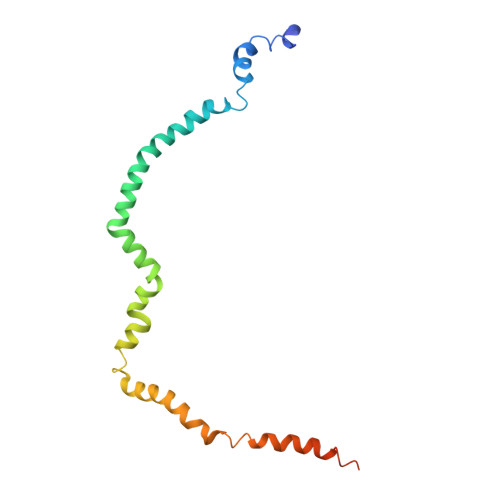
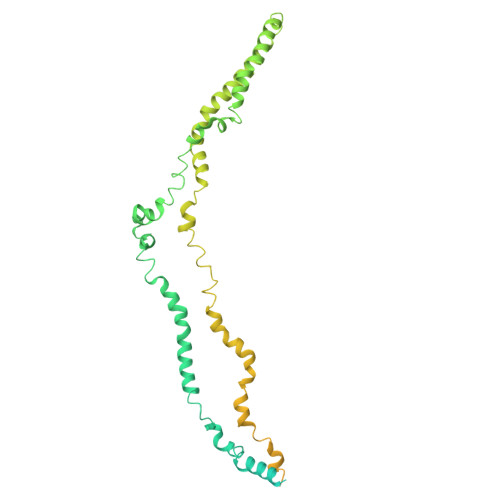
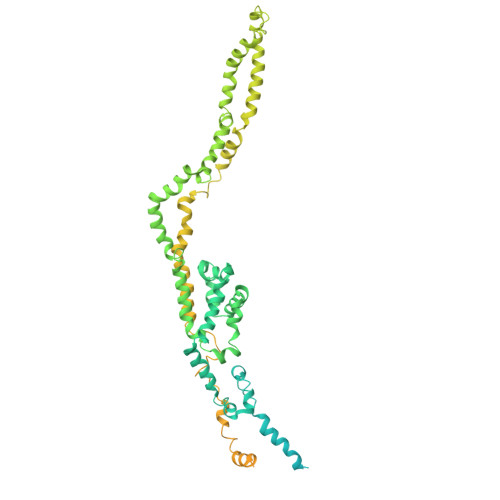
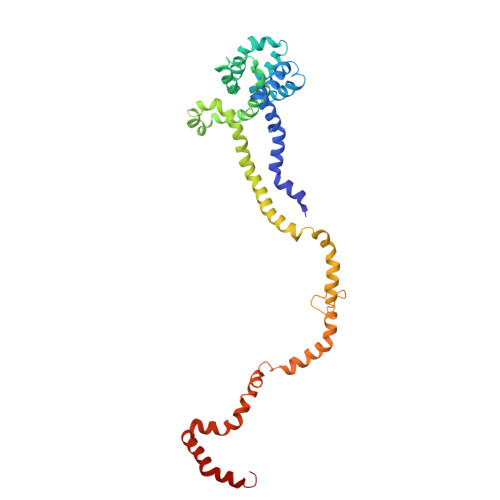
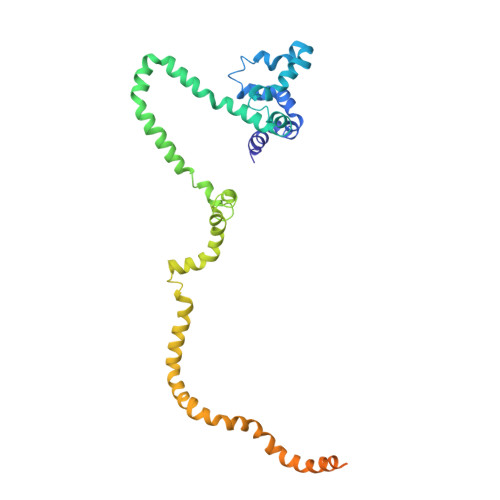
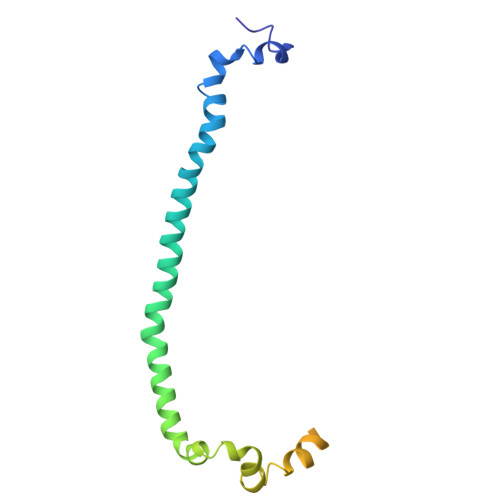
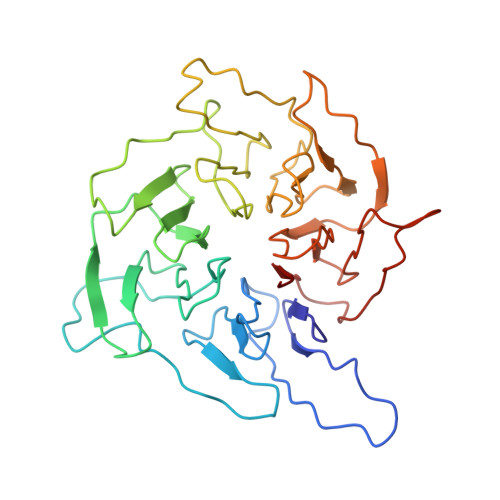
Microtubule (MT) branch nucleation requires Augmin and NEDD1 proteins, which recruit and activate the gamma-tubulin ring complex (γ-TuRC). Augmin is a fork-shaped assembly of eight coiled-coil subunits, while NEDD1 is a β-propeller protein bridging MTs, Augmin, and γ-TuRC. We reconstitute Arabidopsis thaliana Augmin assemblies and determine 3.7-7.3-Å cryo-EM structures of its V-junction and extended regions using crosslinking mass spectrometry. These structures reveal a complete plant Augmin model showing multi-coiled-coil interfaces stabilizing its 40-nm hetero-octameric fork architecture. The dual calponin homology (CH) domains at the V-junction terminus adopt open and closed conformations for MT binding. A 12-Å cryo-EM structure shows Augmin undergoes anti-parallel dimerization through conserved surfaces on its extended region. We determine the NEDD1 β-propeller structure with Augmin, revealing direct binding inside the V-junction that enhances dimerization. Direct coupling and evolutionary analyses identify co-varying residue pairs validating the eight-subunit model and NEDD1 interface. Cooperativity between dual CH domains and NEDD1 binding may regulate V-junction binding to MT lattices. This V-shaped dual binding anchors Augmin along MTs, creating platforms for γ-TuRC recruitment and branched MT nucleation.
- Department of Molecular Cellular Biology, University of California, Davis, CA, USA. mashaduzzaman@ucdavis.edu.
Organizational Affiliation: