9PPX | pdb_00009ppx

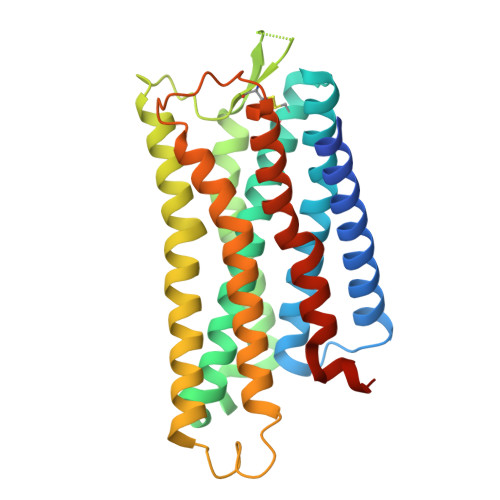
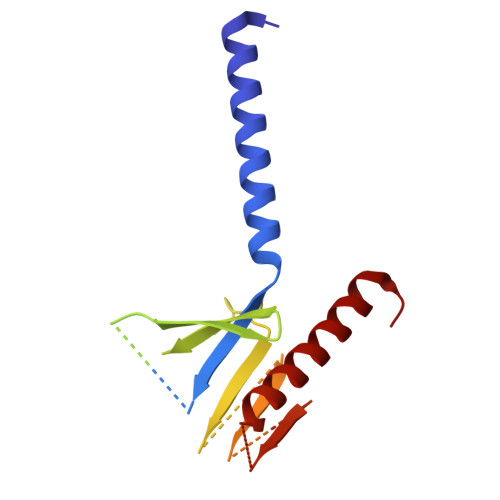
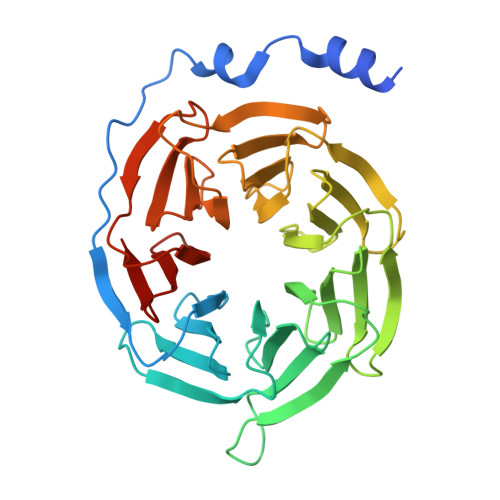
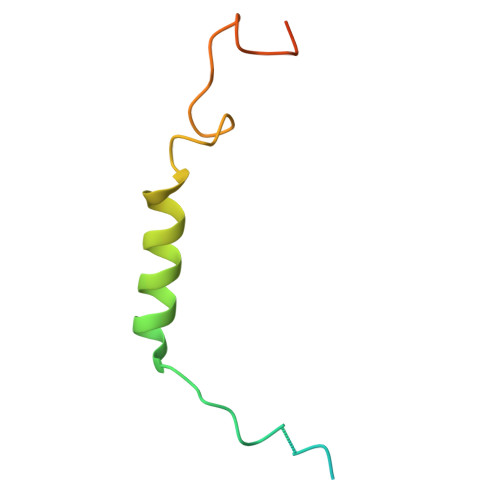
CryoEM structure of delta opioid receptor bound to G proteins and naltrexone


Experimental Data Snapshot

  • Method: ELECTRON MICROSCOPY
  • Resolution: 3.04 Å
  • Aggregation State: PARTICLE 
  • Reconstruction Method: SINGLE PARTICLE 

wwPDB Validation 3D Report Full Report

Validation slider image for 9PPX

This is version 1.1 of the entry. See complete history

Literature

Mechanistic insights into the therapeutic properties of delta opioid receptor.

Bernhard, S.M.Roy Chowdhury, S.Murata, T.Reinl, E.L.Ramos-Gonzalez, N.Denn, E.Appourchaux, K.Inoue, A.England, S.K.Fay, J.F.Majumdar, S.Chanda, B.Che, T.

(2026) Sci Adv 12: eaeb6737-eaeb6737

  • DOI: https://doi.org/10.1126/sciadv.aeb6737
  • Primary Citation Related Structures: 
    9PPW, 9PPX, 9PPY, 9PPZ, 9PQ0

  • PubMed Abstract: 

    The delta opioid receptor (DOR) is a promising target for treating pain, anxiety, and depression, yet no DOR-based drugs have reached the clinic. Here, we examine how ligands with varying therapeutic properties modulate DOR function. While full agonists rapidly internalize the receptor, partial agonists show a slower rate of internalization, and antagonists increase cell-surface DOR levels. High-resolution structures of ligand-bound DOR-G i1 complexes, including those with antagonists engaged, reveal key interactions that account for DOR ligand selectivity, potency, and efficacy. Single-molecule fluorescence resonance energy transfer studies show that DOR dynamically samples three distinct states (active, obligate preactive, and inactive), and transition rates are tuned by both ligand efficacy and G protein coupling. The endogenous agonist, met-enkephalin, not only stabilizes the active-state conformation but also catalyzes transitions between the active and inactive states. These results reveal how ligand-specific interactions and receptor dynamics can govern pharmacological profiles and provide a framework for developing DOR-targeted therapeutics.


  • Organizational Affiliation
    • Center for Clinical Pharmacology, Department of Anesthesiology, Washington University School of Medicine, St. Louis, MO, USA.

Macromolecule Content 

  • Total Structure Weight: 146.3 kDa 
  • Atom Count: 6,894 
  • Modeled Residue Count: 983 
  • Deposited Residue Count: 1,319 
  • Unique protein chains: 5

Macromolecules

Find similar proteins by:|  3D Structure
Entity ID: 1
MoleculeChains  Sequence LengthOrganismDetailsImage
Delta-type opioid receptor303Homo sapiensMutation(s): 0 
Gene Names: OPRD1OPRD
UniProt & NIH Common Fund Data Resources
Find proteins for P41143 (Homo sapiens)
Explore P41143 
Go to UniProtKB:  P41143
PHAROS:  P41143
GTEx:  ENSG00000116329 
Entity Groups
Sequence Clusters30% Identity50% Identity70% Identity90% Identity95% Identity100% Identity
UniProt GroupP41143
Sequence Annotations
Expand
Reference Sequence
Find similar proteins by:|  3D Structure
Entity ID: 2
MoleculeChains  Sequence LengthOrganismDetailsImage
Guanine nucleotide-binding protein G(i) subunit alpha-1354Homo sapiensMutation(s): 4 
Gene Names: GNAI1
EC: 3.6.5
UniProt & NIH Common Fund Data Resources
Find proteins for P63096 (Homo sapiens)
Explore P63096 
Go to UniProtKB:  P63096
PHAROS:  P63096
GTEx:  ENSG00000127955 
Entity Groups
Sequence Clusters30% Identity50% Identity70% Identity90% Identity95% Identity100% Identity
UniProt GroupP63096
Sequence Annotations
Expand
Reference Sequence
Find similar proteins by:|  3D Structure
Entity ID: 3
MoleculeChains  Sequence LengthOrganismDetailsImage
Guanine nucleotide-binding protein G(I)/G(S)/G(T) subunit beta-1340Homo sapiensMutation(s): 0 
Gene Names: GNB1
UniProt & NIH Common Fund Data Resources
Find proteins for P62873 (Homo sapiens)
Explore P62873 
Go to UniProtKB:  P62873
PHAROS:  P62873
GTEx:  ENSG00000078369 
Entity Groups
Sequence Clusters30% Identity50% Identity70% Identity90% Identity95% Identity100% Identity
UniProt GroupP62873
Sequence Annotations
Expand
Reference Sequence
Find similar proteins by:|  3D Structure
Entity ID: 4
MoleculeChains  Sequence LengthOrganismDetailsImage
Guanine nucleotide-binding protein G(I)/G(S)/G(O) subunit gamma-271Homo sapiensMutation(s): 0 
Gene Names: GNG2
UniProt & NIH Common Fund Data Resources
Find proteins for P59768 (Homo sapiens)
Explore P59768 
Go to UniProtKB:  P59768
PHAROS:  P59768
GTEx:  ENSG00000186469 
Entity Groups
Sequence Clusters30% Identity50% Identity70% Identity90% Identity95% Identity100% Identity
UniProt GroupP59768
Sequence Annotations
Expand
Reference Sequence
Find similar proteins by:|  3D Structure
Entity ID: 5
MoleculeChains  Sequence LengthOrganismDetailsImage
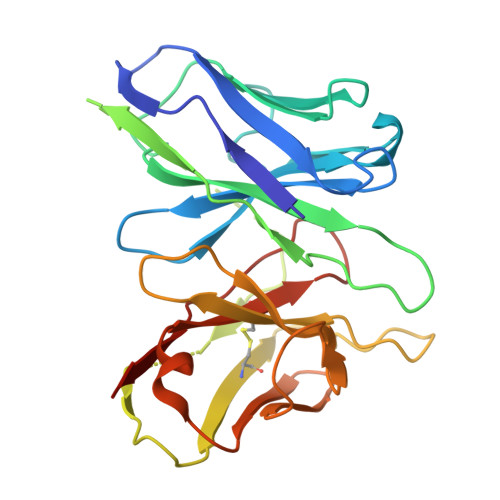
ScFv16 protein251Mus musculusMutation(s): 0 

Small Molecules

Ligands 1 Unique
IDChains Name / Formula / InChI Key2D Diagram3D Interactions
A1CLJ

Query on A1CLJ


Download:Ideal Coordinates CCD File
F [auth A]17-(cyclopropylmethyl)-3,14-dihydroxy-5alpha-4,5-epoxymorphinan-6-one
C20 H23 N O4
DQCKKXVULJGBQN-XFWGSAIBSA-N

Experimental Data & Validation

Experimental Data

  • Method: ELECTRON MICROSCOPY
  • Resolution: 3.04 Å
  • Aggregation State: PARTICLE 
  • Reconstruction Method: SINGLE PARTICLE 
EM Software:
TaskSoftware PackageVersion
RECONSTRUCTIONcryoSPARC

Structure Validation

View Full Validation Report


Entry History 

& Funding Information

Deposition Data


Funding OrganizationLocationGrant Number
National Institutes of Health/National Institute of General Medical Sciences (NIH/NIGMS)United StatesR01DA057790

Revision History  (Full details and data files)

  • Version 1.0: 2026-03-04
    Type: Initial release
  • Version 1.1: 2026-04-08
    Changes: Data collection, Database references