Download Mendeley
Molecular mechanism of HUWE1-HAPSTR1-USP7-mediated ubiquitin chain amplification on nuclear proteins.
Yatskevich, S., Mohapatra, J., Mroue, R., Phu, L., Leitner, A., Azumaya, C.M., Vandlen, R., Cheung, T.K., Soong, T.H., Rose, C.M., Ori, A., Ciferri, C., Juszkiewicz, S.(2026) Mol Cell 86: 3803-3821.e17
- PubMed: 42753704 Search on PubMed
- DOI: https://doi.org/10.1016/j.molcel.2026.08.016
- Primary Citation Related Structures:
9PLQ, 9PLR - PubMed Abstract:
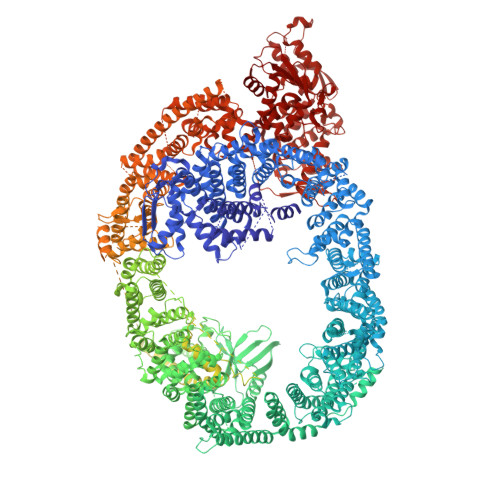
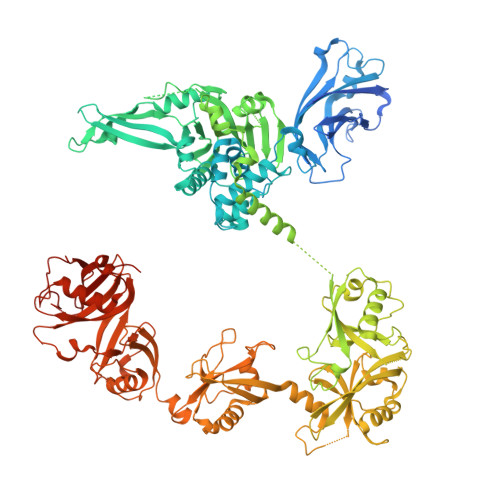
Rapid protein turnover is essential for cellular stress adaptation. HUWE1 (HECT, UBA, and WWE domain containing 1), a large HECT-type E3 ligase, regulates many short-lived stress-responsive proteins, yet the mechanisms underlying its substrate selectivity remain unclear. Here, we reveal that HUWE1 functions as a ubiquitin chain amplifier that captures pre-ubiquitinated substrates and amplifies the degradation signal by assembling long ubiquitin chains containing K11-K48 branch points, a process regulated by its partners HUWE1-associated protein stress response 1 (HAPSTR1) and USP7 (ubiquitin-specific-processing protease 7). Structural and biochemical analyses show that HAPSTR1 engages HUWE1's ubiquitin-binding motifs to drive nuclear import and modulate substrate recruitment. A cryo-EM structure of the HUWE1-USP7 complex reveals a bidirectional regulatory mechanism: HUWE1 activates USP7's catalytic activity, while USP7 modulates HUWE1 conformational states. Global proteomic analyses demonstrate that this axis drives extensive remodeling of the short-lived nuclear proteome. These findings establish the HUWE1-HAPSTR1-USP7 complex as a key ubiquitin code modifier, providing a molecular rationale for HUWE1 dysregulation in neurodevelopmental disorders and cancer.
- Protein Sciences, Genentech, South San Francisco, CA 94080, USA.
Organizational Affiliation: