9PG9 | pdb_00009pg9

Structure of UBR2-AF27 complex


Experimental Data Snapshot

  • Method: X-RAY DIFFRACTION
  • Resolution: 1.22 Å
  • R-Value Free: 
    0.198 (Depositor), 0.198 (DCC) 
  • R-Value Work: 
    0.179 (Depositor), 0.179 (DCC) 
  • R-Value Observed: 
    0.180 (Depositor) 

Starting Model: experimental
View more details

wwPDB Validation 3D Report Full Report

Validation slider image for 9PG9

This is version 1.0 of the entry. See complete history

Literature

Development of High-Affinity Ligands for Human UBR2.

Huang, S.T.Faouzi, A.Thomas, N.Wu, J.Pestonjamasp, K.Chen, D.H.Ren, T.Kuang, Y.Taylor, S.Chen, Y.

(2026) J Med Chem 

  • DOI: https://doi.org/10.1021/acs.jmedchem.5c02881
  • Primary Citation Related Structures: 
    9PG4, 9PG9

  • PubMed Abstract: 

    UBR box-containing ubiquitin E3 ligases recognize the N-termini of their target proteins through the UBR box, and a member of the family, UBR2, has been established as a target to treat cancer- and diabetes-associated cachexia. However, the development of high-affinity small-molecule ligands for UBR2 has not been reported. We developed high-affinity UBR2 ligands through a peptidomimetic approach by incorporating unnatural amino acids to obtain ligands that bind to UBR2 with K d ∼ 20-40 nM and with 10-fold selectivity over UBR2's closest homologue, UBR1. High-resolution cocrystal structures (∼1.2 Å) of UBR2 in complexes with two high-affinity tripeptides revealed molecular mechanisms for their high-affinity binding. Importantly, a high-affinity UBR2 ligand effectively attenuated cancer-induced cachexia in a cellular model. Our findings demonstrate that the UBR boxes are ligandable and thus could spur interest in targeting this class of E3 ligases for developing novel therapeutic approaches for the treatment of cachexia and other illnesses.


  • Organizational Affiliation
    • Department of Chemistry and Biochemistry, University of California, San Diego, La Jolla, California 92093-0021, United States.

Macromolecule Content 

  • Total Structure Weight: 17.91 kDa 
  • Atom Count: 1,441 
  • Modeled Residue Count: 154 
  • Deposited Residue Count: 156 
  • Unique protein chains: 2

Macromolecules

Find similar proteins by:|  3D Structure
Entity ID: 1
MoleculeChains  Sequence LengthOrganismDetailsImage
E3 ubiquitin-protein ligase UBR2
A, B
74Homo sapiensMutation(s): 0 
Gene Names: UBR2C6orf133KIAA0349
EC: 2.3.2.27
UniProt & NIH Common Fund Data Resources
Find proteins for Q8IWV8 (Homo sapiens)
Explore Q8IWV8 
Go to UniProtKB:  Q8IWV8
PHAROS:  Q8IWV8
GTEx:  ENSG00000024048 
Entity Groups
Sequence Clusters30% Identity50% Identity70% Identity90% Identity95% Identity100% Identity
UniProt GroupQ8IWV8
Sequence Annotations
Expand
Reference Sequence
Find similar proteins by:  Sequence   |   3D Structure  
Entity ID: 2
MoleculeChains  Sequence LengthOrganismDetailsImage
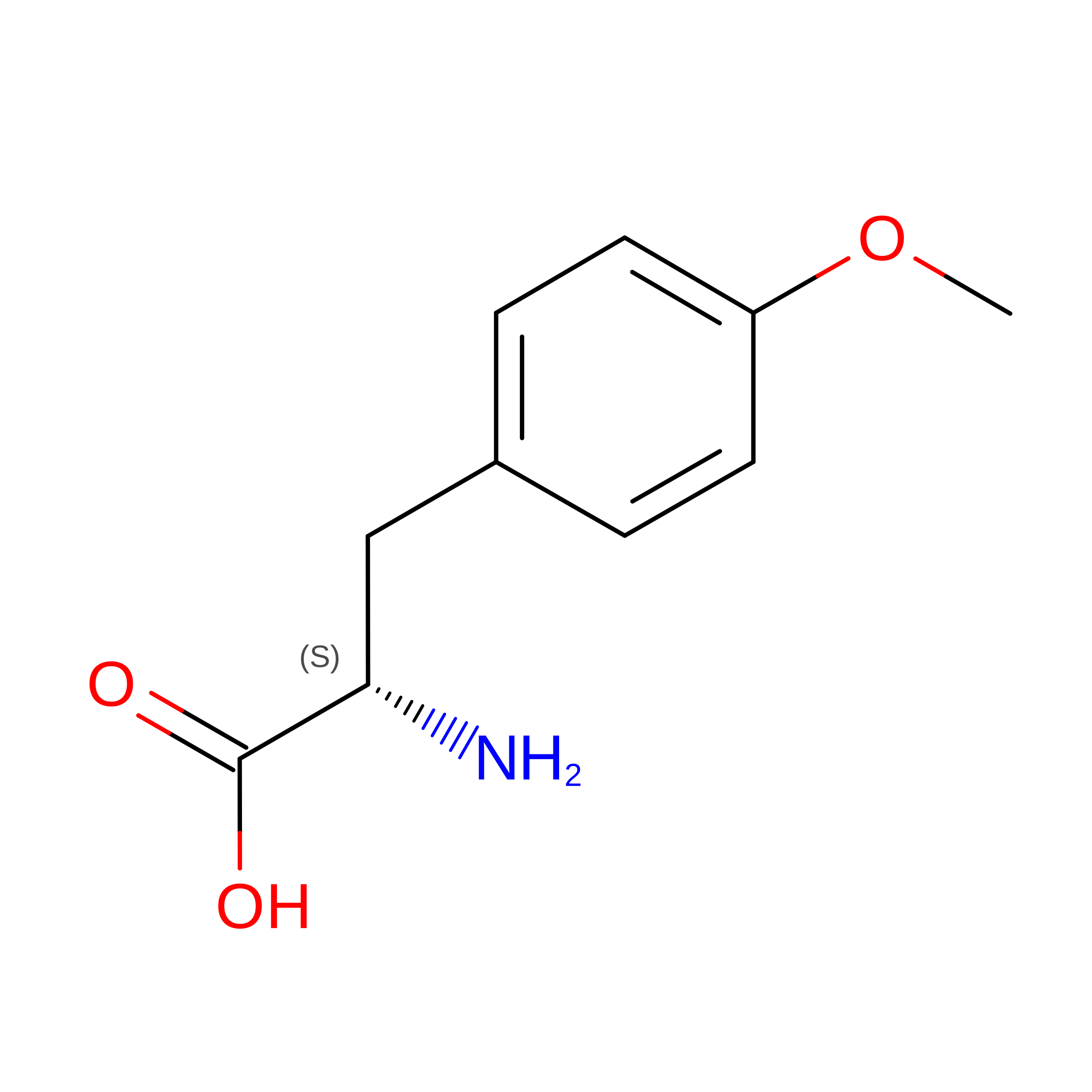
AF27 peptide
C, D
4synthetic constructMutation(s): 0 

Biologically Interesting Molecules (External Reference) 

1 Unique

Experimental Data & Validation

Experimental Data

  • Method: X-RAY DIFFRACTION
  • Resolution: 1.22 Å
  • R-Value Free:  0.198 (Depositor), 0.198 (DCC) 
  • R-Value Work:  0.179 (Depositor), 0.179 (DCC) 
  • R-Value Observed: 0.180 (Depositor) 
Space Group: P 1 21 1
Unit Cell:
Length ( Å )Angle ( ˚ )
a = 29.224α = 90
b = 43.697β = 102.42
c = 56.671γ = 90
Software Package:
Software NamePurpose
PHENIXrefinement
HKL-3000data scaling
PHASERphasing
PDB_EXTRACTdata extraction
DIALSdata reduction

Structure Validation

View Full Validation Report


Entry History 

& Funding Information

Deposition Data


Funding OrganizationLocationGrant Number
Department of Defense (DOD, United States)United StatesHT9425-23-1-0560
Department of Defense (DOD, United States)United StatesPA220024P1
National Institutes of Health/National Cancer Institute (NIH/NCI)United StatesR01 CA212119
National Institutes of Health/National Cancer Institute (NIH/NCI)United StatesR01 CA265410

Revision History  (Full details and data files)

  • Version 1.0: 2026-05-20
    Type: Initial release