9P4C | pdb_00009p4c

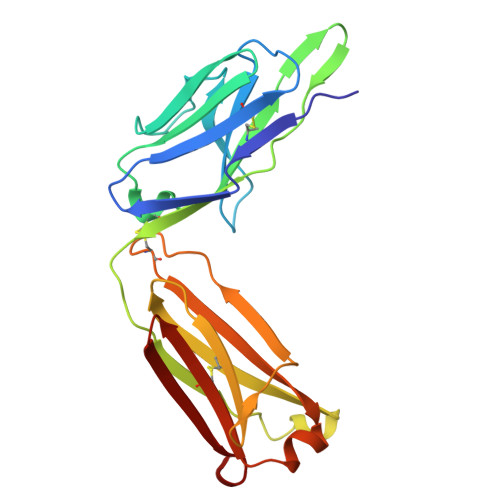
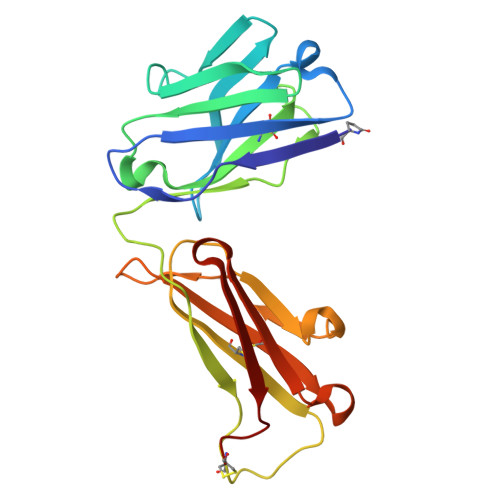
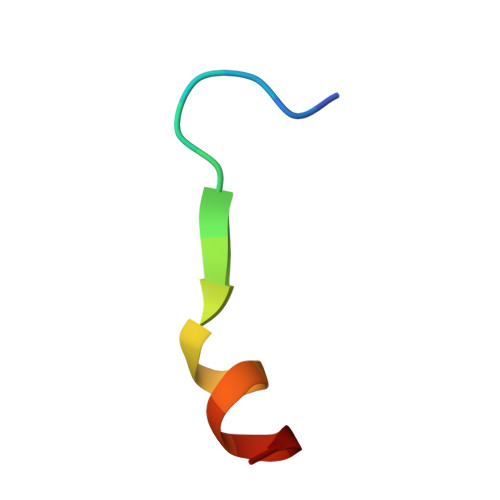
Crystal structure of Mesothelin C-terminal peptide-RO4 Fab complex


Experimental Data Snapshot

  • Method: X-RAY DIFFRACTION
  • Resolution: 1.52 Å
  • R-Value Free: 
    0.180 (Depositor), 0.180 (DCC) 
  • R-Value Work: 
    0.149 (Depositor), 0.149 (DCC) 
  • R-Value Observed: 
    0.151 (Depositor) 

Starting Model: experimental
View more details

wwPDB Validation 3D Report Full Report

Validation slider image for 9P4C

This is version 1.1 of the entry. See complete history

Literature

RO4, a high-affinity humanized antibody against the juxtamembrane region of mesothelin for targeted cancer therapy.

Onda, M.Liu, X.Liu, W.Zhan, J.Maslanka, C.A.Xia, D.Ho, M.Pastan, I.

(2026) Antib Ther 9: 1-12

  • DOI: https://doi.org/10.1093/abt/tbaf022
  • Primary Citation Related Structures: 
    9P4C

  • PubMed Abstract: 

    Mesothelin (MSLN) is a surface antigen highly expressed in several solid tumors, including mesothelioma, ovarian, and pancreatic cancers. However, therapeutic efficacy of MSLN-targeted agents is often compromised by shed MSLN (SM), which acts as a soluble decoy and accumulates in tumor microenvironments, reducing antibody engagement at the tumor surface. To overcome this barrier, we generated antibodies targeting the membrane-proximal, non-shed region of MSLN using a peptide encompassing major cleavage sites for rabbit immunization. From 200 B-cell clones, 14 antibodies specific to the juxtamembrane region of MSLN were identified. The lead candidate, RO4, underwent detailed characterization and humanization to improve clinical applicability. Humanized RO4 (hRO4) exhibited enhanced binding affinity to MSLN and specifically recognized tumor-associated, non-shed epitopes. Structural analysis confirmed precise epitope engagement near the cleavage site. hRO4 effectively inhibited mesothelin shedding in vitro and enabled potent tumor eradication when expressed in chimeric antigen receptor (CAR) T cells in NOD scid gamma mouse models. Targeting a non-shed epitope of MSLN with hRO4 overcomes a critical limitation of conventional MSLN-directed therapies. By avoiding decoy interference and enhancing tumor-specific targeting, hRO4-based therapeutics offer promising clinical potential for improving outcomes in MSLN-positive cancers.


  • Organizational Affiliation
    • Laboratory of Molecular Biology, Center for Cancer Research, National Cancer Institute, National Institutes of Health, Bethesda, MD 20892, United States.

Macromolecule Content 

  • Total Structure Weight: 46.35 kDa 
  • Atom Count: 3,986 
  • Modeled Residue Count: 444 
  • Deposited Residue Count: 444 
  • Unique protein chains: 3

Macromolecules

Find similar proteins by:|  3D Structure
Entity ID: 1
MoleculeChains  Sequence LengthOrganismDetailsImage
Light chain of the RO4 Fab fragmentA [auth L]216Oryctolagus cuniculusMutation(s): 0 
Find similar proteins by:|  3D Structure
Entity ID: 2
MoleculeChains  Sequence LengthOrganismDetailsImage
Heavy chain of the RO4 fab fragmentB [auth H]211Oryctolagus cuniculusMutation(s): 0 
Find similar proteins by:  Sequence   |   3D Structure  
Entity ID: 3
MoleculeChains  Sequence LengthOrganismDetailsImage
Mesothelin, cleaved formC [auth M]17Homo sapiensMutation(s): 0 
UniProt & NIH Common Fund Data Resources
Find proteins for Q13421 (Homo sapiens)
Explore Q13421 
Go to UniProtKB:  Q13421
PHAROS:  Q13421
GTEx:  ENSG00000102854 
Entity Groups
Sequence Clusters30% Identity50% Identity70% Identity90% Identity95% Identity100% Identity
UniProt GroupQ13421
Sequence Annotations
Expand
Reference Sequence

Small Molecules

Ligands 1 Unique
IDChains Name / Formula / InChI Key2D Diagram3D Interactions
GOL

Query on GOL


Download:Ideal Coordinates CCD File
D [auth L]GLYCEROL
C3 H8 O3
PEDCQBHIVMGVHV-UHFFFAOYSA-N
Modified Residues  1 Unique
IDChains TypeFormula2D DiagramParent
PCA
Query on PCA
B [auth H]L-PEPTIDE LINKINGC5 H7 N O3GLN

Experimental Data & Validation

Experimental Data

  • Method: X-RAY DIFFRACTION
  • Resolution: 1.52 Å
  • R-Value Free:  0.180 (Depositor), 0.180 (DCC) 
  • R-Value Work:  0.149 (Depositor), 0.149 (DCC) 
  • R-Value Observed: 0.151 (Depositor) 
Space Group: C 1 2 1
Unit Cell:
Length ( Å )Angle ( ˚ )
a = 92.96α = 90
b = 98.835β = 131.972
c = 66.595γ = 90
Software Package:
Software NamePurpose
PHENIXrefinement
DENZOdata reduction
SCALEPACKdata scaling
BALBESphasing

Structure Validation

View Full Validation Report


Entry History 

& Funding Information

Deposition Data


Funding OrganizationLocationGrant Number
National Institutes of Health/National Cancer Institute (NIH/NCI)United States--

Revision History  (Full details and data files)

  • Version 1.0: 2025-11-12
    Type: Initial release
  • Version 1.1: 2026-02-04
    Changes: Database references