Download Mendeley
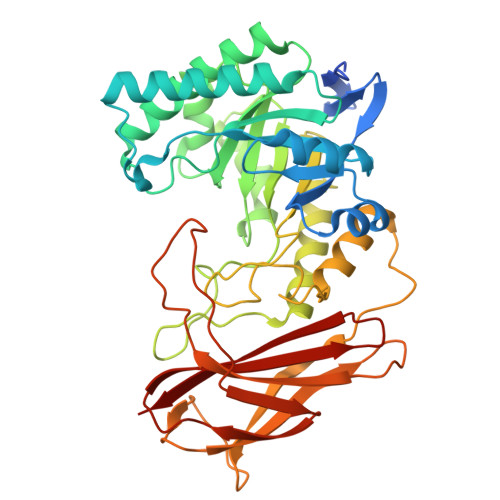
Conformational gating mechanism for processive catalysis of beta (1,3)-glucans.
Gimenis, G.H.B., Spadeto, J.P.M., Colombari, F.M., Miyamoto, R.Y., Higasi, P.M.R., Santos, C.A., Mandelli, F., Martins, M.P., Araujo, E.A., Domingues, M.N., Fuzita, F.J., Oliveira, A.M., Gazolla, M.C., Santos, C.R., Persinoti, G.F., Brumer, H., Rovira, C., Ramos, C.H.I., Morais, M.A.B., Murakami, M.T.(2026) Nat Commun 17
- PubMed: 41896250 Search on PubMedSearch on PubMed Central
- DOI: https://doi.org/10.1038/s41467-026-71224-2
- Primary Citation Related Structures:
9ORO, 9P25, 9P26, 9P27, 9P28, 9P29, 9P2A, 9P2B, 9P2C, 9P2D, 9P2G, 9P2H, 9P2I, 9P2J, 9P2K, 9P2L, 9P2M - PubMed Abstract:
Processive catalysis is a fundamental molecular mechanism to build and dismantle complex biopolymers such as nucleic acids, proteins and carbohydrates, underpinning a myriad of biotechnological applications. Here, we uncover a processive mechanism for the breakdown of β(1,3)-glucans, a widespread carbohydrate class. This mechanism involves a dynamic active site, which adopts a tunnel-like conformation upon substrate binding. For product release, the disruption of a salt bridge triggers an open conformation that interacts with the remnant substrate, essential for subsequent catalytic cycles. Molecular simulations reveal that this processive cleavage involves a non-canonical sugar conformation, a characteristic hitherto limited to exo-acting enzymes. Together, these findings establish the mechanistic basis for β(1,3)-glucan processive catalysis, from substrate recognition to tunnel formation, nucleophilic attack, intermediate state stabilization, product release and translocation. Ultimately, this work broadens the knowledge of β(1,3)-glucan breakdown, demonstrating that enzymatic processive catalysis is a conserved evolutionary strategy across all major classes of β-glucans.
- Brazilian Biorenewables National Laboratory (LNBR), Brazilian Center for Research in Energy and Materials (CNPEM), Campinas, Brazil.
Organizational Affiliation: