9OXT | pdb_00009oxt

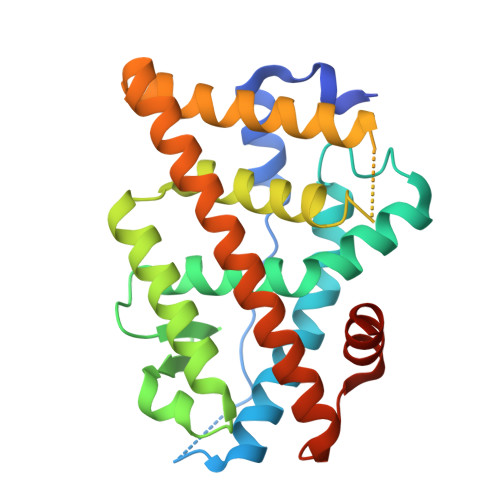
Crystal Structure of Human Estrogen Receptor-alpha (Y537S) in Complex with NCOA2 Peptide and 5-(4-hydroxyphenethyl)-2,2-dimethylchroman-7-ol


Experimental Data Snapshot

  • Method: X-RAY DIFFRACTION
  • Resolution: 2.04 Å
  • R-Value Free: 
    0.258 (Depositor), 0.259 (DCC) 
  • R-Value Work: 
    0.203 (Depositor), 0.203 (DCC) 
  • R-Value Observed: 
    0.205 (Depositor) 

Starting Model: experimental
View more details

wwPDB Validation 3D Report Full Report

Validation slider image for 9OXT

Ligand Structure Quality Assessment 


This is version 1.0 of the entry. See complete history. 

Literature

The prenylation code regulating estrogenic activity of synthetic and natural product derivatives of resveratrol.

Alhusban, M., Haider, S., Pandey, P., Parveen, A., Arbesfeld, A.T., Nwachukwu, J.C., Izard, T., Nettles, K.W., Katzenellenbogen, J.A., Khan, I.A., Chittiboyina, A.G.

(2026) PNAS Nexus 5: pgag351-pgag351

  • DOI: https://doi.org/10.1093/pnasnexus/pgag351
  • Primary Citation Related Structures: 
    9OUD, 9OW0, 9OXR, 9OXT, 9OXY

  • PubMed Abstract: 

    Prenylation of phenolic and aromatic natural products across plants, bacteria, and higher organisms contributes to their lipophilicity and biological function. The process also enhances host defense and serves as a building block for chemical diversity, with medicinal chemistry mimicking these effects to create more effective compounds. While phytoestrogens, particularly those from licorice, are established as key natural regulators of estrogen receptor (ER) biology, the specific mechanisms by which prenylated polyphenolics in licorice regulate ER ligand binding and activity remain unknown. Herein, we show that the widespread prenylation of stilbenes from two commonly used licorice species reveals a broad spectrum of ER interaction profiles in the context of different scaffolds. To identify structural rules for how prenylation modulates ligand binding, we synthesized 16 mono- or diprenylated stilbennoid analogs based on common resveratrol or dihydroresveratrol cores. These variously prenylated stilbenoid compounds exhibited ER agonistic effects on cell growth with a remarkable 5-log range of cellular potencies. X-ray crystal structures of these compounds with ERα showed that this wide range of activities were found in essentially identical ligand-receptor structural states, except for differing side chain rotamers in one region of the binding pocket that accommodates the prenyl substituents. Thus, chemical diversity from a simple class of stilbenoids generated biological diversity through the modular combination of prenyl substitutions that revealed localized structural flexibility in an otherwise highly stable ER agonist conformation. The emergence of this prenylation code provides guidance for understanding and predicting the effect of prenyl-like substitution on phytoestrogens and other ER ligands.


  • Organizational Affiliation: 
    • National Center for Natural Products Research, School of Pharmacy, University of Mississippi, University, MS 38677, USA.

Macromolecule Content 

  • Total Structure Weight: 62.65 kDa 
  • Atom Count: 3,952 
  • Modeled Residue Count: 483 
  • Deposited Residue Count: 542 
  • Unique protein chains: 2

Macromolecules

Find similar proteins by:|  3D Structure
Entity ID: 1
MoleculeChains  Sequence LengthOrganismDetailsImage
Estrogen receptor
A, B
258Homo sapiensMutation(s): 1 
Gene Names: ESR1, ESR, NR3A1
UniProt & NIH Common Fund Data Resources
Find proteins for P03372 (Homo sapiens)
Explore P03372 
Go to UniProtKB:  P03372
GTEx:  ENSG00000091831 
Entity Groups
Sequence Clusters30% Identity50% Identity70% Identity90% Identity95% Identity100% Identity
UniProt GroupP03372
Sequence Annotations
Expand
Reference Sequence
Find similar proteins by:  Sequence   |   3D Structure  
Entity ID: 2
MoleculeChains  Sequence LengthOrganismDetailsImage
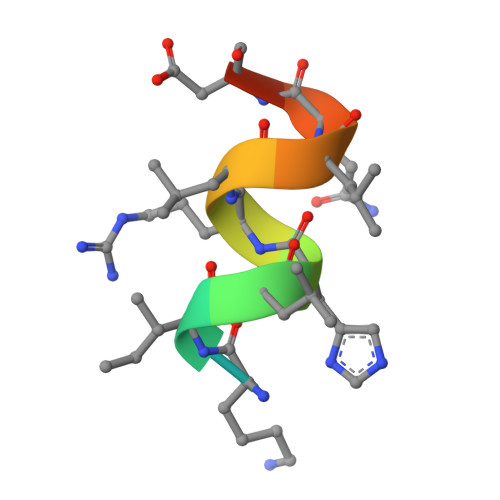
Nuclear receptor coactivator 2
C, D
13Homo sapiensMutation(s): 0 
UniProt & NIH Common Fund Data Resources
Find proteins for Q15596 (Homo sapiens)
Explore Q15596 
Go to UniProtKB:  Q15596
PHAROS:  Q15596
GTEx:  ENSG00000140396 
Entity Groups
Sequence Clusters30% Identity50% Identity70% Identity90% Identity95% Identity100% Identity
UniProt GroupQ15596
Sequence Annotations
Expand
Reference Sequence

Experimental Data & Validation

Experimental Data

  • Method: X-RAY DIFFRACTION
  • Resolution: 2.04 Å
  • R-Value Free:  0.258 (Depositor), 0.259 (DCC) 
  • R-Value Work:  0.203 (Depositor), 0.203 (DCC) 
  • R-Value Observed: 0.205 (Depositor) 
Space Group: P 1 21 1
Unit Cell:
Length ( Å )Angle ( ˚ )
a = 54.269α = 90
b = 83.25β = 111.189
c = 58.555γ = 90
Software Package:
Software NamePurpose
PHENIXrefinement
XDSdata reduction
Aimlessdata scaling
PHASERphasing

Structure Validation

View Full Validation Report


Ligand Structure Quality Assessment 


Entry History 

& Funding Information

Deposition Data


Funding OrganizationLocationGrant Number
National Institutes of Health/National Cancer Institute (NIH/NCI)United StatesR01CA220284
National Institutes of Health/National Cancer Institute (NIH/NCI)United States1R01CA275142

Revision History  (Full details and data files)

  • Version 1.0: 2026-11-11
    Type: Initial release