9OET | pdb_00009oet

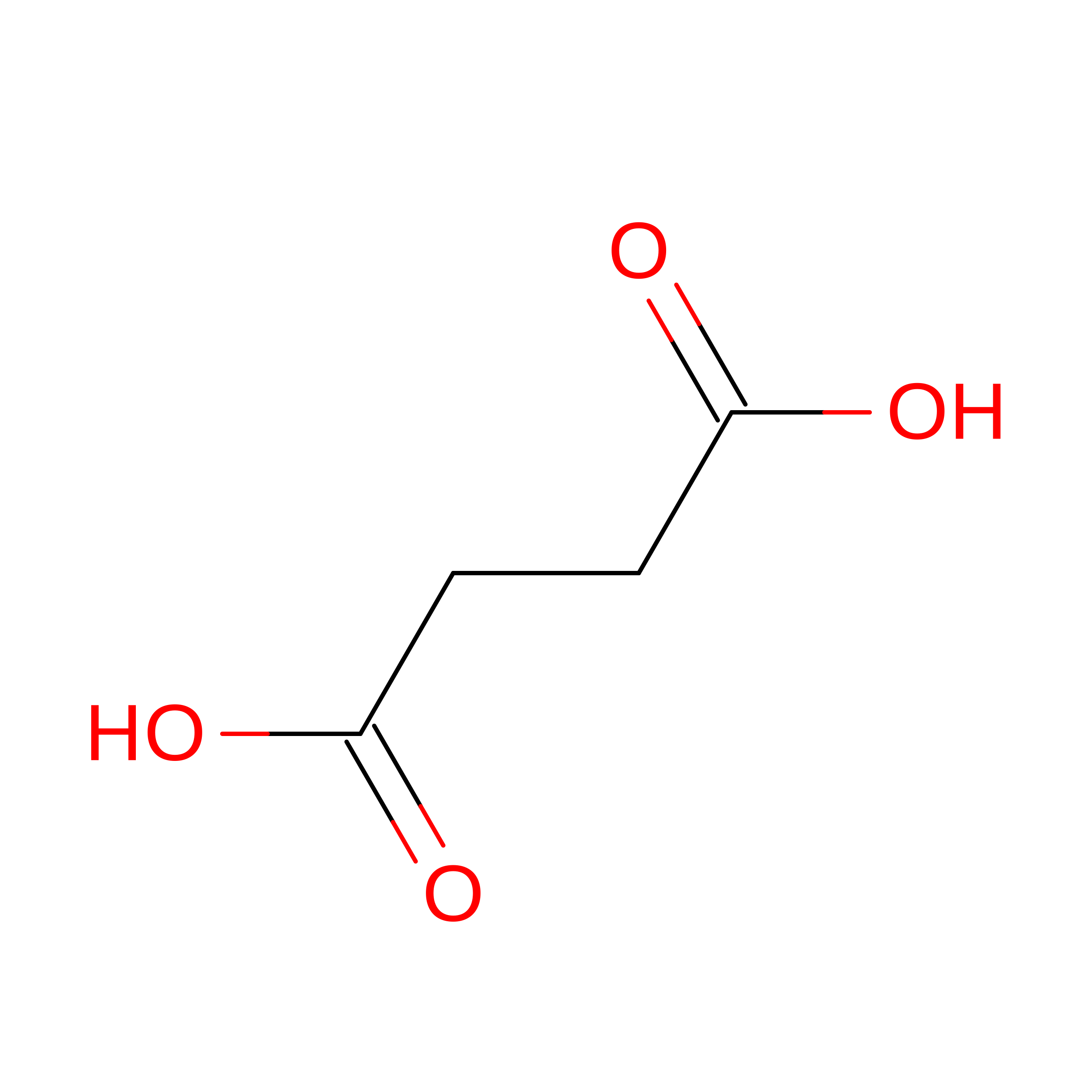
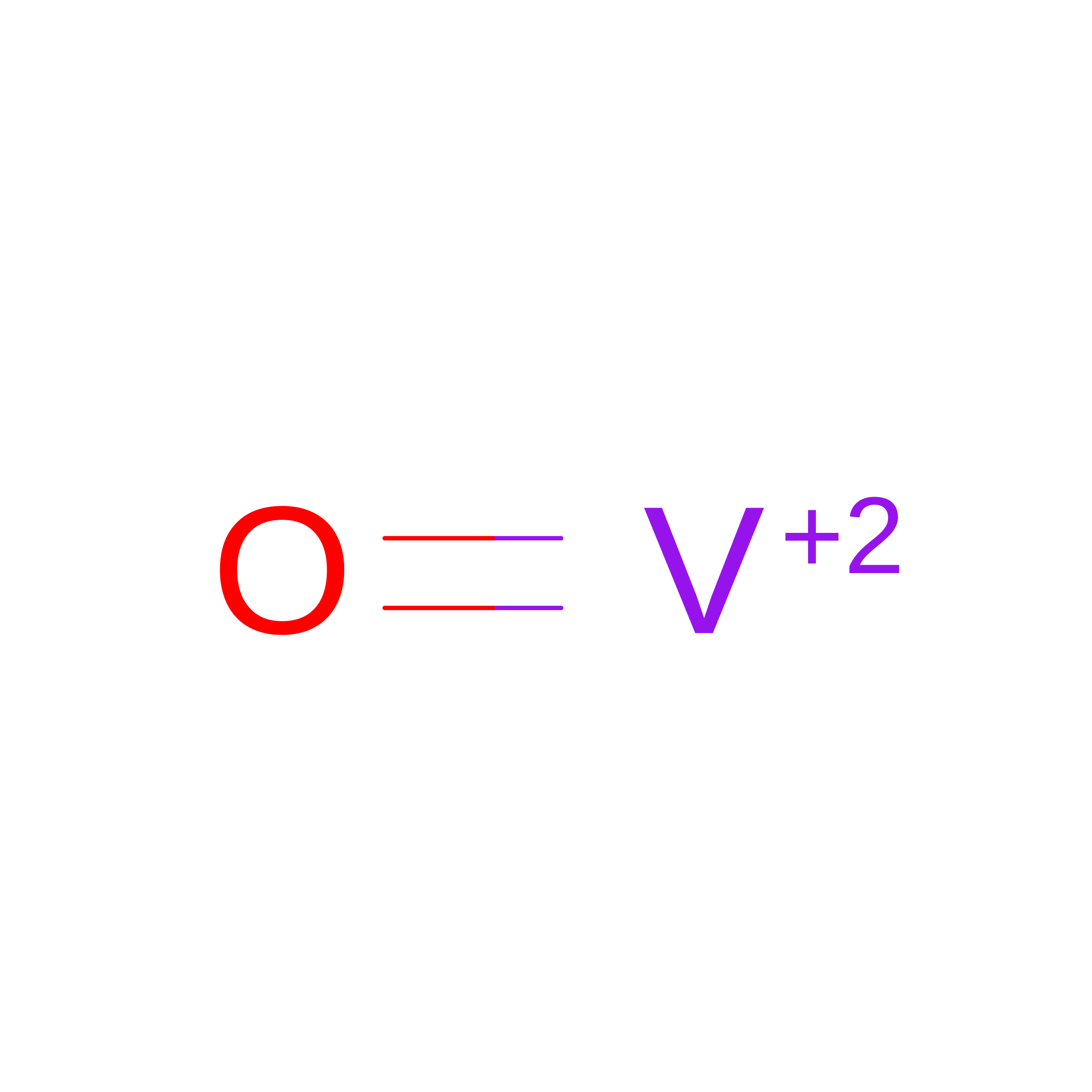
Hydrox with succinate and vanadium(IV)-oxo


Experimental Data Snapshot

  • Method: X-RAY DIFFRACTION
  • Resolution: 1.90 Å
  • R-Value Free: 
    0.243 (Depositor), 0.243 (DCC) 
  • R-Value Work: 
    0.201 (Depositor), 0.201 (DCC) 
  • R-Value Observed: 
    0.203 (Depositor) 

Starting Model: experimental
View more details

wwPDB Validation 3D Report Full Report

Validation slider image for 9OET

Ligand Structure Quality Assessment 


This is version 1.2 of the entry. See complete history

Literature

Dynamic metal coordination controls chemoselectivity in a radical halogenase.

Kissman, E.N.Kipouros, I.Slater, J.W.Stone, E.A.Yang, A.Y.Braun, A.Ensberg, A.R.Whitten, A.M.Chatterjee, K.Bogacz, I.Yano, J.Martin Bollinger Jr., J.Chang, M.C.Y.

(2026) Nat Chem Biol 22: 491-500

  • DOI: https://doi.org/10.1038/s41589-025-02077-x
  • Primary Citation Related Structures: 
    9OER, 9OES, 9OET, 9OEU, 9OEV, 9OEW

  • PubMed Abstract: 

    The activation of inert C(sp 3 )-H bonds by nonheme Fe enzymes provides a powerful biocatalytic platform for the chemical synthesis of molecules with increased sp 3 complexity. In this context, Fe II /α-ketoglutarate-dependent radical halogenases are uniquely capable of carrying out transfer of a diverse array of bound anions following C-H activation. Here, we provide experimental evidence that bifurcation of radical rebound after H-atom abstraction can be driven both by the ability of a dynamic metal coordination sphere to reorganize and by a second-sphere hydrogen-bonding network where only two residues are sufficient. In addition, we present crystallographic data supporting the existence of an early peroxyhemiketal intermediate in the O 2 activation pathway of Fe II /α-ketoglutarate-dependent enzymes. These data provide a paradigm for understanding the evolution of catalytic plasticity in these enzymes and yields insight into the design principles by which to expand their reaction scope.


  • Organizational Affiliation
    • Department of Chemistry, University of California, Berkeley, CA, USA.

Macromolecule Content 

  • Total Structure Weight: 59.82 kDa 
  • Atom Count: 3,851 
  • Modeled Residue Count: 448 
  • Deposited Residue Count: 520 
  • Unique protein chains: 1

Macromolecules

Find similar proteins by:|  3D Structure
Entity ID: 1
MoleculeChains  Sequence LengthOrganismDetailsImage
Lysine hydroxylaseA [auth D],
B [auth A]
260Streptomyces roseifaciensMutation(s): 0 
UniProt
Find proteins for A0A8M0FGT0 (Streptomyces roseifaciens)
Explore A0A8M0FGT0 
Go to UniProtKB:  A0A8M0FGT0
Entity Groups
Sequence Clusters30% Identity50% Identity70% Identity90% Identity95% Identity100% Identity
UniProt GroupA0A8M0FGT0
Sequence Annotations
Expand
Reference Sequence

Experimental Data & Validation

Experimental Data

  • Method: X-RAY DIFFRACTION
  • Resolution: 1.90 Å
  • R-Value Free:  0.243 (Depositor), 0.243 (DCC) 
  • R-Value Work:  0.201 (Depositor), 0.201 (DCC) 
  • R-Value Observed: 0.203 (Depositor) 
Space Group: C 2 2 21
Unit Cell:
Length ( Å )Angle ( ˚ )
a = 88.892α = 90
b = 139.97β = 90
c = 95.427γ = 90
Software Package:
Software NamePurpose
PHENIXrefinement
PDB_EXTRACTdata extraction
XDSdata reduction
Aimlessdata scaling
PHASERphasing

Structure Validation

View Full Validation Report


Ligand Structure Quality Assessment 


Entry History 

& Funding Information

Deposition Data


Funding OrganizationLocationGrant Number
Department of Energy (DOE, United States)United StatesDOE/LBL DEAC02-05CH11231 FWP CH030201
National Institutes of Health/National Institute of General Medical Sciences (NIH/NIGMS)United StatesGM134271

Revision History  (Full details and data files)

  • Version 1.0: 2025-11-19
    Type: Initial release
  • Version 1.1: 2025-12-03
    Changes: Database references
  • Version 1.2: 2026-03-18
    Changes: Database references