Download Mendeley
Single-atom substitution redirects KatG reactivity from cofactor biogenesis to stereoselective sulfoxidation.
Duan, R., Li, J., Griffith, W.P., Xu, Y., Burrows, N.D., Green, A.P., Liu, A.(2026) Nat Commun 17
- PubMed: 42288482 Search on PubMedSearch on PubMed Central
- DOI: https://doi.org/10.1038/s41467-026-73579-y
- Primary Citation Related Structures:
9O6A - PubMed Abstract:
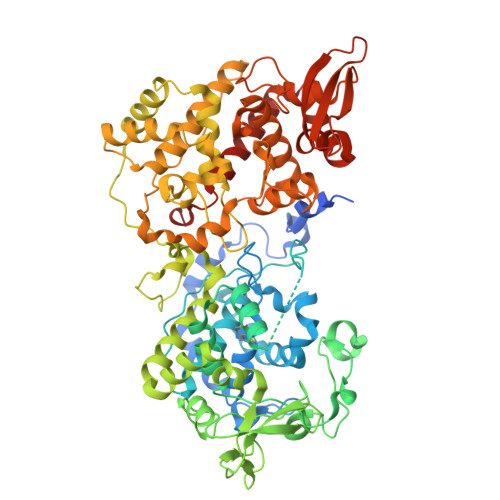
Protein-derived cofactors rely on precisely positioned heteroatoms to direct redox chemistry, yet isolating their individual contributions remains challenging. The indole N-H of tryptophan plays a central yet elusive role in biogenesis and function of the Met-Tyr-Trp (MYW) cofactor in catalase-peroxidase (KatG). Here, we use genetic code expansion to replace cofactor-forming Trp105 with thiotryptophan (S-Trp), enabling a single-heteroatom (N → S) substitution. Instead of forming the MYW crosslink, KatG bearing S-Trp105 undergoes site-specific monooxygenation to yield a chiral sulfoxide. HPLC-MS, circular dichroism, and FT-IR spectroscopy identify selective oxygen insertion at the sulfur, establishing enantioselective formation of an (S)-configured sulfoxide. A 2.22 Å cryo-EM structure visualizes the oxidized S-Trp105, revealing the S = O moiety orienting toward the iron and confirming the absence of crosslinking. The S-atom oxygenation is heme-dependent and proceeds via a two-electron oxygen-atom transfer, contrasting with the radical-mediated one-electron chemistry of native tryptophan. This redirection suppresses catalase activity by perturbing cofactor formation. These results show that a single-atom substitution reroutes the distal heme site from radical crosslinking to stereoselective sulfoxidation, uncovering a monooxygenase-like capability within KatG. This work highlights using noncanonical amino acids to achieve atomic-level control over reaction pathways and to interrogate cofactor biogenesis with unprecedented precision.
- Department of Chemistry, The University of Texas at San Antonio, San Antonio, TX, 78249, USA.
Organizational Affiliation: